

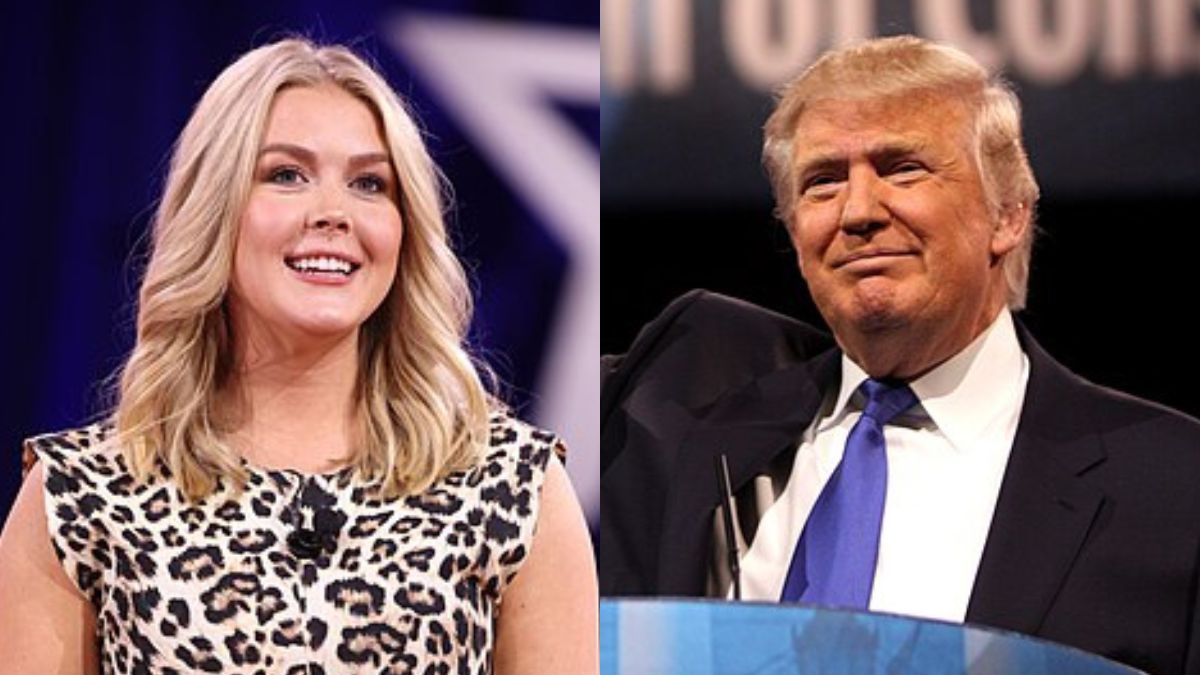
White House Press Secretary Karoline Leavitt defended President Donald Trump’s threat to Iran, after the president warned that “civilization will die tonight” while pushing for a ceasefire agreement.
During a Wednesday, April 8, press conference, a reporter asked Leavitt what President Trump actually meant when he made the statement in a Truth Social post last week.
The White House Press Secretary said, “I think it was a very, very strong threat from the president of the United States that led the Iranian regime to cave to their knees and reopen the Strait of Hormuz.”
Leavitt added that Trump’s statement was “a very strong threat that led to results.”
Reporter asks about Trump posting a civilization is going to be eliminated.@PressSec Karoline Leavitt: “It was a very very strong threat from the president of the United States that led to the Iranian regime to cave to their knees and ask for a ceasefire and agree to re-opening… pic.twitter.com/txjaWGs4Qi
— CSPAN (@cspan) April 8, 2026
She further added, “It was not an empty threat by any means. The Pentagon had a target list that they were ready to hit go on at 8 p.m. last night if the Iranian regime had not agreed to reopen the strait, which they did.”
Trump set a Tuesday, April 14, deadline for an agreement as he threatened to strike civilian infrastructure in Iran.
He also insisted that Iran must consent “to the complete, immediate, and safe opening of the Strait of Hormuz” and the U.S. would “suspend the bombing and attack of Iran for a period of two weeks.”
After more than 21 hours of negotiations on Sunday, April 12, the U.S.-Iran peace talks in Pakistan ended without an agreement, according to Time.
JD Vance Drops ‘Bad News’ After Failed US-Iran Peace Talks in Pakistan
Pakistan Brokered Top-level peace talks between the US and Iran concluded after 21 hours without an agreement, with Vice President Vance citing Iran’s refusal to accept US terms as a major issue.
The US vice… pic.twitter.com/OSbKqdBICu
— Augadh (@AugadhBhudeva) April 12, 2026
The U.S. military said that it will soon block ships from Iranian ports, according to Vice President JD Vance, who is serving as the United States’ lead negotiator.
Vance said during a press conference in Pakistan, “The bad news is that we have not reached an agreement. And I think that’s bad news for Iran much more than it’s bad news for the U.S. They have chosen not to accept our terms.”
According to NPR, the Vice President added that the U.S. needs to see an affirmative commitment that Iran will not seek a nuclear weapon, and will not seek the tools that would enable the country to achieve a nuclear weapon quickly.
Meanwhile, the U.S. military’s Central Command, also known as CENTCOM, mentioned that forces will start implementing a blockade of all maritime traffic entering and exiting Iranian ports on Monday, April 13, at 10 a.m.
Even though the two-week ceasefire is now uncertain, JD Vance left open the possibility that an agreement could still be reached.
BREAKING: Donald Trump on the US-Iran talks!
So, there you have it, the meeting went well, most points were agreed to, but the only point that really mattered, NUCLEAR, was not.
Effective immediately, the United States Navy, the Finest in the World, will begin the process of… pic.twitter.com/40xMuv1NDA
— Clash Observer (@clashobserver) April 12, 2026
“We leave here with a very simple proposal: a method of understanding that is our final and best offer. We’ll see if the Iranians accept it,” the Vice President said.
The talks between the United States and Iran began in Islamabad on Saturday, April 11, as the two sides looked to reach a deal to end the ongoing war.
The POTUS also took to Truth Social on Sunday and wrote, “The meeting went well, most points were agreed to, but the only point that really mattered, nuclear, was not.”
Trump added in his post, “Effective immediately, the United States Navy, the Finest in the World, will begin the process of BLOCKADING any, and all Ships trying to enter, or leave, the Strait of Hormuz.”