



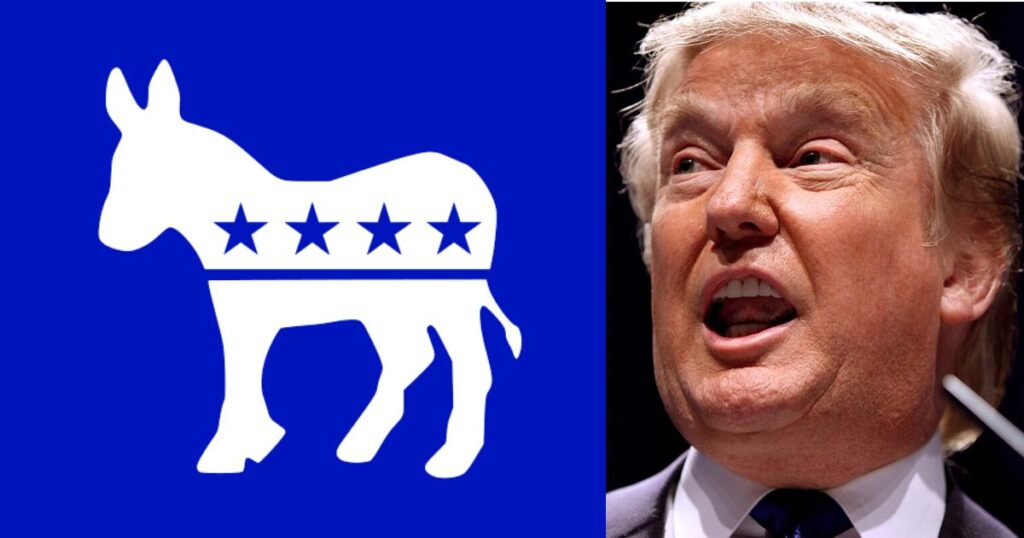
Donald Trump’s return as the American President for the second time in 2024 was a disappointing moment for the Democrats. Since then, the party has been focused on updating strategies, building up a better team, and connecting with the voters.
With the results in New Jersey, New York, and Virginia after the election on Tuesday, one can say with some confidence that the Democrats are getting back in the game before the midterm elections next year.
One of the most interesting takeaways from this election campaign and its results is that in three deep-blue states, California, New Jersey, and Virginia, Democrats turned President Trump into their chief political foil and emerged victorious. Governors Gavin Newsom, Mikie Sherrill, and Abigail Spanberger each ran campaigns that directly harnessed opposition to Trump to rally voters, and it worked.
Trump wasn’t on any ballot on Tuesday. He was quick to point that out on Truth Social, arguing that the setbacks for Republicans didn’t reflect on him. Yet for many voters, he was very much the invisible presence shaping their choices.
Although Trump kept his distance from the off-year contests, historically unkind to the party in power, exit polls showed most voters were thinking about him anyway. More than half said their vote was cast to oppose him, according to CNN.
In New Jersey, 55 percent of voters disapproved of Trump; in Virginia, that figure climbed to 56 percent, according to NBC News. In New York City and California, that disapproval soared to 69 and 63 percent respectively.
View this post on Instagram
Sherrill used that sentiment throughout her campaign. Her Republican opponent, Jack Ciattarelli, mocked her strategy, saying, “If you get a flat tire on the way home tonight, she’s going to blame it on President Trump.” The jab didn’t land as voters rewarded Sherrill with a commanding win.
Democrats had entered the race feeling uneasy about Trump’s recent gains among Black and Hispanic voters. However, those fears proved overstated. Sherrill reversed those trends, outperforming expectations in communities of color. In Passaic County, heavily Hispanic and one of the counties Trump flipped last year, Sherrill led by 15 points in early results. In Essex County, with a large Black population and home to Newark, she won by a wide margin. Exit polls showed her winning comfortably among Black, Hispanic, and Asian voters, the very demographics Democrats had heavily invested in to reconnect with.
Her campaign kept a tight focus on affordability, portraying Trump as having failed to deliver on his 2024 promises to lower costs. Whether voters were rejecting the former message or simply uninterested in Ciattarelli, the formula worked.
In California, Governor Gavin Newsom staked his political capital on Proposition 50, a plan to redraw congressional maps and potentially net Democrats five new seats. The proposition was marketed as a counterpunch to Texas Republicans’ aggressive mid-cycle redistricting. While the move felt like a gamble, it worked as early results showed the measure passing with nearly 65 percent support.
Republicans, divided about how to oppose Proposition 50, never quite found footing. Their fundraising lagged, and their messaging got scattered. Meanwhile, Newsom united national Democrats behind the measure, turning the campaign into a test of his own national influence.
When the results came in, Newsom struck a triumphant tone. “We stood tall and we stood firm in response to Donald Trump’s recklessness,” he declared at his victory rally. “And tonight, after poking the bear, this bear roared with an unprecedented turnout in a special election with an extraordinary result.”
As a result, Newsom, who has already made a name for himself by the constant social media trolling of Trump, further cemented his position as the Democrats’ most visible standard-bearer for the upcoming 2026 elections.
In New York City, meanwhile, Democrats scored an unexpected but complicated win. Progressive candidate Zohran Mamdani captured the mayor’s office, delivering the party’s activist wing a major victory. Republicans, however, saw an opportunity.
Speaker Mike Johnson quickly called Mamdani’s election proof of “the Democrat Party’s transformation to a radical, big-government socialist party.” The National Republican Congressional Committee echoed that, accusing House Democrats in swing districts of “taking orders” from Mamdani.
Representative Elise Stefanik, now running for governor in New York, took aim at Governor Kathy Hochul for endorsing him, blaming her for being “owned lock, stock, and barrel by the radical Far Left Socialist takeover.”
View this post on Instagram
Mamdani didn’t shy away from the controversy. In his victory speech, he quoted Eugene Debs, the socialist leader who once ran for president from prison, drawing cheers from supporters and ammunition for critics.
Despite ideological differences, Mamdani and centrists like Spanberger and Sherrill focused on the issue of rising living costs to unify the voters. Each made affordability the centerpiece of their message. That proved to resonate powerfully with voters.
In New Jersey, 58 percent of respondents told exit pollsters that electricity costs were a “major problem.” In New York City, 70 percent pointed to housing costs as the biggest issue. Mamdani pledged to launch “the most ambitious agenda to tackle the cost of living crisis since the days of former Mayor Fiorello La Guardia.”
Democratic strategist Eric Koch said the night revealed something critical about the party’s strategy. “Democrats are a huge tent, but all over the country they showed two things: it’s not enough to just run against Trump, you need a positive, affirmative vision and you also need to meet the voters where they are on the issues that matter to them,” he said. “It takes many poles to hold up our big tent but tonight we showed how we can do it.”
The results showed how addressing the common issue of affordability worked in favor of Democrats despite the varying ideologies within the party. The common people of America want a life that can be lived without the extreme pressure of making ends meet and that is the point where the Democrats united in their campaign and it clearly worked.