



If you have ever wondered what it feels like to be a human set piece—paid to stand still while a country watches someone else make history—someone is now offering you the chance to find out. For $5,000, give or take a “best offer,” you can buy a sugarcane grass costume from Bad Bunny’s Super Bowl LX Halftime Show and, with it, a very 2026 story about fame, money, and who actually gets paid when the world goes viral.
The costumes were the accidental co-stars of Bad Bunny’s performance, the kind of visual trick television loves: anonymous figures disguised as shrubbery, frozen in place long enough for the internet to do what it always does—name them, meme them, and turn them into a market. People called them “grass bunnies” and “bush people,” and they became one of the most unforgettable parts of Bad Bunny’s halftime show almost instantly.
Now the “bush people” have wandered off the field and onto eBay. According to The Independent, at least two of the already infamous sugarcane grass costumes worn by backup performers during Bad Bunny’s nearly record-breaking halftime show are listed for sale.
Bad Bunny, Ricky Martin, and Pedro Pascal have more decency in their pinky fingers than every single magat in America. pic.twitter.com/bMIA0i9BP6
— ᗰᗩƳᖇᗩ (@LePapillonBlu2) February 13, 2026
One listing is posted for $5,000 or best offer, and it reads like a surreal packing slip from an alternate America where a few minutes in Bad Bunny’s orbit comes with receipts. The buyer gets the green sweatsuit worn under the foliage (size medium-large), a balaclava or ski mask, shoulder harness, gloves, safety glasses, and those oversized grass-covered prop arms that made the humans inside almost impossible to recognize. It also includes an official in-ear radio used during rehearsals with surprise halftime guests Lady Gaga and Ricky Martin—rehearsals that existed because this was, after all, Bad Bunny’s biggest stage.
The package also comes with an official Super Bowl LX tote bag and an NFL credential as proof of participation in the event. In other words: if you’re going to spend thousands on a costume from Bad Bunny’s Super Bowl moment, you’ll at least get documentation that you didn’t buy some DIY lawn project off a costume rack.
Para un artista esto es lo mas triste del mundo 🌎
Bad Bunny viendo cono el publico se quedo parado y sin gritar parecía que estaba sonando un Himno Nacional
Que Show mas Soso y horrible
En Tv le pusieron gente Gritando 😱 en playback. 🤣🤣🤣🤣 pic.twitter.com/DEM9gjHqJC
— Arielipillo (@arielipillo) February 10, 2026
What makes the listing hard to shrug off is the seller’s explanation, because it lands like a small confession in the middle of a loud national spectacle. “All in all, I really do not want to part with this, but you’ll be helping me pay off my student loans and will be helping me with my grandparents’ medical! God bless America and God bless Bad Bunny,” the seller wrote.
It’s funny until it isn’t. A person stood there in a 40- to 50-pound suit, turned themselves into scenery for Bad Bunny, and ended up in a position where selling the costume might do more for their financial life than the job itself. That’s not a knock on Bad Bunny. It’s a reminder of how the Super Bowl economy works: the headline star gets the history, and the supporting bodies get the bill.
And this is where the numbers start to sting. Performers inside the tree and grass costumes were paid about $1,300 for 70 hours of work, including eight days of rehearsals plus the game-day performance, according to Darren Rovell, founder of Cllct Media. That works out to roughly $18.70 per hour, plus travel reimbursements—while the uniform that helped sell Bad Bunny’s visual world is now being priced like a luxury item.
The Super Bowl halftime show didn’t feel like a protest. It felt like a homecoming.
Bad Bunny could have gone another route. He could have used the stage to confront. He could have named names. He could have turned the moment into a culture-war headline.
Instead, Benito chose… pic.twitter.com/6xohODumIp
— Mariana Atencio (@marianaatencio) February 9, 2026
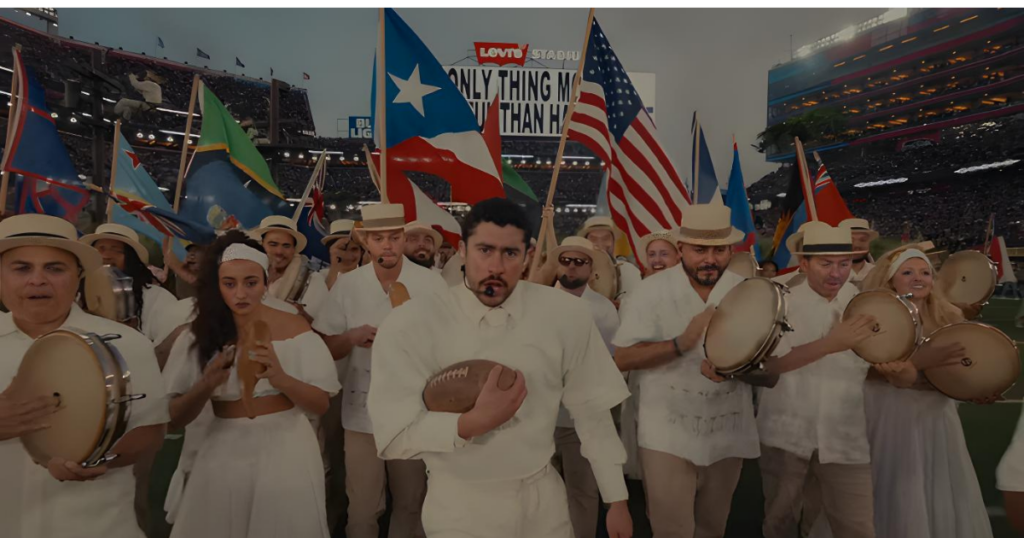
The costumes weren’t light, and they weren’t for just anybody. Multiple performers have said on social media that the “bush people” had to be between 5-foot-7 and 6 feet tall with an athletic build to handle the grueling suits for up to five hours. And during Bad Bunny’s performance itself, the job wasn’t dancing—it was holding still for nearly 13 minutes as part of a tribute to Puerto Rican culture.
For Bad Bunny, that tribute landed at scale. His Super Bowl halftime show drew 128.2 million viewers, making Bad Bunny’s set one of the most-watched performances in the event’s history, even if it fell short of Kendrick Lamar’s 133.5 million record. The game around it was huge too: Seahawks vs. Patriots peaked at 137.8 million viewers, and Seattle won 29–13.
Then came the backlash that felt almost as rehearsed as the choreography. Bad Bunny made history as the first solo male Latin artist to headline the halftime show and the first to perform entirely in a language other than English, which angered MAGA conservatives, including President Donald Trump. Some even launched a competing halftime show with MAGA-friendly artists, as if the existence of Bad Bunny in Spanish required an immediate counter-program.
Bad Bunny naming dozens of countries in the Americas and then holding up a football that reads “together we are America”….such an iconic Super Bowl performance wow pic.twitter.com/zU3R8WBkNL
— Spencer Althouse (@SpencerAlthouse) February 9, 2026
Trump, posting on Truth Social about 30 minutes after Bad Bunny finished, wrote: “Nobody understands a word this guy is saying, and the dancing is disgusting, especially for young children that are watching from throughout the U.S.A., and all over the World.”
But while politics yelled, the market spoke in its blunt language. A costume from Bad Bunny’s halftime show, complete with its NFL credential and in-ear radio, is now worth thousands. And maybe that’s the most American part of the whole thing: Bad Bunny gives the culture a moment, the internet gives it a nickname, and somebody else tries to turn it into rent money.