

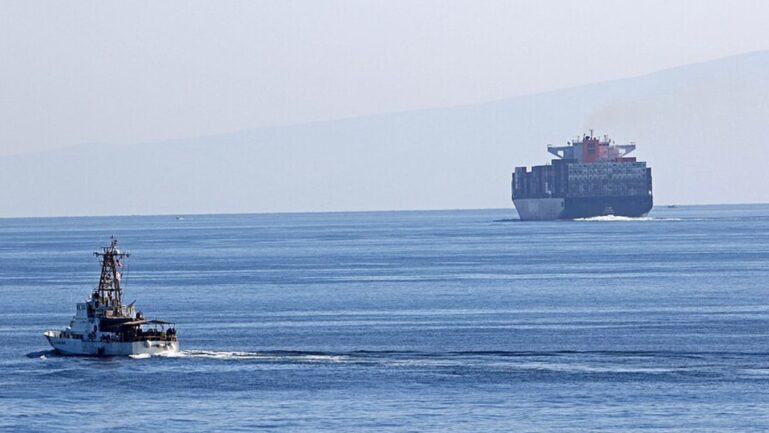
The US conducted “self-defense” airstrikes against Iran amid the already shaky ceasefire between the two countries. These strikes were reportedly targeted at missile launch sites and Iranian mine-laying boats near Bandar Abbas – home to a key Iranian naval base on the coast of the Strait of Hormuz, one of the most critical maritime shipping channels, through which nearly 20 percent of the global oil and liquefied natural gas (LNG) passes, before Tehran blocked it amid the US-Iran war.
Meanwhile, a senior US official who spoke with Fox News Chief National Correspondent Jennifer Griffin claimed that two Iranian boats were seen placing mines in the Strait.
MORE details on US strikes vs Iranian targets today:
2 Iranian boats were caught laying mines in the Strait of Hormuz, senior US official tells me. The US military eliminated both IRGC vessels and also struck at a SAM (surface to air missile) site in Bandar Abbas that was… https://t.co/ew89rCfL5J
— Jennifer Griffin (@JenGriffinFNC) May 25, 2026
Griffin took to X, formerly Twitter, and shared an update with netizens, writing, “The US military eliminated IRGC [Islamic Revolutionary Guard Corps] vessels and also struck at a SAM (surface to air missile) site in Bandar Abbas that was targeting US warplanes.”
The US Central Command (CENTCOM) spokesperson, Tim Hawkins, confirmed Monday evening that US forces carried out ‘self-defense strikes’ targeted at southern Iran “to protect our troops from threats posed by Iranian forces.” He added that the attacks were targeted at missile launch sites and Iranian boats that were trying to position mines.
Iran’s state media also reported about explosions in Bandar Abbas city and coastal areas near the Strait after the US airstrikes.
CENTCOM spox Capt Tim Hawkins to Fox: “U.S. forces conducted self-defense strikes in southern Iran today to protect our troops from threats posed by Iranian forces. Targets included missile launch sites and Iranian boats attempting to emplace mines. U.S. Central Command continues…
— Jennifer Griffin (@JenGriffinFNC) May 25, 2026
Earlier this month, Iran’s senior military officials accused the US of breaching the ceasefire after two Iranian oil tankers near the Strait of Hormuz were reportedly targeted. They also claimed that airstrikes hit civilian areas along Iran’s southern coastline with the support of “some regional countries,” the Iran International reported.
Meanwhile, CENTCOM said that US forces blocked Iranian missiles, drones, and small boats that were allegedly targeting Navy destroyers passing through the Strait of Hormuz on May 7, the outlet reported. After the interceptions, US forces launched retaliatory strikes on Iranian military sites.
According to CENTCOM, no American assets were hit during the incident. The command said the strikes focused on Iranian missile and drone launch locations, command hubs, and intelligence facilities connected to the attacks. It also stated that while it “does not seek escalation,” it is ready to protect its personnel and assets in the region.
🚨 JUST IN: Iran was STRUCK by the US after the IRGC got caught laying MINES in the Strait of Hormuz
The strikes took place in Bandar Abbas, home to a key Iranian base
Missile launch sites were also blasted to smithereens.
Fox is reporting this is NOT an end of the ceasefire,… https://t.co/8b8QTXc7Qk pic.twitter.com/X1OfJk87Zs
— Eric Daugherty (@EricLDaugh) May 25, 2026
Previously, CENTCOM Commander Admiral Brad Cooper testified that the April 7 ceasefire “remains in effect” despite ongoing exchanges of fire, according to CBS News.
Cooper told senators that Operation Epic Fury destroyed over 85 percent of Iran’s ballistic missile, drone, and naval capabilities by launching over 1,450 strikes on Iran’s weapons manufacturing facilities.
On Monday, May 25, President Donald Trump took to Truth Social and wrote that the negotiations with Iran regarding ending the war were “proceeding nicely.”
( @realDonaldTrump – Truth Social Post )
( Donald J. Trump – May 25 2026, 8:23 AM ET )Negotiations with the Islamic Republic of Iran are proceeding nicely! It will only be a Great Deal for all or, no Deal at all — Back to the Battlefront and shooting, but bigger and stronger… pic.twitter.com/wwLKZ4oqMB
— Fan Donald J. Trump 🇺🇸 TRUTH POSTS (@TruthTrumpPosts) May 25, 2026
Trump added that he spoke with the leaders of Saudi Arabia, the United Arab Emirates, Qatar, Pakistan, Turkey, Egypt, Jordan, and Bahrain. He said, “after all the work done by the United States to try and pull this very complex puzzle together, it should be mandatory that all of these Countries, at a minimum, simultaneously sign onto the Abraham Accords.”
The Abraham Accords were U.S.-mediated agreements introduced during Trump’s first term to establish normal diplomatic ties with Israel. The UAE and Bahrain became the first countries to sign the deal.