

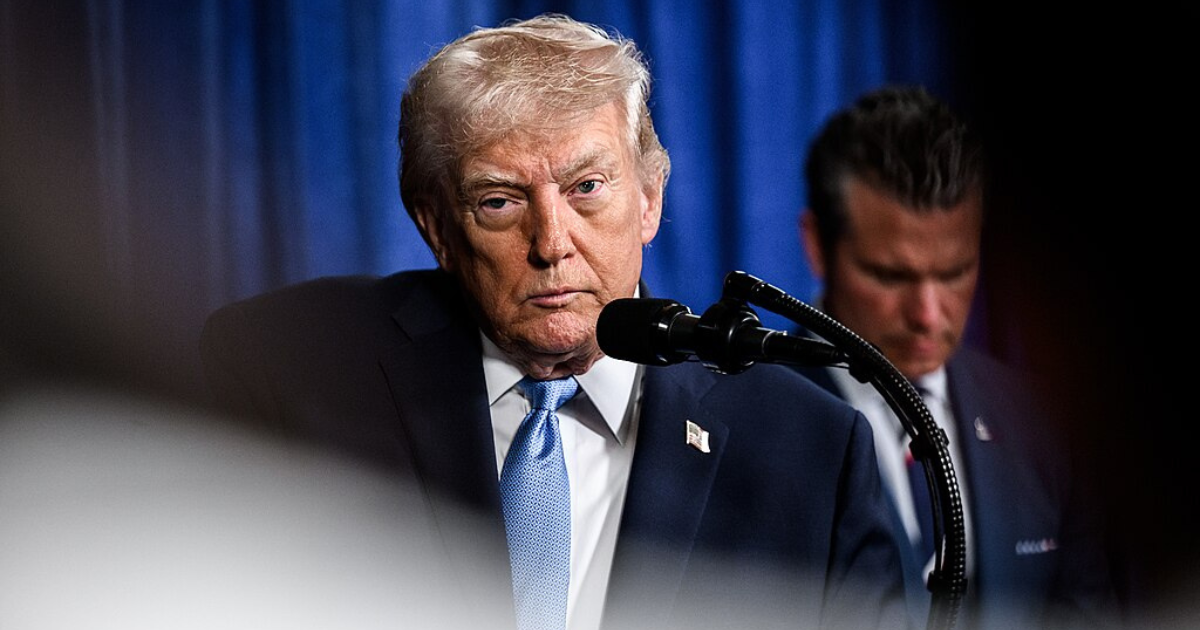
President Donald Trump says the United States could be forced into a financial disaster if the Supreme Court rules against his tariff powers.
In a series of posts on Truth Social late Monday, Trump warned that an adverse ruling would require the government to refund massive amounts of tariff revenue already collected, calling the process nearly impossible to carry out.
“It would be a complete mess, and almost impossible for our Country to pay,” Trump wrote.
The case before the court challenges Trump’s use of emergency powers to impose sweeping tariffs last year, including a 10 percent baseline on most imports and higher rates on countries running trade surpluses with the US. The Supreme Court is expected to rule as early as this week.
Trump framed the issue not as a technical legal fight, but as a high-stakes threat to the economy.
“The actual numbers that we would have to pay back… would be many Hundreds of Billions of Dollars,” he said, adding that the figure could climb into the trillions once broader economic effects are counted.
Those additional costs, Trump argued, would come from companies and countries that made investments in response to the tariffs: factories, plants, and equipment built specifically to avoid future duties.
🚨 THIS WEDNESDAY COULD BE THE WORST DAY OF 2026
US-World tariffs: DUMP
US-China tariffs: DUMP
US-EU tariffs: DUMPPolymarket + Kalshi are pricing around a 74% chance the Supreme Court rules Trump’s tariffs ILLEGAL this Wednesday.
Read that again.
73%.
Here’s the ugly part.… pic.twitter.com/hEUHv8bpyY
— Wimar.X (@DefiWimar) January 12, 2026
“When these Investments are added, we are talking about Trillions of Dollars!” he wrote.
Trump dismissed the idea that such refunds could be handled cleanly or quickly, saying even calculating what was owed would take years.
“It may not be possible but, if it were, it would be Dollars that would be so large that it would take many years to figure out what number we are talking about and even, who, when, and where, to pay,” he said.
According to the New York Post, the president’s warning about the tariffs comes as the Supreme Court weighs Learning Resources v. Trump, a case brought by an educational toymaker arguing that the tariffs imposed under the International Emergency Economic Powers Act amount to an unconstitutional tax.
NEXT WEEK IS YUGE!!!!!
-Wednesday, January 14: US Supreme Court will rule on President Trump tariffs. ⚖️ 🇺🇸
-Thursday, January 15: US Senate Banking Committee will conduct a markup vote on the crypto market structure bill (clarity act). 🗳 🇺🇸 pic.twitter.com/yYoFQASRnx
— Kenny Nguyen (@mrnguyen007) January 11, 2026
As of mid-December, more than $133 billion had been collected under that authority, according to court filings. A ruling against the administration could trigger refund claims from businesses across multiple industries.
Trump has repeatedly described the tariffs as a national security tool rather than a revenue measure, arguing they forced trading partners to make concessions and invest inside the US.
“When America shines brightly, the World shines brightly,” he wrote, before ending with a blunt conclusion. “If the Supreme Court rules against the United States of America on this National Security bonanza, WE’RE SCREWED!”
Polymarket estimates a 78% probability that the Supreme Court will rule President Trump’s tariffs illegal on Friday.
The Supreme Court could force Trump to return >$133 billion in tariff revenue.
The main dispute usually revolves around whether the president has the right to… pic.twitter.com/R4ekLrZhGK
— ThelordofPolymarket (@thelordofpolym) January 7, 2026
Not everyone in his administration shares the same level of alarm.
Treasury Secretary Scott Bessent told Reuters last week that refunding tariff revenue would not pose a major logistical challenge, noting the Treasury currently holds hundreds of billions of dollars in cash.
“It won’t be a problem if we have to do it,” Bessent said, adding that repayments would likely happen over months or longer, not all at once.
Administration officials have indicated Trump could attempt to reimpose similar tariffs using different legal justifications if the court rules against him, though refunds on the original collections would still be required.
For now, Trump is keeping the focus on the size of the risk rather than the legal aspects.
His message was simple, repeated, and written in all caps for emphasis: the cost would be enormous, the process chaotic, and the consequences global.