

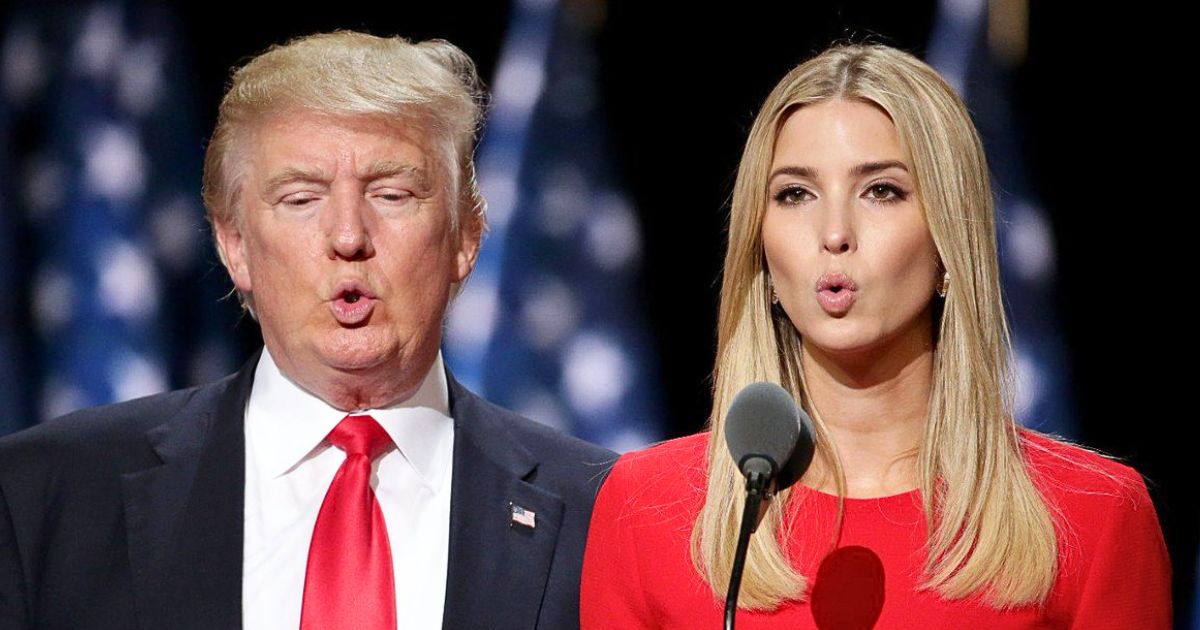
Despite being able to manage crowds of supporters on the campaign trail, Donald Trump‘s parenting style is raising concerns at home, or at least in the public eye. Trump shows many of the traits of a “narcissistic parent.”
It is a term used to describe an approach to parenting in which a child is treated more like a part of the parent than as a unique individual, according to psychologists quoted by HuffPost and other publications.
According to experts, Trump has shown five particular actions over the years that are a sign of narcissistic parenting: treating his kids as mirror images of himself, choosing loyalty over closeness with them, publicly praising them in order to improve his own image, putting them in high-risk circumstances to keep control, and blatant favoritism, in particular toward Ivanka.
Even though such behaviors frequently go unnoticed by glamour and political spectacle, they can result in adverse emotional impacts on kids that continue well into adulthood.
1. Children as Reflections, Not Individuals
The difference between appreciation and self-congratulation can frequently become fuzzy in what Trump says about his kids. His praises seem to come full circle, from praising Ivanka for inheriting his good looks to including Don Jr.’s entrepreneurial skills. Trump referred to Ivanka as “a great piece of ass” in a widely criticized 2006 interview with Howard Stern.
It has never been a secret. @realDonaldTrump has bragged on TV about wanting to f**k his own daughter @IvankaTrump, who is incidentally nowhere to be seen on his campaign because he is losing.
Trump likes them young. Just like Epstein did. https://t.co/SYqBrJq1Gz pic.twitter.com/DXErFIguMB
— KT “Special MI6 Operation” (@KremlinTrolls) November 2, 2024
Critics say this was a highly offensive comment that points out his view of Ivanka’s beauty as a reflection of his sense of worth. “It’s one thing to view your children’s accomplishments as something you helped them achieve,” said therapist Karen Marker. “But it’s another thing to think you are solely responsible for their success and take all the credit.”
Specialists warn that kids who are raised in such a way often develop a “false self” to live up to their parents’ expectations.
2. Loyalty Over Love
Narcissistic parents often prioritize allegiance above authentic connection. And Donald Trump’s apparent preference for his most politically supportive children seems to mirror this dynamic. Donald Jr. and Eric are frequently praised for defending the Trump brand. Ivanka was a top White House advisor.
Tiffany, by contrast, has largely been left out of the spotlight…and out of her father’s accolades.
Tiffany Trump is that girl in undergrad who finds out you’re gay at a party and immediately names every gay person she knows to see if you know them too. https://t.co/8NReGLa2LK
— Phillip (@MajorPhilebrity) October 20, 2020
Psychologist Sarah Darrow put it bluntly: “Loyalty serves their needs for control, validation and protection, while authentic connection requires vulnerability [which] narcissists typically avoid or are afraid of.” This was visible when Trump quickly distanced himself from Ivanka after she accepted the DOJ’s findings that there was no voter fraud in the 2020 election.
3. Praise as Public Performance
Instead of respecting his children as different people in general, Trump often presents their praise as performance, drawing attention to how they reflect his values. According to Darrow, “Narcissistic parents often dangle public praise like a trophy.”
Besides improving Donald Trump’s image, the tactic favors obedience over authenticity.
4. High-Stakes Roles as a Means of Control
Trump has frequently put his kids (and in-laws) in positions of authority in both business and politics. Despite being singled out for their lack of experience, Ivanka and Jared Kushner held important advisory positions in the White House.
Marker says, “When you put your children in leadership roles (…), you can remind them that you put them there.”
5. Favoritism and Sibling Competition
Trump’s clear favoritism is possibly the most apparent sign of narcissistic parenting.
He has referred to Ivanka as his “favorite” in public and even made eerie remarks implying that he would date her if she weren’t his daughter. Tiffany, at the same time, was once left out of a crucial RNC speech.
Melania’s son Barron was mainly unnoticed, except for a few references to his important academic successes.
Speaking about his family, Donald Trump is asked about Barron, who graduated HS on May 17
TRUMP: You know he’s tall, good looking — guy’s a very good student. And, uh, he’s, he’s uh applied to colleges and gets into everywhere he goes…he’s a very smart guy, he’s a very tall guy pic.twitter.com/1FlL1tRrZe
— Bad Fox Graphics (@BadFoxGraphics) June 2, 2024
Favoritism can damage sibling relationships and influence a child’s sense of self-worth, as well as bring about a power struggle. “It’s cruel,” Marker said.