



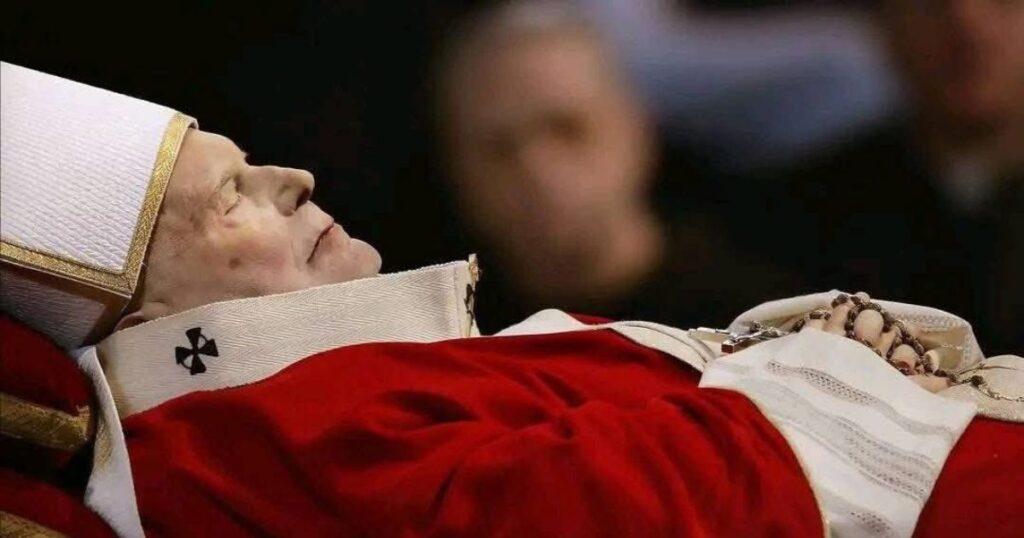
Many people worldwide are perplexed and alarmed by the abrupt appearance of a sizable bruise on Pope Francis’ top left face following his passing. On Sunday, Francis made his last public appearance at the customary Urbi et Orbi blessing. Francis appeared weak, but his face was unblemished.
Then, when his body was shown to the world, it was impossible to overlook the deep purple staining. Was there an injury involved? Or something else?
What could cause a facial bruise after death?
A collapse after a suspected stroke is the most plausible explanation, according to a number of medical specialists. A Madrid hematologist went on to say that even a minor bump or pressure may have resulted in a serious bruise if the Pope had been using blood thinners, which are frequently prescribed to elderly patients recuperating from strokes. And this seems to be just that, they say. But there are other possible explanations.
A fall or physical trauma before death
Pope Francis might have had obvious bruises from the stress he endured if he had been in a fall or was physically impacted just before he died. Antemortem trauma is the term for these kinds of injuries, which happen while the heart is still beating and cause blood to collect beneath the skin.
Postmortem handling of the body
Another reason could be postmortem ecchymosis, which is bruising that happens due to handling after death. This may occur when the body is being transported, being dressed or even when the body is being prepared for an autopsy. Although these marks have the appearance of bruises, they are not hematomas because there is no active blood flow.
When the body belongs to an elderly or a person who is physically frail, this scenario becomes very likely. As people age, their skin’s capillaries become more fragile, thus even the smallest pressure can cause severe discoloration after death.
GRAB A NEW KNOWLEDGE TODAY🤔
Look at these pictures carefully, you’ll see something important around the necks of Pope John Paul II and Pope Francis.
It’s a white cloth with black crosses, called the Pallium. It shows that the Pope is the Shepherd of the Church and the Bishop… pic.twitter.com/GLy5kFAXzR
— CFB🐦 (@CALABARBLOGGER) April 23, 2025
Livor mortis or hypostasis
Another natural postmortem process to take into account is hypostasis, sometimes referred to as livor mortis, which occurs when blood gravitationally pools in the lower body after the heart stops beating. If Pope Francis was lying face-down or with his head twisted for a considerable period, this could have caused blood to pool in that area, resembling the appearance of a bruise.
Cyanosis from cardiac or respiratory failure
Lastly, specialists also mention cyanosis, a bluish coloring that can happen when blood oxygen levels fall precipitously, which is frequently brought on by heart or lung failure. During postmortem examination, this kind of facial pigmentation could be misinterpreted for a bruise and could happen in the last moments of life.
Pope Francis face is heavily bruised in his open casket photos. He is in the Basilica of Santa Maria Maggiore.
This Basilica was built on top of a pagan temple dedicated to the goddess Cybele. Human sacrifices were commonly offered to her.
Just sayin pic.twitter.com/PGPjUYECJZ
— Redpill Drifter (@RedpillDrifter) April 22, 2025
Could this be a normal part of the dying process?
All of these theories make medical sense for a person Pope Francis’ age and condition. The bruising might have been a natural result of his last hours, or perhaps his last moments, if he had had a stroke and was already in a vulnerable situation.
What’s obvious is that this facial mark has sparked deep curiosity and even uneasiness among witnesses. However, the evidence clearly indicates that this is not unusual—and not necessarily suspicious—from a medical perspective.


