


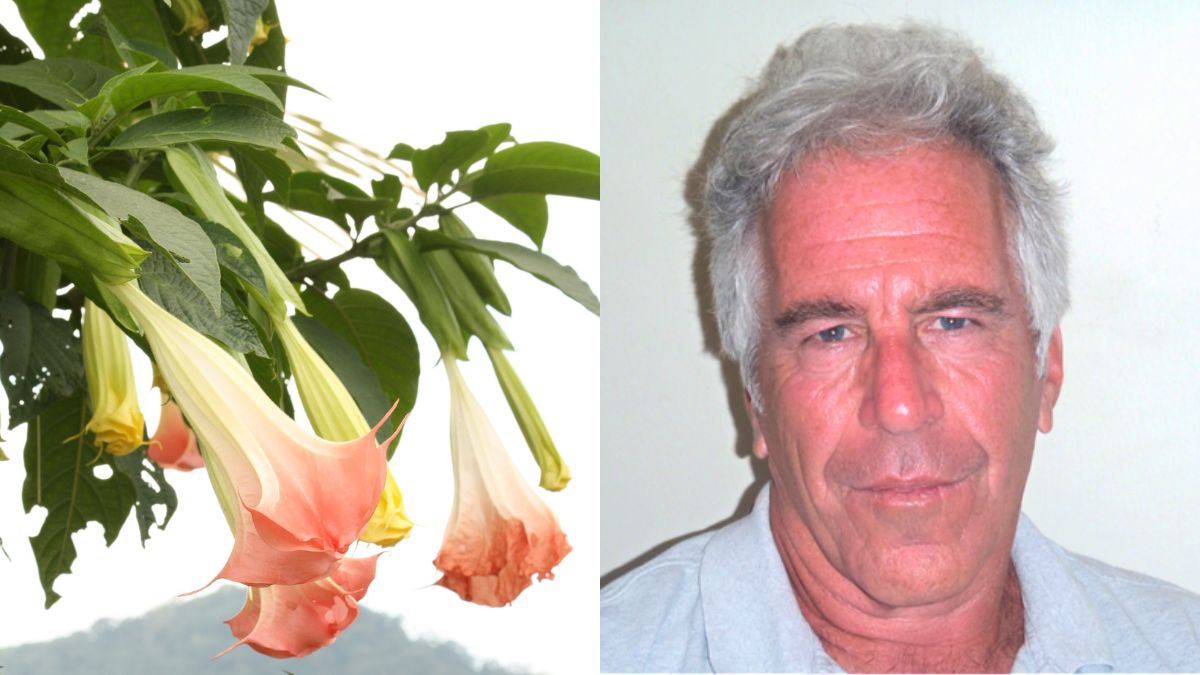
Newly reviewed Epstein files are shedding light on an unusual detail — a toxic flowering plant known for its powerful effects on the human brain. The plant, often called Angel’s Trumpet or “Devil’s Breath,” has long been linked to memory loss and extreme suggestibility — and experts say its documented medical impact is very real.
Jeffrey Epstein, who died in 2019 while awaiting trial on federal trafficking charges, appeared to show interest in the plant in email exchanges dating back more than a decade. In a 2014 message, according to UNILAD, he referenced having “trumpet plants” in a nursery. Months later, in January 2015, he was forwarded a news article about scopolamine — the plant’s primary active compound — describing its ability to “eliminate free will” and erase memories.
The correspondence shows that Epstein emailed a certain Ann Rodriguez about the plants in his ‘nursery’. He penned, “Ask Chris about my trumpet plants at nursery [SIC]?”
Jeffrey Epstein exchanged emails with photographer Antoine Verglas about a drug called Scopolamine. According to the emails it comes from the borrachero tree and a plant called Angel’s Trumpet. Scopolamine starts working within minutes and removes free will, wipes memory and can… pic.twitter.com/lIUBoyompb
— ✨️AreOhEssEyeEe✨️ (@AreOhEssEyeEe) February 17, 2026
Angel’s Trumpet is the common name for plants in the Brugmansia genus, native to South America. The flowers hang downward like bells and are often grown for their dramatic appearance. But beneath the beauty sits a potent mix of alkaloids, including scopolamine and atropine.
According to the U.S. National Library of Medicine, ingestion of Brugmansia can trigger anticholinergic toxicity, a condition that affects the central nervous system. Symptoms may include delirium, hallucinations, agitation, rapid pulse, elevated body temperature, muscle weakness and persistent memory disturbances. Severe cases can lead to convulsions, paralysis or even death.
Scopolamine itself is not illegal. In controlled medical settings, it is used in low doses to prevent motion sickness and nausea, often delivered through a small patch placed behind the ear. The difference, toxicologists note, is dosage. In high or unregulated amounts, the compound can have dramatic neurological effects.
Reports from Colombia over the years have linked scopolamine to criminal activity, where it has been referred to as “Devil’s Breath.” Media investigations have described cases in which victims appeared conscious but highly suggestible, later reporting little or no memory of events. Medical experts caution that while the drug can impair memory and judgment, some sensational descriptions may overstate its effects.
A clinical review published in medical literature notes that severe intoxication can produce confusion so intense that patients require hospital care. Treatment typically involves supportive measures, and in certain cases, intravenous physostigmine may be administered to counteract toxic effects.
🚨Epstein Files Reveal Emails About Toxic “Zombie Drug” Plants He Kept
Newly uncovered in the DOJ’s Epstein dump: Jeffrey Epstein emailing about his “trumpet plants at nursery.”That’s Angel’s Trumpet (Brugmansia), gorgeous but deadly. It produces scopolamine (“devil’s breath”),… pic.twitter.com/x26SYXvoFa
— Bethany O’Leary 🇺🇸 🦅 (@BBMagaMom) February 17, 2026
The newly highlighted emails do not show evidence of criminal use of the plant. They do, however, document Epstein receiving detailed information about its properties. One forwarded article described scopolamine as capable of blocking memory formation — a claim rooted in its well-documented ability to interfere with acetylcholine, a neurotransmitter involved in learning and recall.
Epstein’s properties in New York and elsewhere were known for their unusual décor and eclectic features. Court filings and previously released documents have described art, scientific equipment and a wide range of personal curiosities inside his residences. The mention of Angel’s Trumpet adds another item to that list.
Botanists emphasize that Brugmansia is widely available as an ornamental plant and is not banned in the United States. Garden centers sell it for its striking, fragrant blooms. Still, experts warn that all parts of the plant are toxic if ingested.
As more documents from the Epstein investigation continue to circulate, attention has turned to small details that might once have been overlooked. In this case, it is not a financial ledger or flight log — but a flower.