



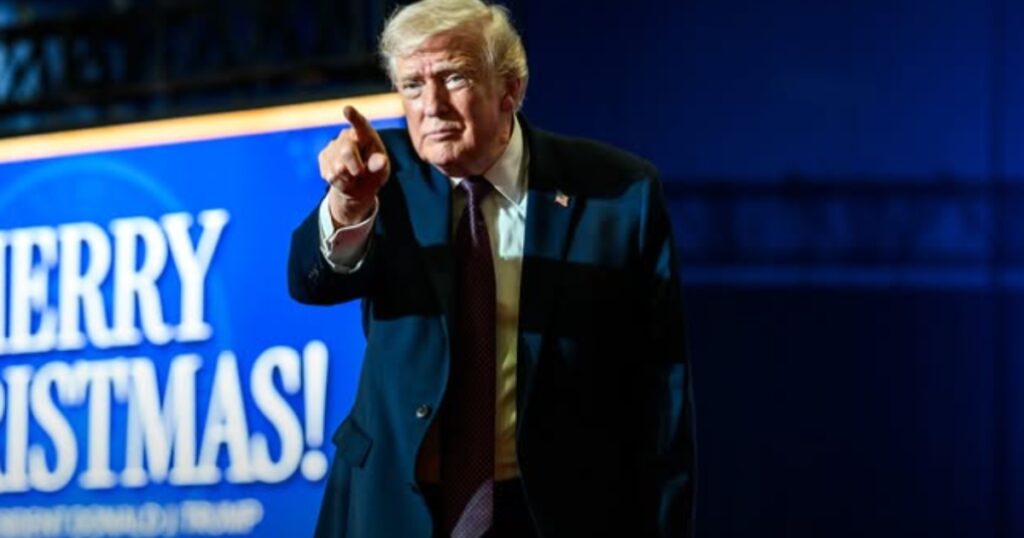
President Donald Trump is once again declaring victory — this time over the federal workforce.
In a Truth Social post shared this week, Trump boosted claims that federal employment has fallen to its lowest level in more than a decade, pointing to a reported 271,000 job losses since he began his second term. The message that he retweeted was short, triumphant, and familiar: promises made, promises kept.
Trump reshared a post from @RapidResponse47 stating that federal employment is now at its lowest level since 2014. The post framed the cuts as a direct result of Trump’s leadership, tying the losses to his long-running pledge to shrink government and “drain the swamp.”
“Big news for the USA!” Trump wrote, amplifying the claim without caveats.
The figures cited in the post align with reporting that shows a sharp reduction in federal jobs across multiple agencies since Trump returned to office. According to People, the cuts span departments involved in administration, oversight, and regulatory enforcement, part of a broader rollback of what Trump has repeatedly called “bloated bureaucracy.”
Trump has framed the layoffs as proof that he is delivering on campaign promises he says other presidents only talked about. Downsizing the federal workforce was a central theme of his second-term pitch, sold to supporters as a way to save taxpayer money and weaken what he often labels the “deep state.”
Oct’s large fall, for example, is attributable almost entirely to a sharp rise in federal Govt #job losses (-162,000) driven by the deferred resignation program initiated by the Department of Govt Efficiency #DOGE – chart @GoldmanSachs pic.twitter.com/Lbf2gjxakG
— ACEMAXX ANALYTICS (@acemaxx) December 25, 2025
But the job losses land awkwardly alongside another Trump-era promise: tighter spending discipline through DOGE, the Department of Government Efficiency.
DOGE was introduced as a watchdog designed to streamline federal operations, reduce waste, and make government spending leaner without chaos. Instead, the agency has struggled to show measurable success, even as federal jobs disappear at scale.
Internal reviews and reporting have shown DOGE lagging behind its own benchmarks, with staffing shortages, delayed audits, and overlapping responsibilities with agencies it was meant to oversee. While workers were cut elsewhere, DOGE itself failed to demonstrate the kind of precision efficiency Trump once promised. In fact, DOGE is no more.
The result is a contradiction Trump hasn’t addressed. He celebrates the headline number — 271,000 fewer federal workers — while the department meant to manage efficiency has become a quiet footnote.
Trump’s messaging focuses on the symbolism of the cuts rather than their execution. He has repeatedly tied job reductions to strength and control, using them as shorthand for reform rather than explaining how the losses affect government services or oversight.
Some Americans have welcomed the move, viewing it as overdue trimming of a sprawling federal system. Online reactions to Trump’s post included praise from supporters who see fewer government workers as an automatic win.
🚨NEW: The Department of Government Efficiency (DOGE) has officially shutdown. End of an era. pic.twitter.com/NSYocd8TVw
— Autism Capital 🧩 (@AutismCapital) November 23, 2025
Others, including former federal employees impacted by the cuts, have described abrupt layoffs, office closures, and stalled programs. Those reactions circulate mostly outside Trump’s feed, rarely acknowledged by the White House.
What remains clear is that Trump is claiming ownership of the outcome — not DOGE, not Congress, not agency heads. The job losses belong to him, at least in his telling.
By resharing the “promises kept” line, Trump is reinforcing a narrative he’s leaned on throughout his political career: results matter more than process, and disruption is proof of success.
Whether the federal government now runs better, cheaper, or simply thinner is a question Trump isn’t answering. For now, the number is doing the work, and he seems content to let it speak for itself.