

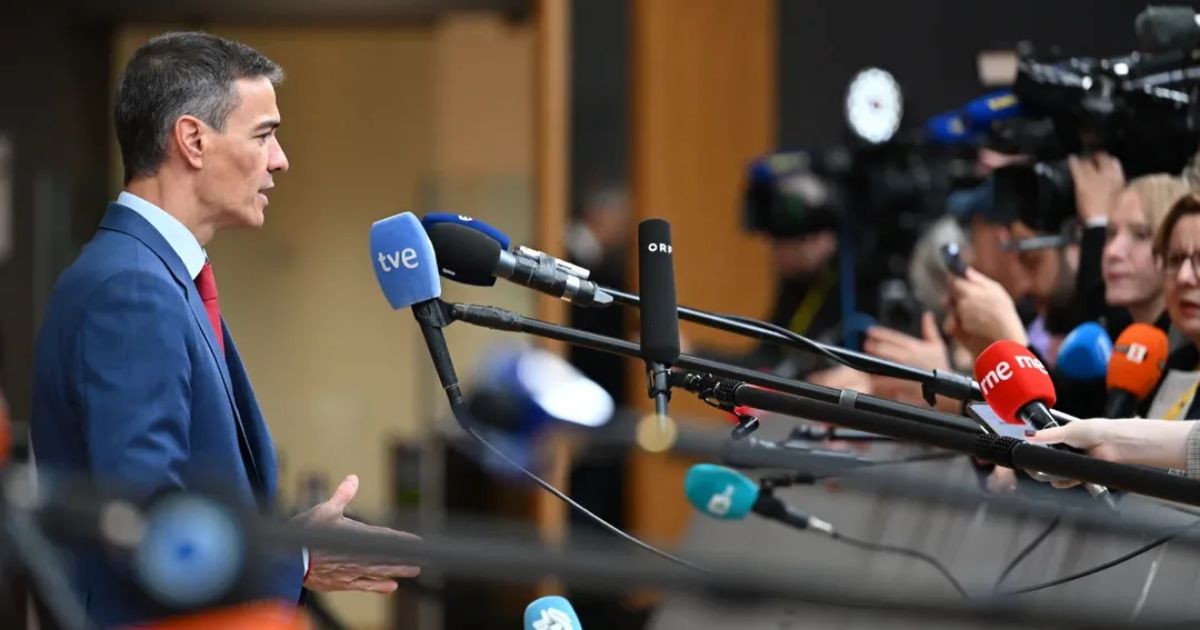
Spain’s Prime Minister Pedro Sánchez reacted to US attacks on Venezuela over the weekend, as governments across Latin America and beyond aired their voices in alarm over the risk of regional escalation.
As noted by Reuters, Sánchez called for restraint and respect for international law following the attacks on the Latin American country, stating that the Spanish government is “closely monitoring developments in Venezuela. Moreover, the Spanish prime minister confirmed that his country’s embassy and consulates in the country remain operational. Sánchez urged all parties involved to act responsibly and with respect for international law and the principles of the United National Charter, that US President Donald Trump appears to be ignoring.
“We call for de-escalation and responsibility. International law must be respected,” Sánchez said, stressing the need to avoid further instability in the region.
Cómo Pedro Sánchez Pérez Castejón ninguno.
Luchador por nuestro país y su gente, entré otras muchas cualidades. pic.twitter.com/GKpplnAy9C— Franz M Ruiz (@Franzmruiz) January 3, 2026
Translation: There was no one like Pedro Sánchez Pérez Castejón. A fighter for our country and its people, among many other qualities.
The Spanish government’s opposition leader Alberto Núñez Feijóo also reacted to the strikes, while stating it was a “bad day” for the government of Nicolás Maduro. He further said it was bad for its allies, “including those within the orbit of the Spanish government.”
The Popular Party leader wrote on X, stating that prudence was “compatible with hope” that Venezuela could regain the future he claimed had been taken from it “with the complicit silence of too many leaders in my country.”
Feijóo’s remarks clearly reveal the deep political divide in Spain in how to respond to the escalating crisis in Venezuela and the role of international actors.
Meanwhile, Russia strongly condemned this “act of armed aggression” by the US against Venezuela. Moscow warned in a statement issued hours after the bombings in Caracas and a number of Venezuelan states of the danger of a wider regional escalation. Moreover, its government stressed that “Latin America must remain a zone of peace,” while referencing commitments made by the Community of Latin American and Caribbean States in 2014.
According to the Russian foreign ministry, the Latin American nation must be guaranteed the right to determine its own destiny “without any destructive interference, and even less military interference from outside.” Moreover, it dismissed Washington’s justifications for the intervention, stating that the hostility has overridden pragmatic considerations.
The ripples are being felt in Latin America, with President Gustavo Petro of Colombia announcing the activation of a National Security Council, as well as the deployment of public forces along its shared border with Venezuela.
In a statement, Petro described the US action as an aggression against their neighbor’s sovereignty, while stating that Colombia, which at present only holds a non-permanent seat on the UN Security Council, would seek to convene the body to address this crisis.
“The government of Colombia rejects the aggression against the sovereignty of Venezuela,” Petro said, while calling for dialogue and unity among the Venezuelan people. He further reaffirmed the UN principle of self-determination.
Moreover, Petro expressed his “deep concern” over reports of explosions and aerial activity, while rejecting “any unilateral military action” that could endanger the civilian population.
Not to be outdone, the foreign ministry in Mexico has issued a strong statement where it condemns what it terms US military actions against targets in Venezuela. Moreover, that government described the strikes in Venezuela as a flagrant violation of Article 2 of the UN Charter, while reiterating Mexico’s commitment to international law and a pacifist foreign policy.
Meanwhile, the Mexican government urged an immediate cessation of all acts of aggression against Venezuela’s government and people, while warning of the serious consequences for regional stability.