


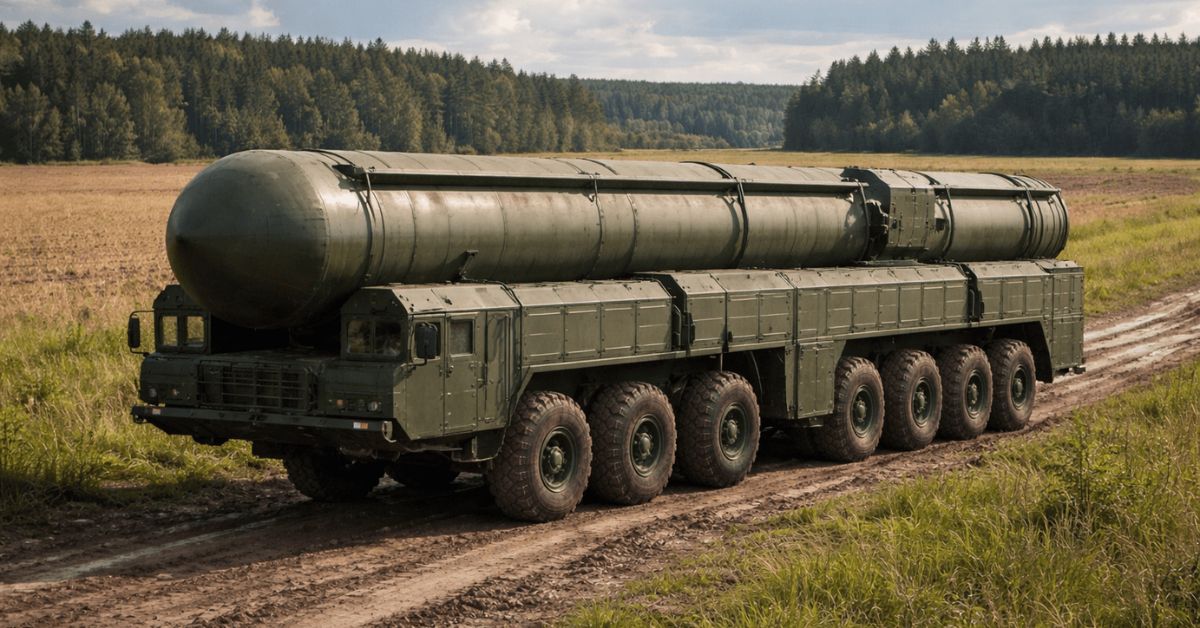
Russia unveiled its new “unstoppable” nuclear missile in Belarus. The Russian hypersonic, nuclear-capable Oreshnik ballistic missile has set off World War 3 alarm bells across the globe, stoking fears that a long-simmering arms race could spiral into open conflict. The Kremlin’s boast that the weapon is “unstoppable” has been seized upon by leaders and analysts in Ukraine, throughout Europe, and the United States as a dramatic escalation in the world’s most dangerous standoff since the Cold War.
Moscow announced that its Oreshnik missiles — reported to travel at speeds exceeding Mach 10 and capable of carrying both nuclear and conventional warheads — have entered active service and are being positioned in Belarus. From there, Russia could reach major European capitals within minutes, shortening response times and deepening anxiety among NATO members already grappling with Russia’s ongoing assault on Ukraine.
Russia state outlet TASS has openly boasted about the missile’s terrifying speed, claiming the Oreshnik could reach a NATO air base in Poland in just 11 minutes and strike NATO headquarters in Brussels in a mere 17 minutes — a window so short it would leave leaders with almost no time to respond. Although the missile is not capable of reaching the U.S. mainland, its range places America’s closest allies directly in the crosshairs, creating a hair-trigger scenario in which any strike could instantly drag the United States into a catastrophic global war.
— India Today Global (@ITGGlobal) December 30, 2025
🔥 19 December 2025
» Russia’s Oreshnik Enters Service in Belarus; A Missile with Nuclear Capability and Strategic Penetration Power
Alexander Lukashenko, President of Belarus, officially announced that the Russian missile system “Oreshnik” has fully entered combat service on… pic.twitter.com/VJzwOIOpmG
— Punisher346 (@punisher346) December 19, 2025
President Vladimir Putin described the new Russia missile complex in starkly strategic terms, emphasizing deterrence even as critics warn it signals a willingness to escalate. According to Kremlin state media, the Putin suggested the missile adds “a layer of security” for Russia while serving as a stark warning to Western powers. Analysts view that as a thinly veiled reference to the potential of the nuclear missile to undercut Western missile defenses and disrupt NATO’s collective security calculations.
The Oreshnik nuclear missile itself is believed to be based on proven intermediate-range ballistic technology repurposed by Russia with hypersonic reentry capabilities, multiple independently targetable warheads, and agile flight paths designed to frustrate interceptors. U.S. military and intelligence officials have acknowledged that while the system remains experimental, it represents a significant tactical shift that could complicate any future European theater conflict.
Despite insistence by Russia that the deployment is defensive, many Western defense experts see it differently. One NATO official, speaking on condition of anonymity given the sensitivity of the topic, said, “Positioning nuclear-capable hypersonic systems closer to NATO borders erodes strategic stability. It shortens decision timelines and raises the risk of miscalculation.” The official’s stark warning reflects a growing fear among alliance members that the missile could be used to intimidate or threaten civilian targets if diplomatic crises worsen.
BREAKING; EUROPE on High Alert as RUSSIA Places Nuclear-Capable Oreshnik Hypersonic Missiles on Combat Duty in BELARUS
Russia has officially deployed the Oreshnik intermediate-range hypersonic ballistic missile system to Belarus, and it has been placed on combat duty as of late… pic.twitter.com/S9HbkdOHK9
— Global Surveillance (@Globalsurv) December 30, 2025
The Oreshnik made its combat debut in November 2024 when a version of the missile was used against Ukrainian territory, drawing condemnation from Kyiv and its Western backers. Although that strike reportedly caused limited physical destruction, the political and psychological impact was profound, reinforcing fears about Russia being willing to integrate advanced weapons into a broader campaign of coercion.
Wikipedia
Allies of Russia have defended the deployment, with Belarusian President Alexander Lukashenko asserting that the missile increases his country’s “ability to defend peace” in a turbulent geopolitical environment. Putin’s supporters assert that Russia’s actions are a response to what they characterize as provocative Western military support for Ukraine and the possible placement of U.S. missiles in Eastern Europe.
Yet Western leaders have been quick to push back. A senior U.S. defense official said bluntly this week, “We view the deployment as destabilizing. Weapons that can strike within minutes at such ranges force us to reconsider our own deterrence postures and heighten the risk of unintended conflict.” While that official emphasized diplomacy remains the preferred path, the statement underscored how serious Washington views the threat.
Just a few days before Russia introduced its “unstoppable” nuclear missile to the world, President Donald Trump said, “Things like this end up in a third world war. Everybody keeps playing games like this, you’ll end up in a third world war, and we don’t want to see that happen,” when discussing the Ukraine and Russia war, according to a Daily Mail report.
For European capitals, the Russia nuclear missile fear is not abstract. Officials in London, Berlin, and Paris have privately expressed concern that the Oreshnik’s deployment places their homelands at greater risk — especially given the speed at which the nuclear missile could travel should it ever be used. The specter of a weapon that could theoretically reach Europe’s population centers in a matter of minutes has revived old debates about nuclear strategy, defense spending, and the viability of existing missile defense networks.
The introduction of the Oreshnik nuclear missile by Russia has heightened tensions at a time when major powers are already locked in disputes over Ukraine, the South China Sea, and Middle East security. As the world enters 2026, the underlying question on the minds of many analysts is whether deterrence will hold — or whether WW3 is looming on the horizon.