

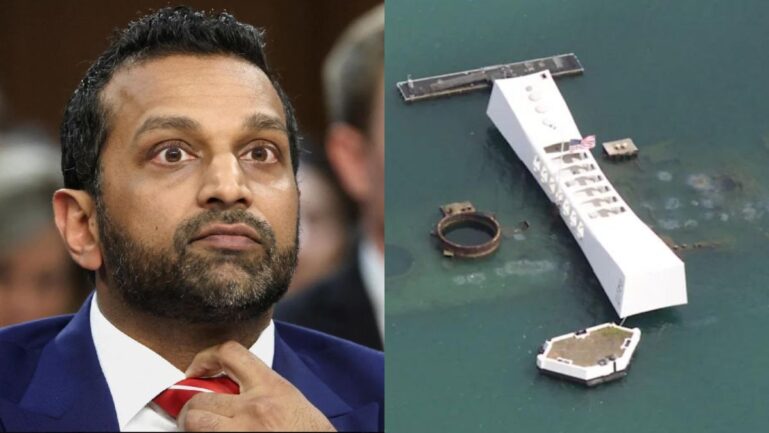
Kash Patel’s recent “VIP snorkeling excursion” at the USS Arizona Memorial controversy has sparked more outrage than ever.
The controversy began when the Associated Press obtained Defense Department emails documenting Patel’s August 2025 “VIP snorkel” at Pearl Harbor. The activity was not listed on his public schedule. The outing was reportedly facilitated by the U.S. military.
Patel spent around 30 minutes snorkeling near the wreckage of the battleship at Pearl Harbor, where more than 900 U.S. sailors and Marines remain entombed. The USS Arizona memorial is widely considered one of the most sacred military sites in the U.S. It serves as the resting place for many victims killed during the Japanese attack on Pearl Harbor on Dec. 7, 1941.
View this post on Instagram
The snorkeling in the restricted area has sparked outrage from retired Navy Captain Jon Duffy.
In an opinion piece published in the Los Angeles Times, Duffy condemned not just Patel but also the Navy for treating the memorial as a picnic spot. He opened the piece by writing:
“The USS Arizona is a tomb. That should have been enough.”
Duffy, who said he spent 30 years in the Navy and served on senior staffs, argued that the issue extended beyond Patel’s participation. The larger concern here, according to Duffy, is that Navy personnel and resources were used to facilitate a recreational activity at a war grave.
He wrote:
“It is a shipwreck, a grave and a shrine. The Navy has taught generations of sailors to treat that place as sacred.”
“Public office is not a VIP pass, and a swim around a war grave should not be a perk.”
He argued that “the Navy owns this disgrace”, as he explained how powerful and influential figures often use government resources for themselves. Having spent 30 years in the Navy, he said that it’s not uncommon for a powerful person to want something and make requests for it.
Sometimes they ask themselves; sometimes a senior staff member asks on their behalf. Either way, calls are made, and “an obvious boundary becomes a coordinated effort.”
However, he still feels that for a request like this, the answer should have simply been no. He wrote:
“Military professionalism requires more than sheer efficiency. It requires standards and judgment. It requires someone in the chain of command to know when to stop the machinery and say no. At Pearl Harbor last summer, someone should have stopped it.”
“The answer should have been simple: No, sir. The Navy will not help you do that.”
Emphasizing how Patel did something he should have refused to participate in, he added that it was the Navy that made it possible. He argued that the same institution that teaches sailors at the USS Arizona Memorial is not merely a historic site, but instead found a way to approve the request and failed in its duty. He said:
“Somewhere along the way, too many people treated this as a task to complete rather than a standard to uphold. The staff work succeeded. The principle failed.”
He added that “the military is not a concierge service for the powerful,” and the institution should have made a better decision. Honoring a guest and dishonoring the dead are very different, and although the line between them may have appeared thin in this case.