

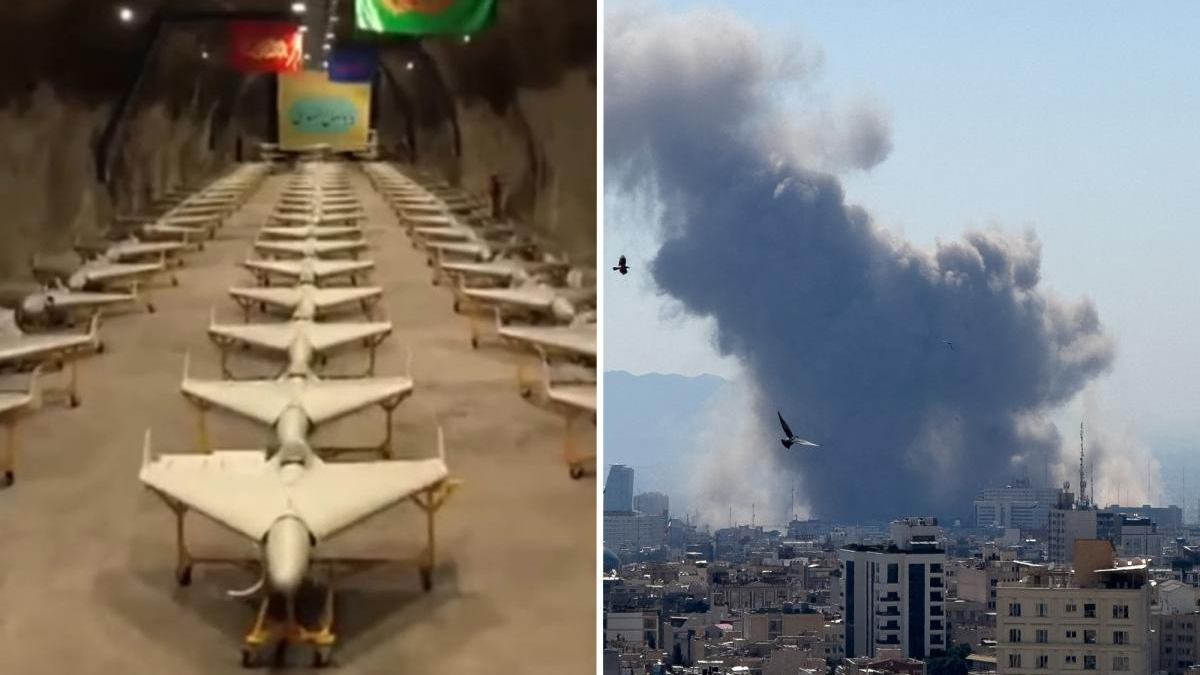
Iran has reportedly unveiled a vast underground naval base packed with attack boats and so-called “suicide drones” as the regime escalates threats to cripple the global economy by targeting shipping routes in the Strait of Hormuz.

Tehran has already forced the closure of the critical maritime chokepoint — a passage responsible for transporting roughly 20 percent of the world’s oil supply — as it intensifies attacks on vessels operating in the Iran region. Earlier propaganda videos released by the Islamic Republic also showcased an extensive network of underground tunnels, dubbed “missile city” stocked with naval drones, anti-ship missiles, and sea mines ready to strike passing ships, according to a Daily Mail report.

Iran has already forced the closure of the critical maritime chokepoint — a passage responsible for transporting roughly 20 percent of the world’s oil supply — as it intensifies attacks on vessels operating in the region. Earlier propaganda videos released by the Islamic Republic also showcased an extensive system of underground tunnels filled with naval drones, anti-ship missiles, and sea mines.

Iranian leaders have also threatened to deploy high-speed underwater missiles that they claim only Iran and Russia possess, warning the weapons could send global oil prices soaring. Senior Islamic Revolutionary Guard Corps General Fadavi declared: “We have missiles that are fired from underwater and their speed is one hundred meters per second and we may use them in the coming days.”


The regime’s threats quickly escalated beyond economics and into outright warfare rhetoric, with officials warning the Gulf could become a deadly battleground if U.S. and Israeli strikes continue. Iranian leaders vowed they would make the Persian Gulf run with the “blood of invaders,” a chilling warning aimed squarely at Western military forces operating in the region.

Iranian officials also issued a stark warning about the potential economic fallout of the escalating conflict, suggesting global oil markets could spiral out of control if the confrontation continues. In remarks apparently directed at Washington, Iranian figures warned: “You will not be able to artificially lower the price of oil. Expect oil at $200 per barrel. The price of oil depends on regional security, and you are the main source of insecurity in the region.”


Those threats followed a series of late-night attacks targeting commercial shipping near the Iraqi port city of Basra. Two vessels — the US-owned Safesea Vishnu and the Malta-flagged Zefyros — were struck while carrying fuel cargoes loaded in Iraq. The attacks left the ships burning and forced emergency rescue operations for dozens of crew members.


The dramatic show of force was revealed in footage broadcast by Iranian state media, which displayed long underground tunnels carved into coastal mountains and filled with rows of high-speed missile boats and explosive-laden naval drones designed for rapid strikes against enemy vessels.


Military officials described the sprawling complex as part of a secret network of fortified naval bases intended to protect Iran’s maritime arsenal from airstrikes while allowing fast deployment into the Persian Gulf. “These facilities allow our forces to respond immediately to any threat in the Gulf,” an Iranian naval commander said in the broadcast. “Our enemies should know that we are fully prepared.”


The base reportedly houses dozens of fast attack craft capable of launching missiles or ramming enemy ships with explosive payloads. Iranian state media also highlighted fleets of unmanned vessels, openly describing them as suicide drones designed to detonate on impact.


“These vessels can be used for precision attacks against hostile ships,” one Iranian military official said. “They are designed to destroy enemy targets and defend the Islamic Republic.”


The display comes as the region faces one of the most severe maritime disruptions in decades. Shipping traffic through the Strait of Hormuz has plummeted as vessels avoid the increasingly dangerous corridor, where Iranian attacks and threats have forced tankers to reroute or halt voyages entirely.


The strait is considered one of the most strategically important waterways in the world, carrying around one-fifth of the planet’s daily oil supply. Any prolonged disruption has the potential to send global energy prices surging and ripple through economies worldwide.


Military analysts say Iran’s reliance on swarms of small attack boats, drones, and explosive vessels reflects its strategy of asymmetric warfare — using large numbers of inexpensive weapons to overwhelm larger and more advanced naval forces.


Instead of trying to match Western warships directly, Iran’s naval doctrine focuses on flooding the battlefield with fast-moving attack craft capable of launching missiles, laying mines, or slamming into targets with suicide drones.


With tensions already running dangerously high, the unveiling of Iran’s underground naval arsenal has intensified fears that the conflict could rapidly spiral into a broader crisis threatening global trade routes, oil supplies, and economic stability around the world.