



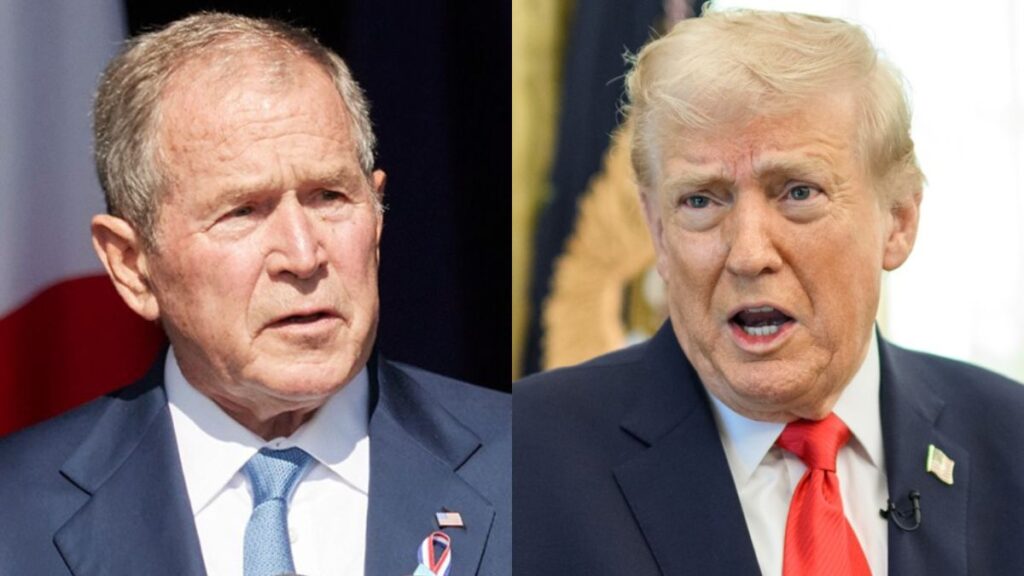
Former President George W. Bush has released an essay praising George Washington for surrendering power, elevating humility and stepping away after two terms — a reflection that lands as President Donald Trump signals he may seek more time in office. Bush never names Trump in this cryptic piece. He does not have to, because the current president has already shown his own hand.
The essay, “George Washington by George W. Bush, “ published as part of a project called “In Pursuit” by the group More Perfect, centers on Washington’s decision to relinquish command of the Continental Army and later decline a third presidential term. Bush doesn’t hold back as he subtly shreds the actions of a certain sitting president.
“Our first president could have remained all-powerful, but twice he chose not to,” Bush wrote. “In doing so, he set a standard for all presidents to live up to.”
Bush describes those choices as foundational.
“His decision to cede command of the army ensured America wouldn’t become a monarchy, or worse,” he wrote. “By stepping away after two terms, he made clear that the presidency is temporary, and the republic is permanent.”
This Presidents Day, we’re launching In Pursuit, a new essay series on the people and principles that shaped the American experiment.
Our first essay comes from President George W. Bush, writing on George Washington and the leadership trait he returns to: humility. pic.twitter.com/6sJBMANAzD
— In Pursuit USA (@InPursuitUSA) February 16, 2026
The words arrive at a moment when Trump has repeatedly floated the idea of serving beyond two terms, despite the clear prohibition in the Twenty-second Amendment to the United States Constitution. The amendment, ratified in 1951, limits presidents to two elected terms. Trump has suggested in speeches that “there are methods” to extend his time in office, though he has not outlined a lawful path to do so.
Bush does not address Trump’s remarks directly. Instead, he focuses on tone and temperament.
“Few qualities have inspired me more than Washington’s humility,” Bush wrote. “Washington modeled what it means to put the good of the nation over self-interest and selfish ambition.”
He adds that Washington “carried himself with dignity and self-restraint, honoring the office without allowing it to become invested with near-mythical powers.”
Trump, during and after his first term, attempted to overturn the results of the 2020 election, which he lost to Joe Biden. Courts rejected challenges filed by his campaign and allies. On Jan. 6, 2021, a mob of his supporters stormed the U.S. Capitol as Congress met to certify the election results. Trump has continued to describe the election as “rigged,” despite a lack of evidence supporting widespread fraud.
George Washington crossed an icy river to fight a monarchy.
Trump posts in all caps.
“Unwavering courage” is not rage tweeting at 2 a.m. “Steadfast love of nation” is not praising autocrats while burning alliances that took generations to build. And “American prosperity” is not… https://t.co/o3JRVziICb
— Gandalv (@Microinteracti1) February 16, 2026
Bush’s essay also arrives as he maintains distance from public political fights. According to reports, he is not giving interviews about the piece. Colleen Shogan, who is leading the “In Pursuit” initiative, said, “We are taking the long view of things. The lesson of presidential humility transcends time.”
The project is tied to the upcoming 250th anniversary of the Declaration of Independence. Other former presidents, including Barack Obama and Bill Clinton, are expected to contribute.
Bush’s message is restrained, but its theme is firm: power is meant to be surrendered. “Our first president understood that character would shape the country’s future,” Bush wrote. “He showed that strength and restraint are not opposites.”
He closes by returning to the idea that the office belongs to the Constitution, not the individual who occupies it.
“Presidents come and go,” Bush wrote. “The republic endures.”
The essay contains no direct rebuke. It does not need one. Bush’s argument rests on history — and on the example of a president who chose to walk away.