



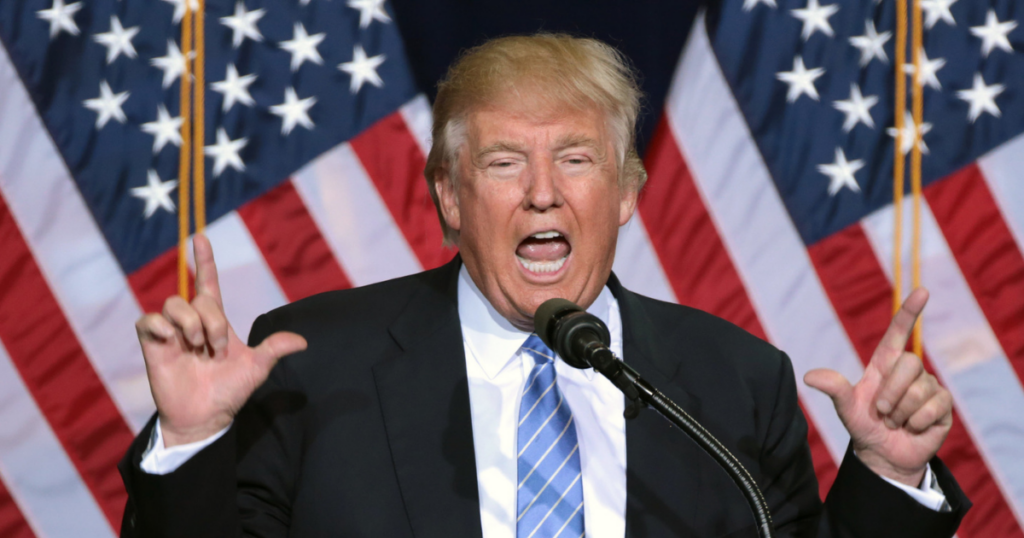
There is a distinct, uncomfortable silence that descends upon a room when a world leader loses their thread. It is not the pause of a rhetorician calculating their next blow, but the hollow static of a mind momentarily untethered. For those watching Donald Trump’s return to the world stage since his inauguration last year, these moments have become less of a rarity and more of a routine feature of the presidency.
We saw it in Davos last month. In what was billed as a triumphant return to the World Economic Forum, the President’s address descended into a painfully elongated exercise in free-association.
Donald Trump muddled Greenland with Iceland—a geographical slip that might be forgiven in a pub quiz but lands differently coming from the leader of the free world—and frequently trailed off, only to “come to” moments later, launching into entirely unrelated subjects. It was a performance that invited not just political critique, but medical scrutiny.
Trump has bandages on his bruise covered hand and is falling asleep at public events almost daily. This man is not well and I don’t think MAGA can deny it anymore. pic.twitter.com/70LeXjkFLq
— Harry Sisson (@harryjsisson) December 4, 2025
Now, that scrutiny has taken a markedly grim turn. Adam James, a licensed physical therapist speaking to political commentator David Packman, has offered a prognosis that is as specific as it is startling: the President may have as little as four months to live.
James suggests, as The Daily Star reported, that the chaotic cadence of Trump’s recent appearances—the ‘word salads’, the near-falls, the public slumber—are not merely symptoms of fatigue, but of a biological clock winding down with terrifying speed.
The theory posited by James connects the dots between behavioural erraticism and physical decay in a way that the White House press corps has largely danced around. Most notable are the markings on Donald Trump’s hands—strange, persistent bruises often hastily obscured by make-up.
The official line from the administration has always been benign, attributing the marks to the occupational hazard of enthusiastic handshaking. James, however, dismisses this explanation with withering bluntness.
Trump’s *left* hand — not the one that is usually disfigured — now has a large bruise and is discolored
These pictures are from today in Davos and are via Chip Somodevilla (Getty) and Fabrice Coffrini (AFP) pic.twitter.com/FRp4RdITSp
— Aaron Rupar (@atrupar) January 22, 2026
“It’s nonsense,” James told Packman, arguing that the marks are tell-tale signs of medical intervention rather than diplomatic rigour. “That’s an IV injection site. My guess is that he’s getting IV diuretic medication to pull excess fluid off his body, so he doesn’t end up in hospital.”
This paints a picture of a presidency being propped up by significant pharmacological assistance, a frantic behind-the-scenes effort to keep the principal upright.
If the body is failing, the mind appears to be eroding faster. James points to the President’s inability to filter his speech—specifically the inhibition control managed by the frontal lobe—as the smoking gun. This was thrown into sharp relief recently when Donald Trump, discussing Venezuela, casually referenced a classified military “discombombulator.”
Trump’s other hand now has a massive bruise….and his face is a very natural color today pic.twitter.com/Dd5vKjAtEI
— Wu Tang is for the Children (@WUTangKids) January 22, 2026
The moment was surreal. “I know I’m not supposed to be talking about this,” the President admitted, even as he continued to talk about it. According to James, this wasn’t just a gaffe; it was a neurological failure. “He knows he’s not supposed to be talking about it,” James observed. “But his brain is not stopping him.”
James asserts that President Donald Trump’s “often-absent trails of thought” are directly tied to this atrophy, suggesting the frontal lobe is physically shrinking inside the skull.
The expert’s assessment draws a chilling parallel to the decline of Bruce Willis, whose battle with dementia forced his retirement and eventual move to a care facility. James notes that Willis’s symptoms began affecting his work in 2022, aligning with a timeline Trump seems to be mirroring.
‘If it’s frontotemporal dementia, then the life expectancy after diagnosis is roughly seven to 12 years,’ James explained, suggesting that Donald Trump has been displaying these symptoms since well before his 2016 victory.
Based on the acceleration of these symptoms and typical life expectancy models, James arrived at his four-month estimation. It is a timeline that suggests the frantic energy of the current administration might be less about policy and more about preserving its legacy before the clock runs out.
Perhaps most conspiratorial, yet clinically plausible, is the claim regarding the President’s medical records. James alleges a deliberate strategic pivot within the White House medical team: a shift from MRIs to CT scans. The logic is simple and cynical.
“His frontal lobe is shrinking inside his skull, and the MRIs will show this,” James asserted. “That’s why they have pivoted to the CT scans, because they don’t want you to see that his brain is shrinking.”
PHOTO: President Donald Trump seen today with visible bruising on his hand. pic.twitter.com/QpQkjsSrB3
— Faytuks Network (@FaytuksNetwork) January 22, 2026
The danger, as James frames it, is not just a leader who cannot stand up, but one who cannot shut up. The administration’s ability to mask the condition is effective only until President Donald Trump steps in front of a microphone.
As the lapses in logic become more frequent and the bruises on his hands harder to hide, the question is no longer if Donald Trump is unwell, but simply how long the theatre of vitality can be maintained.