



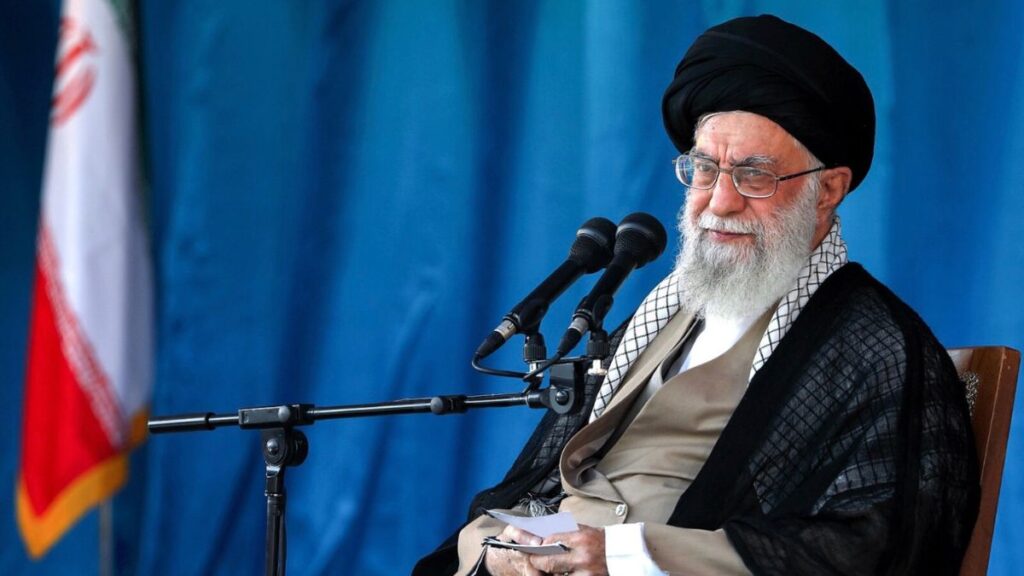
Iran’s Supreme Leader Ayatollah Ali Khamenei was killed in joint U.S.-Israeli strikes on Saturday, February 28. While his death has prompted both celebration and fury among Iranians, it particularly brought back painful memories for one American.
A Brooklyn individual, Barry Rosen, who was taken hostage during the 1979 Iran hostage crisis, opened up about one of the darkest chapters of his life. Speaking with News 12, the East New York native recalled being held inside the U.S. Embassy in Tehran.
The incident took place under the former Supreme Leader Ayatollah Ruhollah Khomeini, as part of the Iranian Revolution. During that time, 66 Americans, including diplomats and other civilians, were taken hostage in the U.S. Embassy.
Meanwhile, Ali Khamenei was mentored by the former leader Khomeini, and brought into his inner circle during the Iranian Revolution. Years later, he became Khomeini’s political successor, carrying forward his vision for Iran’s Islamic Republic.
Iran’s Supreme Leader Ayatollah Ali Khamenei, who led the Islamic Republic since 1989, is dead at 86 https://t.co/t9eESkP5yS
— Defense News (@defense_news) March 2, 2026
Now that Khamenei’s demise has marked a temporary end of the Islamic Republic, Rosen spoke about the incident from under Khomeini’s rule when he was taken hostage. After followers of Khomeini stormed the compound in Tehran, Rosen recalled being held captive for 444 days.
Now 82 years old, the Brooklyn native expressed how hearing about Khamenei’s death felt personal. Especially after he survived mock executions, isolation and torture, during the months he spent in captivity.
“This all occurred on my birthday, yesterday, my 82nd birthday,” Rosen said. “I think the death of Khamenei absolutely is positive, but there is no way that this is the end of the Islamic Republic,” he added.
Rosen shared an ominous warning, “There is a system there in Iran where there’ll be a replacement and the regime will continue.” Despite his horrifying experience, Rosen still fondly remembers his early days in Iran when he first traveled there in 1967 as a member of the Peace Corps.
“My experience in Iran was overwhelmingly positive. Iranian people are very friendly,” he said. Years later, Rosen returned to Iran, to work as a press attaché at the U.S. Embassy in Tehran. But the November 1979 incident changed everything.
As Iranian students and supporters of Khomeini seized the U.S. Embassy, they took several Americans as hostages. Rosen was one among them. Later on as Rosen was released, he recalled the first seconds of his freedom.
“There are moments in my life right now that remind me very much of what captivity meant to me,” the U.S. citizen said.
Khamenei was elected as Iran’s supreme leader by the Assembly of Experts in 1989, after the death of Ruhollah Khomeini. Since then, he has ruled Iran as the most powerful figure, which make his death a major incident in the country’s history.
BREAKING
The supreme leader of Iran, Ayatollah Ali Khamenei, has reportedly fallen into a coma and DIED. Good riddance!
Iran will soon be free! pic.twitter.com/JBWV9G9e4J
— Dr. Maalouf (@realMaalouf) November 16, 2024
However, despite his death, Rosen does not believe it will bring quick or easy change. While he feels sympathy for the Iranian people, the East New York native also believes they deserve better leadership.
“I would tell those Iranians who are living within their homes and care about the change in the system to keep that going, but be careful,” he said, adding, “We don’t know what will be happening in the near future.”
Rosen further stated, “This could go on for a long time and I think only when we see a defection in the regime will I feel confident that these Iranians in Tehran and all over Iran will have an opportunity to change the system.”
He concluded by saying that real change will only come if people inside the ruling system decide to break away.