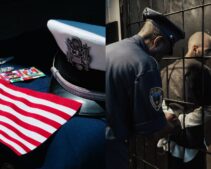


The USS Iwo Jima, a U.S. Navy amphibious assault ship, became the unexpected focal point of a global political shock on Saturday after President Donald Trump posted images claiming Venezuelan leader Nicolás Maduro was captured aboard the vessel. The photos, shared on Trump’s Truth Social account, show Maduro handcuffed and blindfolded inside what appears to be a secured area of the ship. USA Today reports the images were released hours after overnight U.S. strikes in Venezuela.
The USS Iwo Jima is a Wasp-class amphibious assault ship capable of carrying helicopters, Marines, and special operations units. Its presence in the Caribbean had been noted weeks earlier as part of an expanded U.S. naval deployment, but Trump’s photos marked the first public claim that the ship played a direct role in detaining a sitting head of state. Central News described the image as a “bold visual confirmation” meant to remove doubt about Maduro’s status.
Nicolas Maduro on board the USS Iwo Jima. pic.twitter.com/omF2UpDJhA
— The White House (@WhiteHouse) January 3, 2026
The images themselves quickly spread across social media and international news outlets, becoming one of the most striking visual moments of Trump’s second term. CBS News noted that Trump bypassed traditional briefings by posting directly, fueling immediate reaction before officials could provide detailed explanations of the operation or its legal footing.
Venezuelan officials disputed the claims almost immediately. From an undisclosed location, Maduro’s government dismissed the photos as manipulated and declared a national emergency, according to Central News. Still, the lack of independent access to Maduro has left the images — and the USS Iwo Jima — at the center of a rapidly escalating information battle.
Trump said Maduro and his wife were “captured and flown out of the country” following what he described as a “large-scale strike,” offering the images as visual confirmation. Trump later told reporters the United States would temporarily “run” Venezuela, a statement that immediately raised questions about the scope and duration of U.S. involvement.
Trump outlined how the strike went down, likening it to World War II. “Overwhelming military power, air land and sea, was used to launch a spectacular assault, and it was an assault like people have not seen since World War II,” he said.
The president continued, “It was a force against a heavily fortified military fortress in the heart of Caracas to bring outlaw dictator Nicolás Maduro to justice… This was one of the most stunning, effective and powerful displays of American military might and confidence in American history.”
Addressing the nation, he said, “We want peace, liberty and justice for the great people of Venezuela.” Trump then established that the United States had the upper hand since they had taken Maduro. He stated that “all Venezuelan military capacities were rendered powerless as the men and women of our military, working with U.S. law enforcement, successfully captured Maduro in the dead of night.” He added,
U.S. officials say the operation followed months of military pressure on the Venezuelan regime, including counter-drug strikes and maritime seizures. The Trump administration had long accused Maduro of drug trafficking and ties to criminal networks, charges he has repeatedly denied.
What remains unresolved is what happens next — for Maduro, for Venezuela, and for the U.S. forces now visibly linked to his detention. For now, the USS Iwo Jima has become more than a naval asset. It is the physical symbol of a moment that has already reshaped headlines, diplomacy, and the tone of U.S. power projection in 2026.