


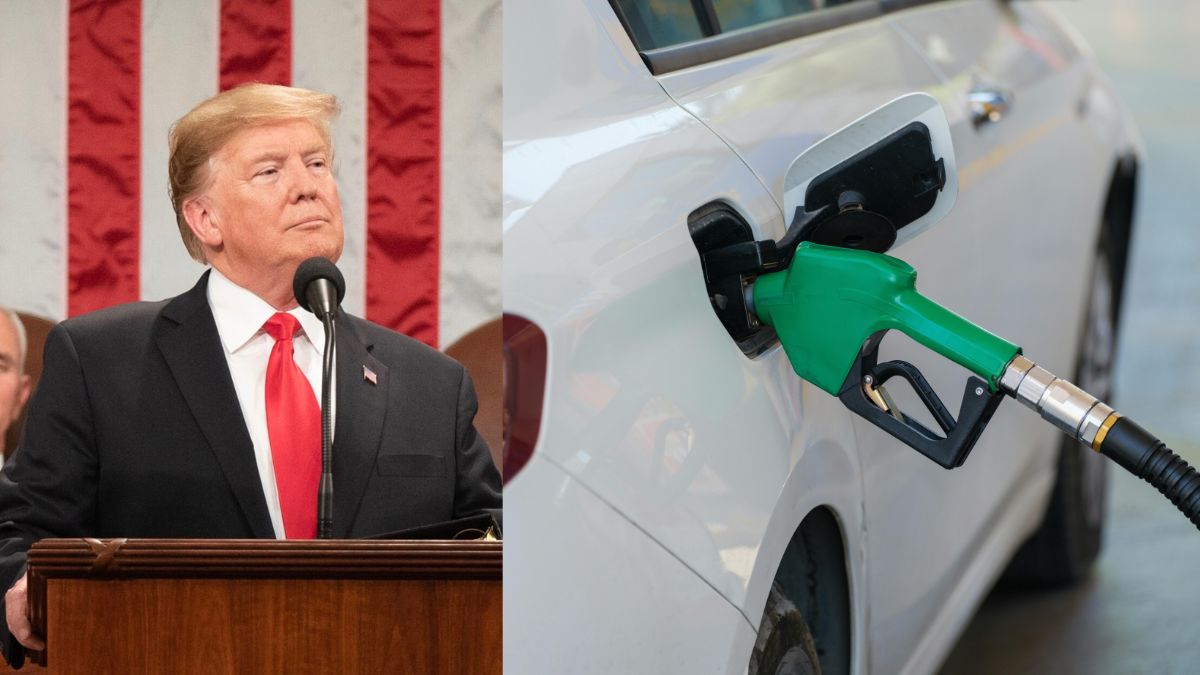
Amid the ongoing conflict in the Middle East following the U.S.-Israeli airstrikes on Iran, Americans have been struggling with a surge in oil prices. U.S. crude oil has crossed $100 per barrel for the first time since the 2022 Russia-Ukraine crisis, while diesel prices have climbed above $5 per gallon.
However, despite the crisis, President Donald Trump said that the issue will be short-lived. According to Reuters, Trump has asserted repeatedly that the current spike in oil prices is temporary. In addition, the president has also expressed confidence that once the conflict ends, energy prices will “drop like a rock.”
U.S. average gas prices currently sit at $3.82 per gallon which is more than $1.40 higher than when Biden became president.
— GOP (@GOP) September 1, 2023
So far, the ongoing tensions between the United States and Iran which began on February 28, seem to have pushed global oil supply into trouble, thus raising prices. As per reports, one major reason behind this sudden rise in price is Iran’s blockade of the Strait of Hormuz.
Since Hormuz serves as a key route for nearly 20 percent of the world’s oil supply to pass, Iran’s disruption of this critical route has affected fuel prices universally.
Higher prices of fuel don’t simply mean that people will have to pay more at the pump. It also means that the everyday cost of living will rise since goods and services depend on transportation. In addition, with summer approaching, there are growing concerns among people that prices could climb even further, because fuel demand is usually high during this season.
However, the Trump administration believes that after U.S.’ military goals are achieved, oil supply will stabilize quickly, bringing prices back down. The White House has strongly backed this view, saying that the situation is under control and that the president’s predictions will prove correct.
White House spokeswoman Taylor Rogers said, “Once the military objectives of Operation Epic Fury are completed and the Iranian terrorist regime is neutralized, oil and gas prices will drop rapidly — potentially even lower than before the strikes began.”
Gas prices in the US have moved up to $3.79/gallon, their highest level since September 2023. The 30% spike over the last month ($2.92/gallon to $3.79/gallon) is the biggest we’ve seen in the past 30 years. pic.twitter.com/TF90U1B2C7
— Charlie Bilello (@charliebilello) March 17, 2026
However, traders and industry analysts aren’t so sure about Trump’s claims. They warn that even if a peace deal is reached soon, oil prices are unlikely to fall quickly. Matt Smith, an analyst at energy consultant group Kpler, stated, “It’s going to take time for those prices to come back down.”
Meanwhile, Rabobank energy strategist Florence Schmit said, “Even if they signed a peace deal tomorrow, it would take months before we see a full resumption of traffic and energy flows.” These comments from experts come backed by the fact that prices usually rise faster than they fall.
This means that even if tensions cool down, oil and gasoline prices may remain higher than expected not just this year, but even into 2027.
Meanwhile, the U.S. Energy Information Administration has changed its forecast for oil and fuel prices. It now expects Brent crude to average around $79 per barrel in 2026, a sharp rise from its earlier estimate of $58. In addition, U.S. gasoline prices are also predicted to reach about $3.34 per gallon, nearly 15 percent higher than before.
Further into 2027, crude prices are projected to be about 22 percent higher, while gasoline may rise by around 8.4 percent.