
Entire Known Universe In Single View: Pablo Carlos Budassi Image Shows All Observable Bodies
From the archive: published Jan 4, 2016, 10 years ago. Details may have changed since.
While not a true map, but a “visualization showing fields of view” of the entire observable Universe, a new illustration created by Pablo Carlos Budassi was based on almost incomprehensible logarithmic maps created by Princeton University, of the portions of creation known to humankind, according to Tech Insider. Budassi’s illustrations of celestial bodies were based on images from NASA.

“Just remove a few billion light years between the objects,” is how Popular Mechanics recommended viewers digest the massive amount of information contained in the “hypnotizing” new view of the known Universe. When considering the “incomprehensible” maps from Princeton it becomes clear that if Pablo Carlos Budassi were to have designed his view of the observable Universe to scale that it would have run off the computer screens of readers, down their streets, and across entire towns to be viewed in its entirety.
Josh Worth documented the issues of scale Budassi was faced with when creating his image of the Universe with the website, If The Moon Were Only 1 Pixel.

Observable in the Pablo Carlos Budassi image are all the bodies of our solar system, with the Sun at the center, the Kuiper Belt, the Oort Cloud, the Perseus arm of the Milky Way Galaxy, and the Andromeda Galaxy. The outer rim is said to be comprised of the Cosmic Microwave Background, a byproduct of the Big Bang, and a “ring of plasma” said to have been created by the Big Bang.
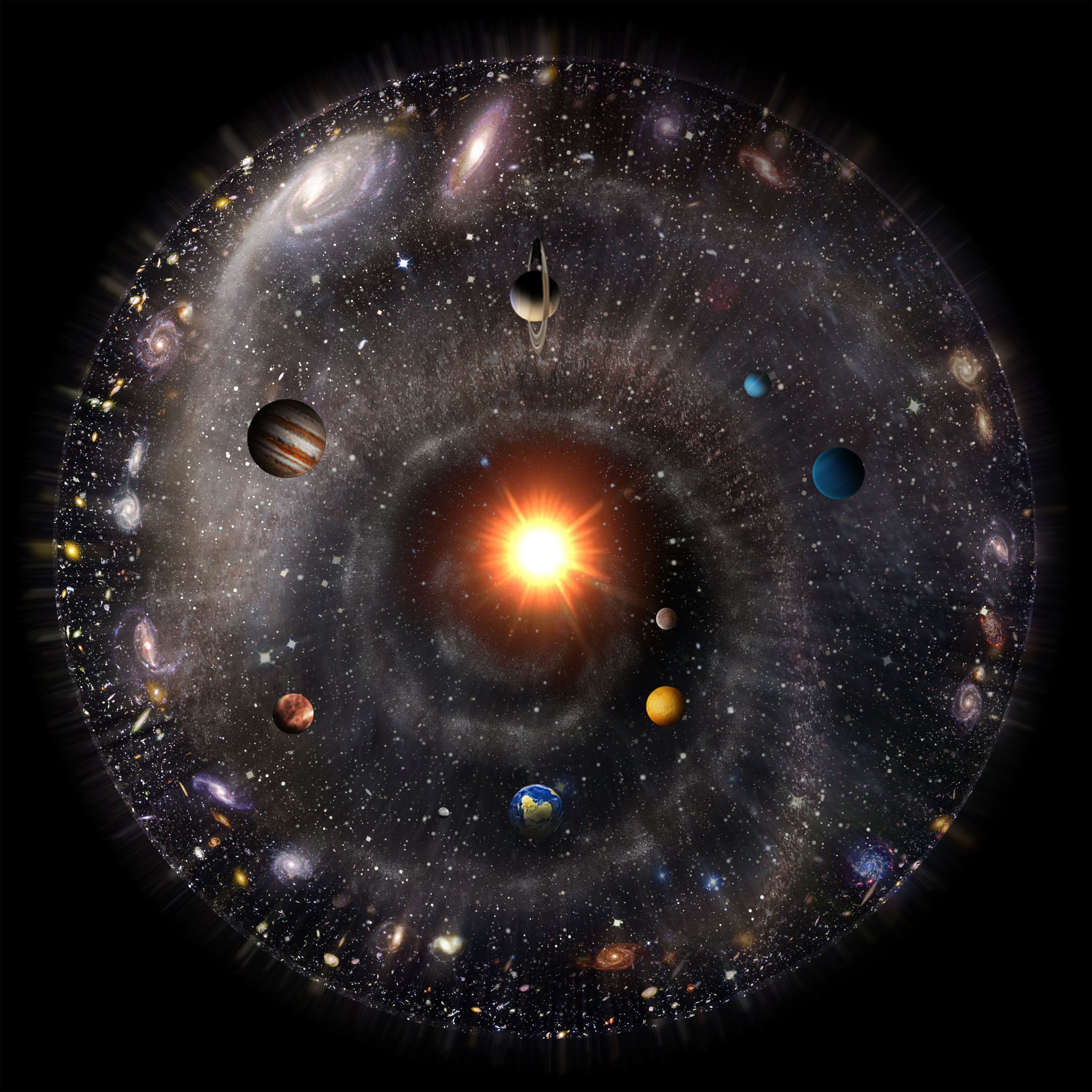
“Then when I was drawing hexaflexagons for my sons birthday souvenirs I started drawing central views of the cosmos and the solar system,” Budassi was quoted from an e-mail. “That day the idea of a logarithmic view came and in the next days I was able to [assemble] it with photoshop using images from NASA and some textures created by my own.”
The logarithmic map data that Budassi used in the placement of the celestial bodies in the image was compiled by Princeton researchers J. Richard Gott and Mario Juric, according to Science Alert. Data published by the group was reported to have been documented by the Sloan Digital Sky Survey, which uses the New Mexican Apache Point Observatory’s wide-angle optical telescope in a study that has continued for over 15 years. Data compiled by the survey team comprises findings on 3 million celestial bodies used to make the most detailed three-dimensional of space ever available.
[Photo Courtesy of Unmismoobjetivo via Wikimedia Commons | Cropped and Resized | CC BY-SA 3.0 ]