

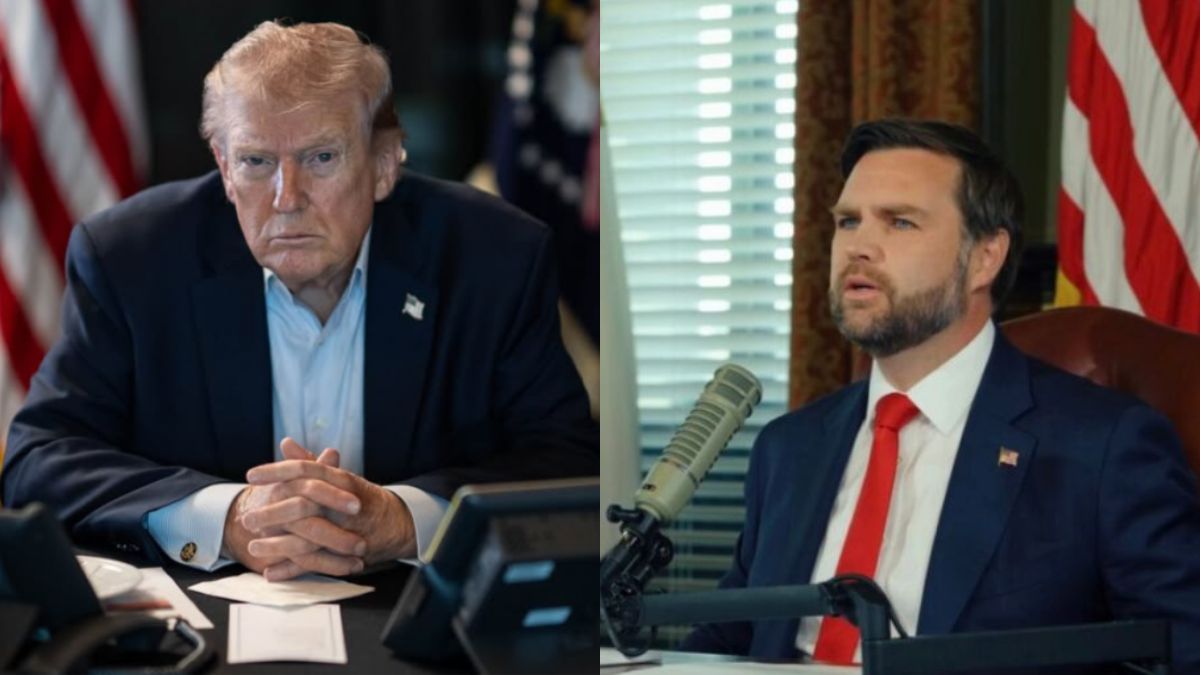
JD Vance is back in the news after the United States and Israel jointly launched military strikes against Iran as part of Operation Epic Fury. The 41-year-old, who has been serving as the 50th vice president of the nation has emerged as a prominent defender of the Trump administration’s expanding pressure campaign against Iran.
A Marine veteran of the Iraq War, Vance previously questioned U.S. military involvement in the Middle East but has since revised his perspective. Vance was the one who reportedly persuaded President Donald Trump to attack Iran.
Israeli Prime Minister Benjamin Netanyahu had allegedly spent months convincing Trump to take action against Iran, arguing that Tehran was at a vulnerable spot and that diplomacy should not prevent a military operation.
Trump and Netanyahu met in the Oval Office on February 11 to discuss the plan, while publicly, Trump did not reveal any information about the attack. The “peace president” at times said he wanted to negotiate a deal with Iran and at other times suggested he wanted to remove its government.
The president, however, did not make a strong public case that war was immediately necessary.
On February 18, after weeks of Israel and the U.S. discussing military ambitions against Iran, a meeting in the Oval Office brought together Trump, Vance, Secretary of State Marco Rubio, Central Intelligence Agency (CIA) Director John Ratcliffe, White House Chief of Staff Susie Wiles and other military leaders to discuss the strategy for Operation Epic Fury.
Options ranged from smaller, calculative strikes intended to influence negotiations to larger operations aimed at overthrowing Iran’s regime. The meeting came after the president tried negotiating with Iran regarding its nuclear ambitions.
View this post on Instagram
Vance stated that if the United States decided to act, it should “go big and go fast.”
At the same time, Joint Chiefs of Staff Chairman General Dan Caine warned Trump that a larger operation could lead to more U.S. casualties, heavy use of weapons, intense media attention and regional instability.
However, Trump became more open to military action after the U.S. carried out Operation Absolute Resolve and captured Venezuelan President Nicolás Maduro and his wife Cilia Flores, from their Caracas residence on January 3, 2026.
View this post on Instagram
On February 28, the United States and Israel launched what officials described as one of their most important attacks on Iran. Netanyahu said Iran’s Supreme Leader Ayatollah Ali Khamenei’s compound had been destroyed in the strikes. Iranian state media later confirmed his death.
Trump addressed the media virtually, saying that Iran must never acquire a nuclear weapon. He cited intelligence indicating that Tehran was attempting to rebuild its nuclear capabilities following earlier U.S. strikes.
The president called Khamenei “one of the most evil people in history” as the world reacted to the shocking news.
“Just imagine how emboldened this regime would be if they ever had and actually were armed with nuclear weapons as a means to deliver their message,” Trump added.
According to Navy Times, after the strike, Vance said during a primetime interview on Fox News that Trump will not allow the U.S. to enter a long war without clear goals.
View this post on Instagram
“There’s just no way that Donald Trump is going to allow this country to get into a multiyear conflict with no clear end in sight and no clear objective,” Vance said. He noted that Trump’s main goal is to prevent Iran from getting a nuclear weapon.
“The president wants to make it clear to the Iranians and to the world that he is not going to rest until he accomplishes that all-important objective of ensuring that Iran can’t have a nuclear weapon,” he added.