



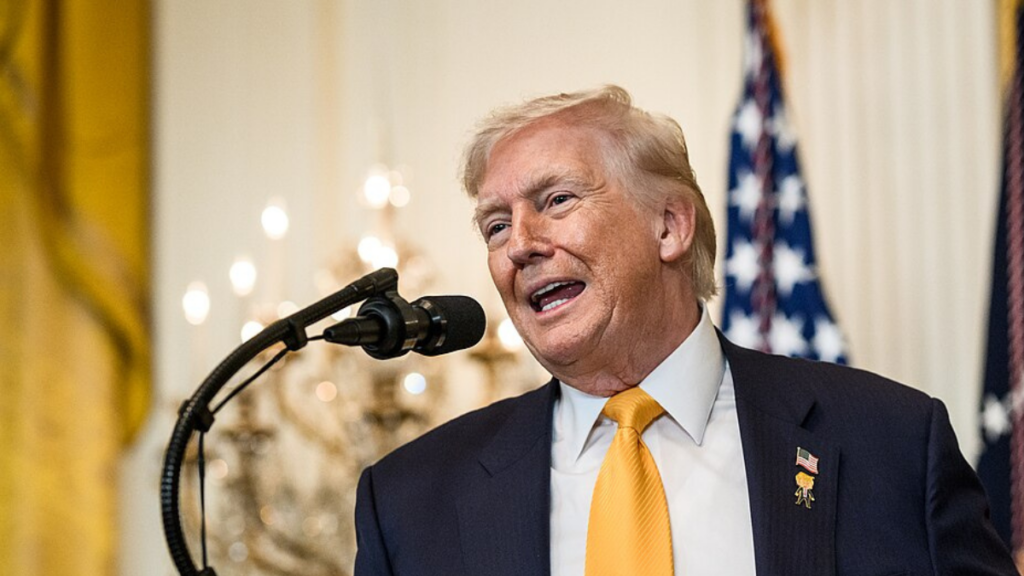
The room went still in that familiar, slightly theatrical way—cameras rolling, reporters leaning forward, the president deciding which reality gets to speak first. Donald Trump stepped to the lectern at the White House and, with the Supreme Court having just punched a hole through his signature tariff strategy, he did what he often does when cornered: he tried to make the messenger the story.
The spark was CNN. When correspondent Kristen Holmes moved to ask a question, Donald Trump cut her off mid-breath. “No, No…I’m not talking to you. I’m talking to — I don’t talk, I don’t talk to CNN. It’s fake news!” he said, before tossing the floor to someone else with a curt “Go ahead.”
A presidency that sells itself as “strong” shouldn’t have to dodge a question like it’s a thrown snowball. But Donald Trump has always understood that refusing an outlet can play, to his base, like refusing an enemy. The problem is that the Supreme Court doesn’t grade on vibes.
🚨HE’S LIVID: Donald Trump loses it when a CNN reporter tries to ask a question.
There is no worse time for narcissist than when they are DEFEATED!
You love to see it. pic.twitter.com/XTvP0mplzr
— CALL TO ACTIVISM (@CalltoActivism) February 20, 2026
On Friday, the Supreme Court ruled 6–3 that Donald Trump’s sweeping worldwide tariffs were illegal and could not stand without congressional approval. Chief Justice John G. Roberts Jr., writing for the court, said Congress holds the power to impose taxes and tariffs—and that the International Emergency Economic Powers Act, the law Donald Trump leaned on, “does not authorize the President to impose tariffs.”
What makes this ruling sting isn’t just its substance; it’s the lineup. Three Democratic-appointed justices joined Roberts, along with two of Donald Trump’s own appointees, Neil M. Gorsuch and Amy Coney Barrett. The dissent came from Brett M. Kavanaugh, Clarence Thomas, and Samuel A. Alito.
The case name alone—Learning Resources vs. Trump—sounds like a dry fight between lawyers. But the court record is stuffed with the kind of real-world consequences that don’t fit neatly into a soundbite, like an educational-toy company warning it would need to raise prices sharply because its products are manufactured in Asia.
🚨DONALD TRUMP MELTS DOWN AT KAITLAN COLLINS
BREAKING: Trump absolutely lost it when CNN reporter Kaitlan Collins asked him an Epstein related question. An innocent person doesn’t act like this:
TRUMP: “You are the worst reporter. No wonder CNN has no ratings because of people… pic.twitter.com/ISgk4slGOp
— CALL TO ACTIVISM (@CalltoActivism) February 3, 2026
In other words: consumers and small businesses were never an abstraction here, even if the tariff talk often is.
That’s the context Donald Trump was walking into when he decided the real crisis was a question from CNN. Mediaite reported the moment came after Holmes had described Donald Trump as becoming “enraged” upon learning of the decision during a White House governors’ breakfast, including a profane outburst—though Fox News correspondent Jacqui Heinrich later posted a conflicting account, and Donald Trump’s communications director Steven Cheung amplified Heinrich’s pushback by calling CNN “fake news.”
The dynamic is almost too on-the-nose: an argument about presidential power ends with the president trying to exercise power over the press pool. It’s not censorship in the literal sense—CNN is still reporting, still broadcasting—but it’s the petty, corrosive kind of control attempt that has become a tell in Donald Trump’s political style.
Kaitlan Collins: What would you say to Epstein survivors?
Donald Trump: “You are so bad. You’re the worst reporter. No wonder CNN has no ratings. She’s a young woman. I don’t think I’ve ever seen you smile. They should be ashamed of you.”
Asked about Epstein survivors.
He… pic.twitter.com/ZMsFQ408qv
— Brian Allen (@allenanalysis) February 3, 2026
And it’s a bad look strategically. When your policy has just been ruled illegal by a bipartisan-ish coalition of justices, picking a fight with a reporter can read less like confidence and more like panic-management for the cameras.
The uncomfortable truth for Donald Trump’s critics is that the tariff machine has brought in real revenue. The Committee for a Responsible Federal Budget reported that monthly customs duties climbed dramatically as Donald Trump’s tariffs took effect, rising from $7 billion in January to $30 billion by September, with total tariff collection hitting $195 billion in fiscal year 2025. CRFB also warned that court rulings could reverse those gains and potentially trigger large refunds if the tariffs are ultimately struck down.
That’s the trap door beneath all the posturing: the money is large, the legal footing is shaky, and the aftershocks—refund fights, price pressures, business uncertainty—don’t care which network asked the question.
Don Lemon calls Trump a “pig” after he said CNN reporter Kaitlan Collins never smiles.
“Donald Trump is a pig…I don’t understand how any woman supports this President.”
Fired from CNN is quite a trick. My question is “did Don ever have a prime”…??? pic.twitter.com/zKEP4LTXkw
— Mooses Felix 🇺🇸 (@MoosesFelix) February 5, 2026
So yes, Donald Trump can call CNN “fake news” and move on. But the ruling isn’t going anywhere, and neither is the core message Roberts delivered in plain English: if a president wants sweeping new taxes, Congress is supposed to do the taxing.


