


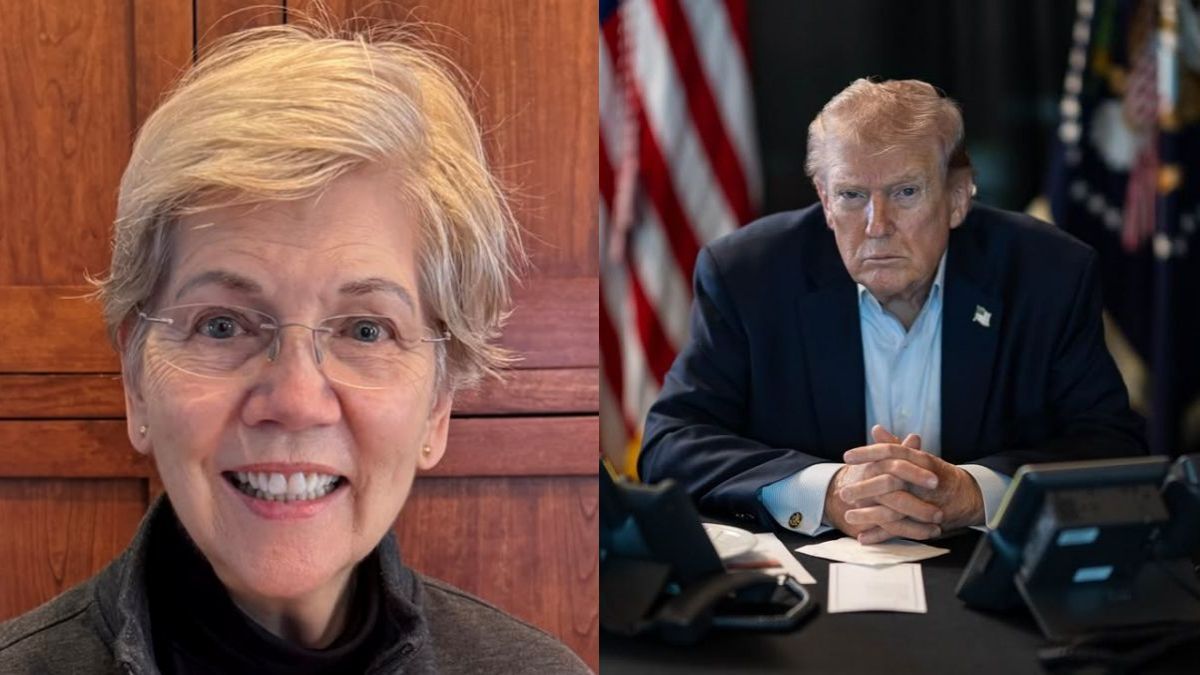
A critical war powers resolution vote is imminent to limit President Donald Trump’s actions in the Middle East, at a time when Sen. Elizabeth Warren has warned about the sudden war. After a classified Iran war briefing, Warren warns that things are “so much worse than you thought.”
The vote will hopefully limit Trump’s actions in the Middle East, unless the president wins the approval of Congress. Warren warned, “You are right to be worried, the Trump administration has no plan in Iran.”
The senator made the claims as she emerged from the second day of classified briefings at the US Capitol over the Trump administration’s oscillating rationale over the war with Iran. She claimed that in the meeting, what she heard is “so much worse than you thought.”
“I just left a classified briefing on Iran, and here’s what I can say: it is so much worse than you thought. You are right to be worried. The Trump administration has no plan in Iran,” she said in a video posted to X (formerly Twitter).
“This illegal war is based on lies and it was launched without any imminent threat to our nation. Donald Trump still hasn’t given a single clear reason for this war and he seems to have no plan for how to end it either,” she added
“Like a lot of you, I am really angry. I am angry at what Donald Trump is doing, and I feel grief for those who already killed in this unnecessary conflict. And I will keep doing everything I can to fight to end this war,” the Massachusetts senator said.
I just left a classified briefing with the Trump Administration about the war in Iran.
I was worried before, but I’m more worried now. pic.twitter.com/HoSWLVWrR8
— Elizabeth Warren (@SenWarren) March 3, 2026
Sen. Warren’s statement came as a time when a critical war powers resolution vote could limit Trump’s actions in the Middle East, unless he gains the approval of Congress for what many members claim is an illegal campaign. Meanwhile, both chambers of Congress had already draft ed resolutions long prior to the US and Israel strike in Iran early on Saturday.
Speaking with reporters at the Capitol in a tense exchange, Secretary of State Marco Rubio tried to discredit his own suggestion made the day before that the president had decided to strike Iran because Israel was ready to act first. However, Rubio stated that it was Trump himself that made the decision to attack, as it offered a unique opportunity for success.
However, the sudden attack has raised questions relating to the risks ahead for a prolonged conflict and regime change, following the killing of Iran’s Supreme Leader Ayatollah Ali Khamenei.
As reported by The Associated Press, at least six US military service members have so far died in the attack. Moreover, the current situation has intensified the push in Congress for a war powers resolution. This is among the most consequential votes a lawmaker can take as the war is already well underway, as administration officials warn lawmakers they will likely required supplemental funds to pay for the conflict. Meanwhile, this comes at the beginning of a highly competitive midterm election season, set to test Trump’s slim GOP control of Congress.
Moreover, during an Armed Services Committee hearing over Rubio’s claim Monday that the president, believing Israel was ready to act, had decided it was better for the US to launch a preemptive strike in order to stop Iran’s potential retaliation on US military bases and interests abroad.
Sen. Brian Schatz of Hawaii said the Iran briefing let him with more questions than answers. “There are times when you go into a classified session and you walk out with a better understanding about the rationale behind the military action,” he said, as reported by the BBC. “This is not one of those times. We remain as confused as the American people are.”
Meanwhile, Sen. Angus King, an independent from Maine, said after the briefing that it is “very disturbing that Trump took the US to war, due to the fact that Israel’s Prime Minister Benjamin Netanyahu wanted to bomb Iran. Moreover, past US presidents “have consistently said, ‘No.’”
Under the Constitution, it is the responsibility of Congress, not the president, to decide when the US goes to war. However, lawmakers reportedly often shirk that duty, thus enabling the executive branch to gain more power to send the US military into combat without congressional approval.
The Trump administration’s decision to join with Israel to launch what appears to be an open-ended joint military operation, aimed at changing the government in Tehran, is testing the Constitution’s separation of powers in dramatic ways. Almost two months prior, Trump had ordered US strikes on Venezuela and arrested its leader, Nicolas Maduro.
Meanwhile, a congressional debate over war powers would be mostly symbolic as, if a resolution was passed by the narrowly split Congress, Trump would likely veto it. In this case, Congress would not have the two-thirds majority required to overturn the rejection.