



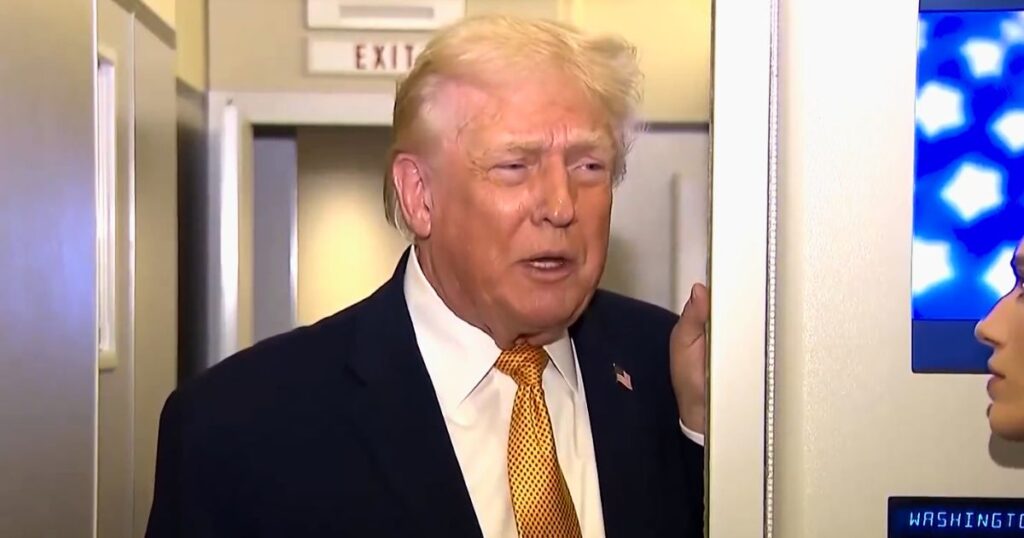
Donald Trump has already moved on to his next target. After threatening Colombia over the U.S. raid that captured Venezuelan President Nicolás Maduro, the president has issued a warning to Iran. The president was cruising back toward Washington and had reporters around him on Air Force One. But within seconds, his conversation jumped from Latin America to the Middle East.
Trump’s foreign policy, once again, appeared unpredictable.
Over the weekend, Trump confirmed that the U.S. operation in Venezuela resulted in Maduro and his wife, Cilia Flores, being flown to New York on narcoterrorism charges. Speaking to reporters on Air Force One, Trump described Colombia as “very sick” and accused its president, Gustavo Petro, of running a state that “likes making cocaine and selling it to the United States.”
He was then asked if a U.S. military operation in Colombia could be next, and replied:
“Sounds good to me.”
But within a few seconds of this, Trump turned to Iran. He warned that if Tehran resumed violence against U.S. interests, he’d respond. If Iran started “killing people [as] they have in the past,” he said, the country would be hit “very hard.” So, in one breath, he was threatening Colombia, and in the next, he aimed at the Middle East.
US President Donald Trump broadened his hardline stance toward Latin America, issuing sharp remarks about Colombia, Cuba and Mexico in the aftermath of the dramatic US operation that captured Venezuelan President Nicolas Maduro https://t.co/IO44fAd1bJ pic.twitter.com/zLrAcChPZH
— Reuters (@Reuters) January 5, 2026
There’s already been a lot of international backlash over the Venezuela operation. The governments of Brazil, Chile, Mexico, Uruguay, Colombia, and Spain have all condemned the U.S. action as a “dangerous precedent” that violated international law. Critics are also saying that abducting a sitting head of state under the banner of law enforcement might be perceived as regime change. What’s worse is that American officials have been openly discussing controlling Venezuela’s oil reserves since then.
RELATED: Marjorie Taylor Greene Questions Maduro’s Capture — “Clear Move for Control Over Venezuelan Oil”
Trump insisted the U.S. remains “in charge” of Venezuela, despite the country’s Supreme Court appointing Vice President Delcy Rodríguez as interim leader. He has also warned that U.S. troops could return if Caracas “doesn’t behave.”
From there, Trump suggested Cuba was “ready to fall,” as the island’s economy collapsed without access to Venezuelan oil. He warned Mexico to “get [its] act together” on drug trafficking. Interestingly, he praised Mexican President Claudia Sheinbaum. What is now way too clear is that when there is any instability in the Western Hemisphere, the U.S. will intervene.
JUST IN:
Trump says Claudia Sheinbaum is a good woman, but the cartels are running Mexico. She’s not running Mexico.
Something’s going to have to be done with Mexico. pic.twitter.com/nwGLbgEQrs
— Current Report (@Currentreport1) January 3, 2026
Analysts have dubbed this the “Trump Corollary” to the Monroe Doctrine, as Chatham House says. This is the belief that the U.S. dominates the Western Hemisphere militarily. The new national security strategy has a single framework.
Still, many are struggling to predict how much of Trump’s rhetoric will translate into action. All we know is that Venezuela is already rocked, Colombia is rebuking Washington, Iran is back in the crosshairs, and U.S. allies are fed up.
NEXT UP: Kamala Harris Slams Trump Over Venezuela Operation — But Old Posts Come Back to Haunt Her


