



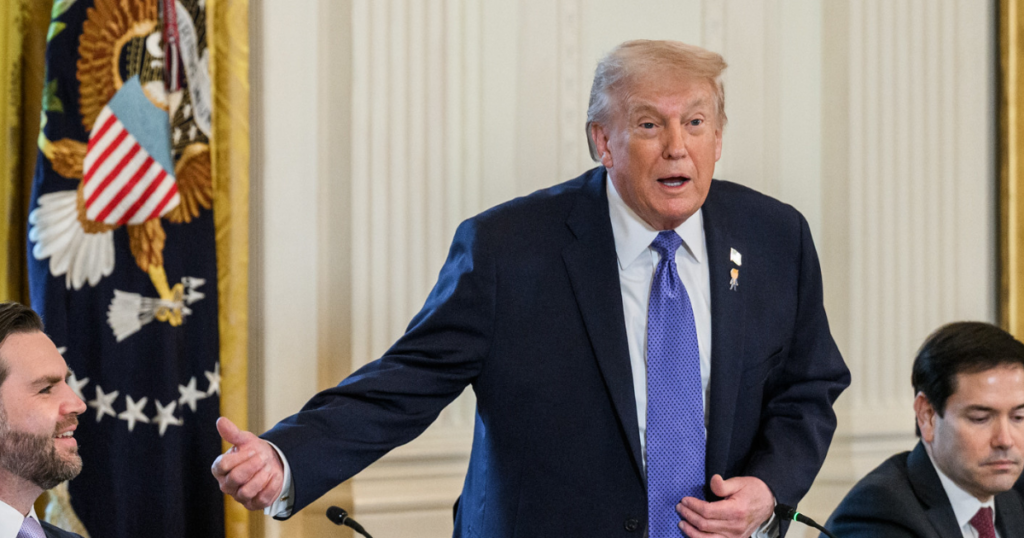
President Donald Trump appeared to forget about the $2,000 checks he vowed to send to most Americans using tariff revenue. The moment was striking not because he disagreed with the premise, but because the POTUS appeared genuinely unsure if he had made the promise at all.
In a two-hour Oval Office interview last week, Trump was asked about a commitment he had repeatedly made. “You’ve promised $2,000 checks to Americans based on your tariff revenues. When can—” Katie White said before Trump interrupted, “I did do that? When did I do that?”
Instead of giving a direct retort, Donald Trump pivoted and mentioned a $1,776 bonus that had been sent to service members before the holidays instead. When asked again about the $2,000 checks, the president acknowledged the commitment but surprisingly shifted the timeline.
Trump is already trying to back out of giving the $2,000 stimulus checks.
“When did I say that?” pic.twitter.com/QIH563WVLl
— The Green Dragon Tavern (@greendragonhq) January 12, 2026
“Well, I am going to. The tariff money is so substantial that’s coming in, that I’ll be able to do 2,000 sometime, I would say, toward the end of the year,” Trump said.
To recall, the POTUS promised to issue the payments to middle- and low-income Americans sometime before the 2026 midterm elections. Interestingly, the math behind the promise of $2,000 checks has always been problematic.
The Committee for a Responsible Federal Budget stated that sending $2,000 checks to most Americans would cost about $600 billion. The tariffs Donald Trump imposed in April have generated about $90 billion as of September 30, 2025, according to U.S. Customs and Border Protection data, leaving a significant gap.
Trump to start handing out struggling Americans $2000 dollars as soon as the government opens.
Man of the people. pic.twitter.com/6tdSsyKRz2
— 0HOUR1 (@0hour1) November 10, 2025
Trump has repeatedly argued that the tariffs will eventually generate far more revenue. He even claimed, in a November post on Truth Social, that tariff revenues would soon “skyrocket” as inventory stockpiles get depleted.
“[Americans have not yet felt] the full benefit of the Tariffs,” Donald Trump wrote at the time.
The Supreme Court is expected to rule on the legality of tariffs themselves this week. If the court overturns them, the government could be forced to refund all related tariff revenue, which potentially makes the check promise impossible to fulfill.
Republican lawmakers have already raised concerns about the proposal. Some of them, including Treasury Secretary Scott Bessent, worry that distributing hundreds of billions of dollars to consumers would trigger inflation. During an interview with Fox News in 2025, Bessent suggested Americans should save the money rather than spend it.
Trump, when confronted by reporters over whether voters could still expect him to deliver on the $2,000 checks he said they would receive from revenues raised by his flagship tariff policy.
“When did I do that?”
There is always a post and an audio https://t.co/roArK1TThp pic.twitter.com/FSRd90Ek54
— Since we’re renaming things – #TrumpEpsteinFiles (@MaggieJordanACN) January 12, 2026
In March 2020, Donald Trump signed off on congressionally approved COVID stimulus checks. Democrats campaigned on promises of more stimulus checks, which then-President Joe Biden sent out in 2021. While most Americans were delighted with the amounts they received, economists blamed those checks for the inflation spike that followed.
As of this writing, Americans patiently waiting for the $2,000 checks based on tariff revenues face uncertainty. Donald Trump has made a promise, but the details are unclear. Worse, the funding does not appear to exist.


