



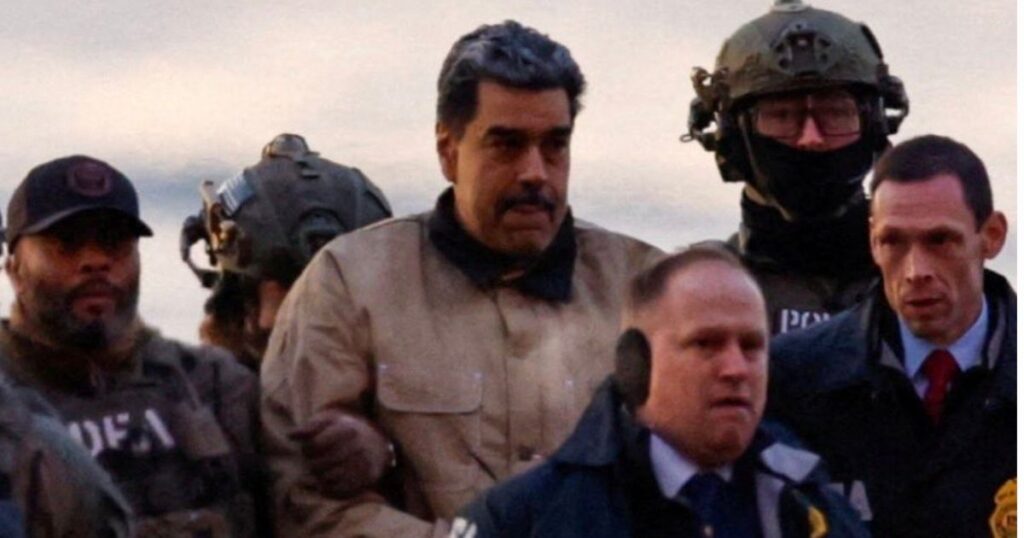
U.S. forces raided Venezuela, captured its sitting president, and flew him to New York overnight. Now, Nicolás Maduro sits in American custody, raising questions about whether the Venezuelan strongman could face the death penalty if convicted.
To answer that, a brief recap is needed. U.S. helicopters touched down at Maduro’s Caracas compound after 2 a.m. on Jan. 3, 2026. The operation was compared to the 2011 raid that killed Osama bin Laden. Later, President Donald Trump called the operation one of the most “stunning, effective and powerful” military actions in history. Soon after, a blindfolded Maduro was flown to New York.
He wore a gray tracksuit as DEA agents escorted him aboard the USS Iwo Jima.
The 63-year-old leader has been indicted in the United States on multiple charges, including narcoterrorism. Prosecutors allege the charges tie him to drug networks that funneled cocaine into the U.S. For years, Washington had offered a $50 million reward for information leading to his arrest. Now, U.S. authorities have carried out the arrest, moving the case from theory to reality.
BREAKING: President Maduro’s first statement in a U.S. court today has been: “I am the President of Venezuela and I consider myself a prisoner of war. I was captured in my home in Caracas.”
The U.S. has no political or legal authority to kidnap a foreign head of state. pic.twitter.com/vcr8H6RSAe
— Manolo De Los Santos (@manolo_realengo) January 5, 2026
So what’s next? Could Nicolás Maduro face the death penalty?
U.S. law allows capital punishment for certain federal crimes. Narcoterrorism charges are linked to large-scale drug trafficking and alleged ties to armed groups, offenses that can carry life sentences or, in rare cases, the death penalty. Maduro’s execution is far from guaranteed, but his case is not a routine extradition either. History offers precedents that suggest the stakes in such prosecutions can be exceptionally high.
RELATED: Is Oil the Cost of War for the U.S.? Why Did Trump Capture Nicolás Maduro?
Nicolás Maduro was captured 36 years after the U.S. arrest of Panama’s dictator Manuel Noriega. Notably, like Maduro, Noriega was once a U.S. ally before being accused of drug trafficking. He was also flown to the United States to stand trial, sentenced to decades in prison, and died in 2017 after a multination legal saga.
Unlike Noriega, however, Maduro presided over a country that prosecutors describe as a hub for narcotics trafficking on an industrial scale. U.S. officials have framed his arrest as a warning to other leaders accused of running “narco-states.” Critics, however, argue that the U.S. strikes preceding Maduro’s capture violated international law and killed several civilians. The United Nations has also questioned whether Washington had the authority to use force against a sitting head of state, regardless of diplomatic recognition.
Maduro in court: “I am innocent. I am the president of Venezuela and I consider myself a prisoner of war. I was captured in my home in Caracas.”
All the homies stand with Nicolas Maduro and Venezuela! pic.twitter.com/wH1nJ6cTRd
— Nick Cruse 🥋 (@SocialistMMA) January 5, 2026
Meanwhile, supporters insist Maduro forfeited any claim to immunity by overseeing crimes against humanity, election fraud, and violent repression. Since 2019, many governments have refused to recognize him as Venezuela’s president.
Back in Caracas, Venezuela’s Supreme Court has sworn in Vice President Delcy Rodríguez as acting president, though Trump says the U.S. will “run” the country until a new leader is chosen. Maduro’s fate now lies in a U.S. courtroom, and execution is not inevitable. Still, the fact that a strongman could face the harshest punishment under American law is historic.
Even if Nicolás Maduro faces the death penalty, how far will the U.S. go?
NEXT UP: Democrats Accused of Hypocrisy After Nicolás Maduro’s Arrest: “They Are a Hot Mess”