



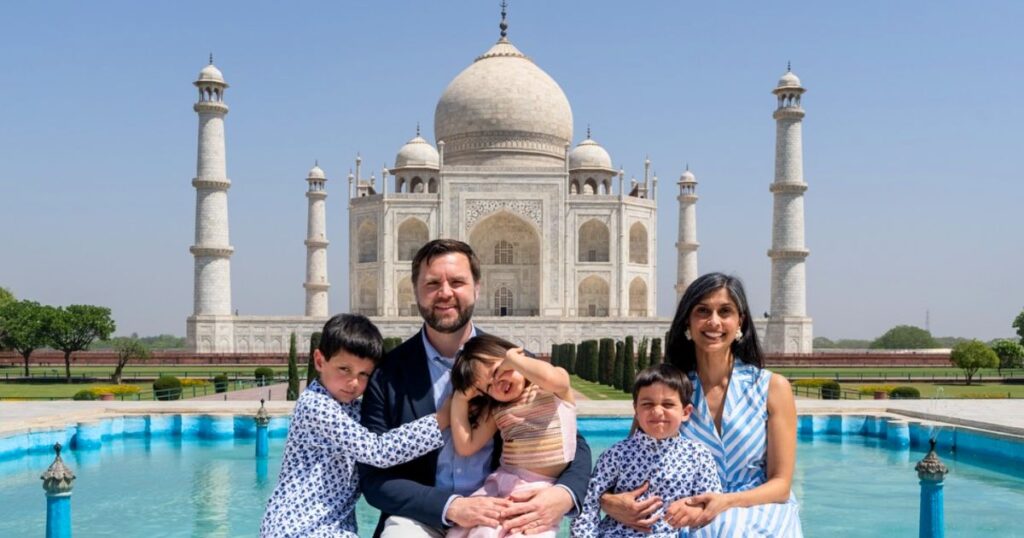
Let’s be real — American politics needed just one more act to feel like a late-night skit. And JD Vance just handed it over with a début about religious identity and his already-speculated marriage that caused an international uproar. The U.S. Vice President recently said on record that he hopes his wife, Usha Vance, eventually converts to Christianity.
Usha, on the other hand, has repeatedly said she’s not converting.
Last month, while speaking at a Turning Point USA event (founded by the late conservative activist Charlie Kirk) at the University of Mississippi, JD Vance opened up about his interfaith marriage. He told the crowd of thousands that he wanted his wife one day to be “moved by the Christian gospel” the way he was. India didn’t love that — and there’s history to back up their reaction.
Let’s get to Usha Vance’s background, as she was raised Hindu in Southern California. Her roots trace back to Andhra Pradesh, India. On Meghan McCain’s podcast, she stated, “I’m not Catholic, and I’m not intending to convert.” She even described how their children attend Catholic school but stay connected to Hinduism through her grandmother’s daily prayer and temple visits.
But that didn’t stop JD Vance from hoping. He later went online after the criticism and called a comment on X (formerly Twitter) “disgusting,” clarifying that while he loves and supports Usha as she is, he’d still like her to one day see faith through his lens. Critics weren’t impressed, especially those who saw his words as religious pressure.
When JD Vance had hit his lowest, it was his “Hindu” wife and her Hindu upbringing that had helped him navigate through the tough times. Today in a position of power, her religion has become a liability. What a fall. What an epic fall for the man. pic.twitter.com/Zvz7bFQ0hZ
— Monica Verma (@TrulyMonica) October 30, 2025
For that very reason, in India, the reaction is emotional. For some, JD Vance hit a historical nerve, as we briefly mentioned before. South Asians have, for hundreds of years, been under Christian colonial rule and have been forced to convert, thereby erasing their culture. Journalist Areena Arora wrote in The Hindu that when a top U.S. leader frames his religion as the ultimate destination for one and all, it “ceases to be personal.”
Religious studies scholar Chad Bauman noted that for several Indians (particularly supporters of Narendra Modi’s BJP, the ruling party in India since 2014), Christianity is seen as a foreign ideology that overwrites local identity. JD Vance just made things worse.
One young Delhi resident told CNN the remark was “ridiculous and absolutely wrong,” adding that “no one should be forced (…) into any religion.” Another Indian commenter online asked why a man married to a woman named Usha Lakshmi, mother to a child named Vivek, and married in a Hindu ceremony, feels compelled to frame her Hindu upbringing as incomplete. Even former Indian foreign secretary Kanwal Sibal questioned whether JD Vance’s stance goes against America’s proclamations about religious freedom.
To many in India and the diaspora, seeing a Hindu woman rise to become the Second Lady of the United States is significant. Usha Vance has been silent so far, though consistent in her stance.
NEXT UP: JD Vance’s Claims About the Economy Contradict Trump’s – And the Internet Mocks Him


