



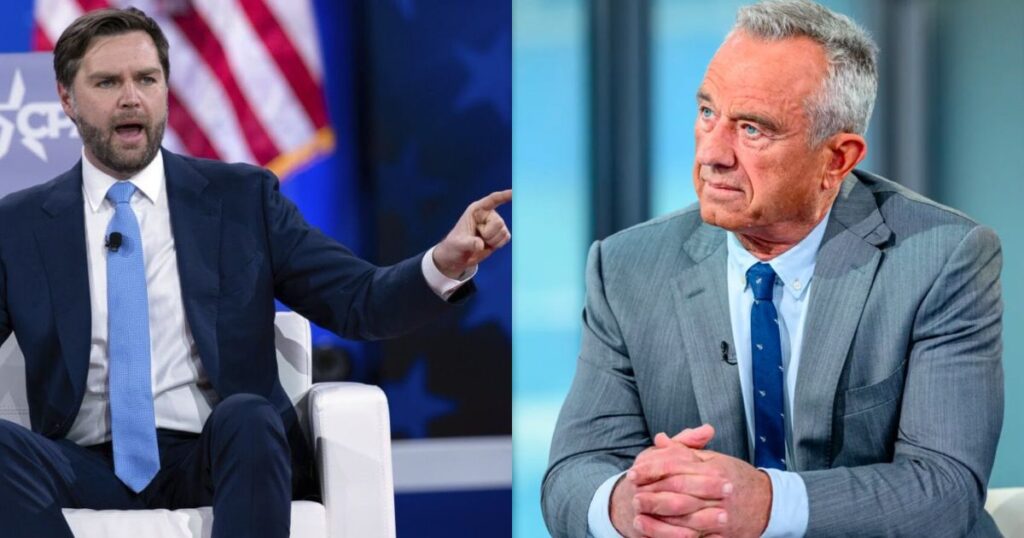
At the “Make America Healthy Again” summit in Washington, D.C., JD Vance publicly praised Robert F. Kennedy Jr. Per ABC News, he was especially impressed with Kennedy’s willingness to challenge the system. “All the experts were wrong,” Vance said. “Of all the specific initiatives that you guys have worked on effectively, the most important thing is that your team is willing to ask questions that people in government haven’t been asking in a long time.”
Kennedy, who earlier worked as an independent public‑health advocate, has been a controversial figure, from vaccine debates to food‑policy reforms. Vance’s showing of support signals a shift, according to AP News.
Great conversation with Vice President Vance at the MAHA Summit. Thank you, @VP, for being a fearless leader and championing the Make America Healthy Again movement. pic.twitter.com/VqJekYxo8S
— Secretary Kennedy (@SecKennedy) November 12, 2025
While they were on stage, Vance told Kennedy, “We’ve got to be comfortable challenging some of these old orthodoxies, and part of that is welcoming people that are a little unusual.”
Some of Kennedy’s network is outside mainstream medical circles, and Vance was letting him know that he was okay with that.
Inside conservative media and political circles, reactions were diverse. Some hailed Vance’s move as brave: acknowledging that health‑policy innovation needs new voices. Others were alarmed: Kennedy’s history of vaccine skepticism and heavy criticism of federal health agencies makes many experts nervous.
Vance’s wording is key. He did not actually endorse Kennedy politically. He simply admired the way he challenged things around him
Kennedy’s MAHA movement, which he helped lead, is seen by many as trying to reshape food, health, and regulatory policy. Vance described it as “a critical part of our success in Washington.”
JD VANCE: “The MAHA crowd … is asking the right questions. What are we putting into our bodies? … If we’re putting medications into our body, are we actually confident … that they’re safe and effective?” pic.twitter.com/pSI7LZV5aP
— Chief Nerd (@TheChiefNerd) November 12, 2025
Vance was clever in the way he approached a topic which was sensitive to his constituency. Republicans may not know where they stand as far as health policies go. Do they stay strictly within the tried-and-tested scientific norms and established institutions? Or, alternatively, do they embrace voices outside the norm?
It may signal how the party approaches health legislation going into the 2026 cycle. If Vance keeps backing nontraditional voices, the GOP message could broaden or fragment.
Across social‑media platforms, the moment became a talking point. One conservative influencer wrote: “Finally someone saying what we feel. The experts got it wrong too often.” Others replied: “This is exactly how we lose message discipline in the primaries.”
That split mirrors what’s happening in the halls of Congress.
J.D. Vance, at MAHA summit, urges people to ‘challenge orthodoxy’ about living healthilyhttps://t.co/mflF9fDYTu pic.twitter.com/HaW8C2TCbu
— The Washington Times (@WashTimes) November 13, 2025
For everyday Americans watching, the takeaway is simple. Healthcare isn’t just about doctors and hospitals anymore. The conversation is shifting into food systems, bias in regulation, innovation in tech and who gets to shape the rules. When someone like Kennedy, once outside the mainstream, gets public backing from a major GOP figure like Vance, it means this shift is real.
The coming months will show whether this remains a moment of applause or will it become a turning point. Will Vance pull back and re‑align with conventional health policy? Or will he keep leaning into the outsider voices and hope the GOP follows?
Either way, healthcare is no longer a safe back‑row topic in politics. It’s now central to the identity of major players and might shape what the party stands for — not just in 2026, but beyond.


