



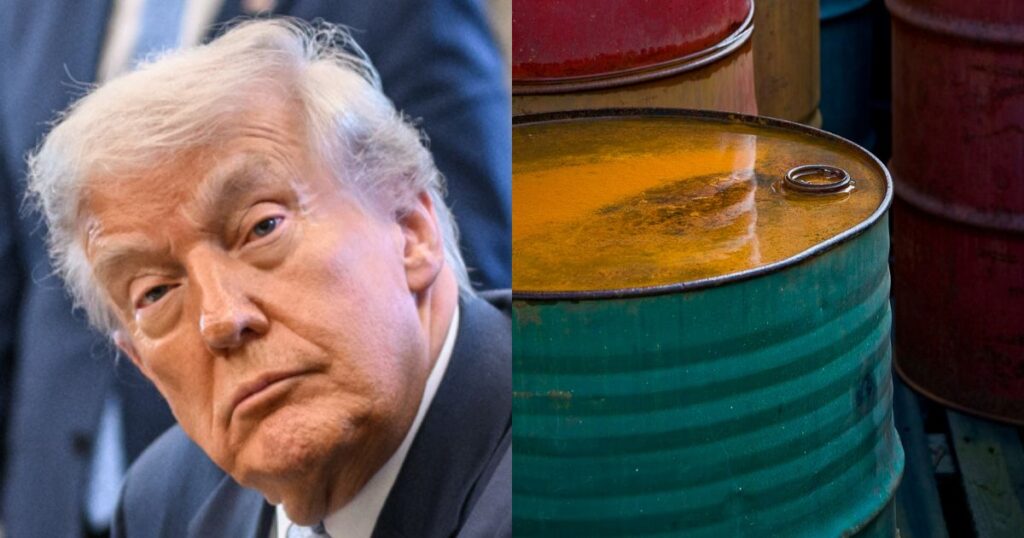
President Donald Trump’s effort to quickly revive Venezuela’s oil sector faced a reality check from industry leaders after Exxon Mobil CEO Darren Woods told him that the country’s current oil structure is “uninvestable.”
Woods shared this view during a White House meeting with senior executives from U.S. energy companies. Trump used the opportunity to argue that American firms were willing to invest at least $100 billion to rebuild Venezuela’s declining oil industry following the capture of Venezuelan leader Nicolás Maduro earlier this month.
“If we look at the legal and commercial structures in place today in Venezuela, it’s uninvestable,” Woods said, according to a statement from Exxon Mobil. He mentioned that any large investment would depend on solid investor protections and changes to Venezuela’s hydrocarbon laws.
Trump informed the attendees that oil companies would finance the effort using private capital, not U.S. government funds. He claimed that restoring production could benefit U.S. consumers and companies.
Executives and analysts pointed to ongoing legal disputes, past expropriations, and poor infrastructure as major obstacles to large investments. Both Exxon and ConocoPhillips had their assets seized in Venezuela, and the country’s oil facilities have faced years of underinvestment, according to the meeting report.
Chevron, the only major U.S. oil company still operating in Venezuela, discussed a slower approach. Chevron vice chairman Mark Nelson told the attendees that the company sees a path to increase output by about 50% within two years from roughly 240,000 barrels per day through its partnerships with Venezuela’s state oil company, Petróleos de Venezuela SA, as reported by Reuters.
The chief executive of oil company ExxonMobil says Venezuela is currently “uninvestable” as he calls for “significant changes” to the country’s legal system at a White House meeting with Donald Trump and other oil executives.
📺 Sky 501 pic.twitter.com/HPJEQx0ajL
— Sky News (@SkyNews) January 9, 2026
Other executives showed different levels of interest that was music to Trump’s ears. Harold Hamm, an oil producer and Trump ally, acknowledged Venezuela’s “challenges” but stated that the industry knows how to manage them, according to the Associated Press. Jeffery Hildebrand, CEO of Hilcorp Energy, said his firm was “fully committed and ready to go” to help rebuild the infrastructure, as reported by Newsweek.
Energy Secretary Chris Wright later explained that Trump’s $100 billion figure was an estimate of how much reconstruction of Venezuela’s oil sector would need, rather than a guaranteed spending commitment from companies, according to Newsweek.
Analysts noted that the quickest improvements might come from smaller projects focused on restoring existing production before pursuing more costly developments. Thomas O’Donnell, an energy industry analyst, mentioned that companies could start with limited work to boost output while evaluating larger investments, including projects around Lake Maracaibo and, in the long term, Venezuela’s extra-heavy oil belt in the Orinoco region.
The Trump administration contended that a significant increase in Venezuelan production would further its energy and economic agenda. However, the executives’ remarks at the White House meeting suggested that major investment choices would hinge on legal reforms, contract terms, and security conditions in Venezuela.
It is yet to be seen how stable the situation in Venezuela remains as the president did not promise the oil executives security from the U.S. Rather, Trump suggested that local forces will offer protection. Regardless of the situation, before American oil companies start extracting oil, it will take many years to say the least, and a lot can change in that time.