

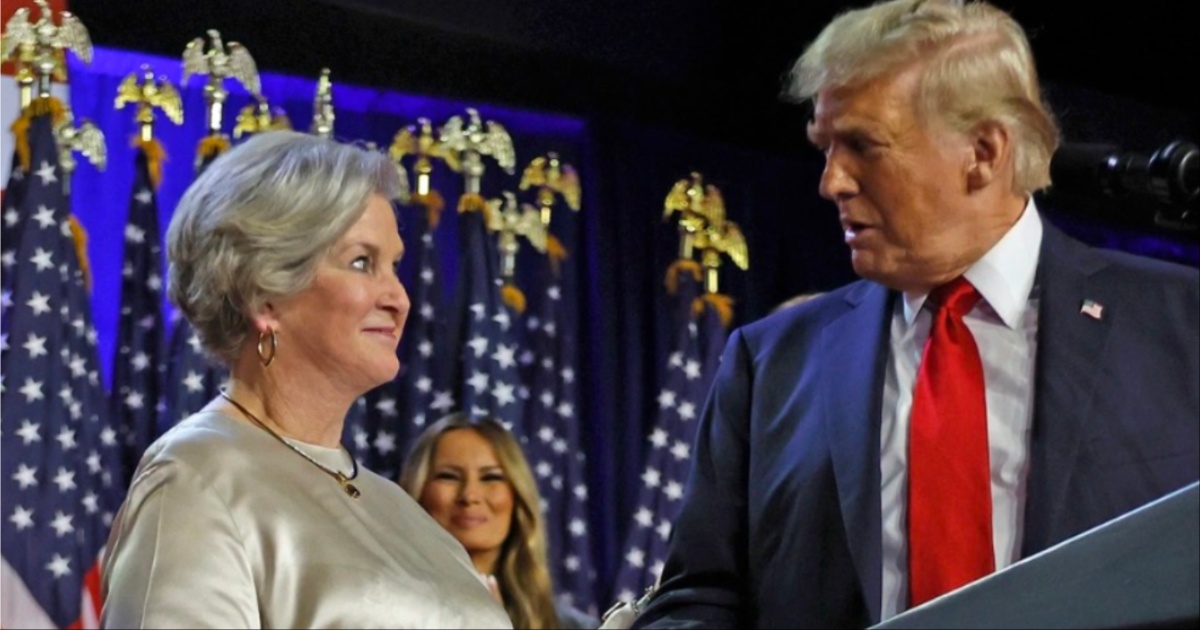
Susie Wiles, Trump’s chief of staff and one of the few aides to survive multiple election cycles with his trust intact, offered unusually candid and at times jarring assessments of President Donald Trump.
She opened up about his governing style and his second-term priorities in a series of interviews published this week by Vanity Fair. The remarks were drawn from more than ten conversations over the past year with author Chris Whipple.
The line drawing the most attention is also the most personal. Wiles said Trump “has an alcoholic’s personality,” despite the president’s long-publicized status as a teetotaler. Her comment was not about drinking, she suggested, but about temperament and impulse. Trump, she said, governs with a belief that there are no real limits on his power. “He has a view that there’s nothing he can’t do. Nothing, zero, nothing,” Wiles said.
She described the observation based on her own background, growing up with an alcoholic father, the late sportscasting legend Pat Summerall. “High-functioning alcoholics or alcoholics in general, their personalities are exaggerated when they drink,” she said. “And so I’m a little bit of an expert in big personalities.”
The interviews also touched on the belief that Trump is seeking retribution with many of his legal battles against his perceived enemies. Wiles acknowledged that many of the president’s second-term actions have been motivated partly by retribution.
Asked whether prosecutions of Trump’s political opponents could be seen as vindictive, Wiles did not dismiss the idea. “I mean, people could think it does look vindictive,” she said. “I can’t tell you why you shouldn’t think that.” When it came to the mortgage fraud accusations against New York Attorney General Letitia James, she replied, “Well, that might be the one retribution.”
She added that Trump does not necessarily wake up each day plotting payback, but when the chance presents itself, he rarely hesitates. “I don’t think he wakes up thinking about retribution,” she said, continuing: “But when there’s an opportunity, he will go for it.”
Wiles also opened up about Trump’s foreign policy and seemingly contradicted the official narrative. She suggested Trump was effectively pursuing regime change in Venezuela through a controversial campaign targeting boats near Venezuelan waters.
She also described moments when Trump brushed aside her advice, including on deportations and pardons, reinforcing the image of a chief of staff who manages the president’s impulses rather than trying to restrain them.
Unlike several of the men who cycled through the role during Trump’s first term, she is widely seen inside the White House as a careful operator with few internal enemies. Trump himself frequently refers to her as the “most powerful woman in the world,” praising her ability to influence events with a single phone call.
Her historically low public profile made the interviews all the more striking because until now, Wiles had largely avoided the media, making her conversations with Whipple, whose book, The Gatekeepers, is considered a definitive account of the chief of staff role, especially notable.
Wiles responded to the backlash from the interview, writing on X, that the interview was a “disingenuously framed hit piece,” claiming that key context was omitted to paint a distorted picture of chaos inside the administration.
The White House quickly rallied behind her with Press Secretary Karoline Leavitt saying Trump “has no greater or more loyal advisor than Susie,” adding that the administration is united behind her leadership.
Regardless of walking back her comments, it paints a picture most would imagine with Trump’s eccentricities, chaotic speeches, and midnight ramblings on Truth Social.