



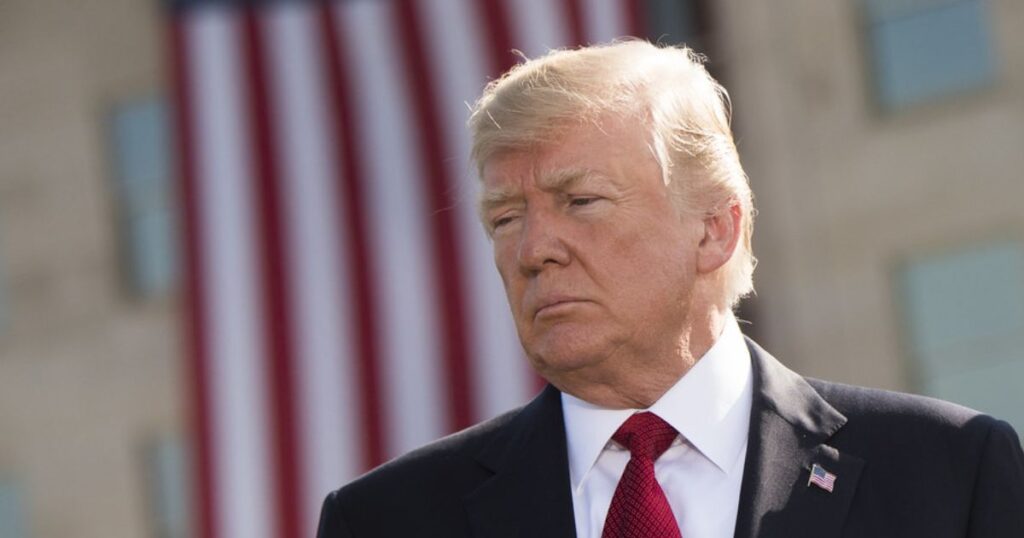
President Donald Trump’s approval rating is declining in a district that should be secure for him. This change is happening just days before voters go to the polls.
A new Emerson College survey of Tennessee’s 7th Congressional District, where a closely watched special election will be held next week, shows Trump’s approval rating underwater, dragged down by independents who say they have had enough of his stewardship of the economy and the cost of living.
Overall, 49 percent of likely voters in the district say they disapprove of the job Trump is doing as president, compared to 47 percent who approve. That slim negative margin would be worrying anywhere, but it is especially striking in a solidly Republican district that Trump carried easily in his previous campaigns and where the GOP still dominates voter registration.
The erosion is clearest among independents as the poll shows 59 percent of independents in the district disapprove of Trump’s job performance, while just 34 percent approve. That is the kind of gap that can flip a race or at least make it far more competitive than Republicans would like.
However, among his base of Republicans in the 7th, his approval stands at a towering 88 percent, with just 8 percent disapproving. On the other side, fewer than 4 percent of Democrats give him positive marks, while 95 percent disapprove, a reminder of how polarized the electorate has become.
Trump underwater in a district he won by 22 points a year ago.
If that’s true Republicans have huge problems and their current trajectory is insanely out of touch with their own voters.
And if TN-7 is competitive, their ability to hold the House *this year* becomes a real issue https://t.co/fYf59O6Ssf
— Aaron Fritschner (@Fritschner) November 26, 2025
All of this is playing out as voters get ready to choose a new member of Congress. The Emerson poll shows Republican candidate Van Epps leading Democrat Behn by a razor thin margin, 49 percent to 47 percent, well within the survey’s margin of error of plus or minus 3.9 percentage points. The two are vying to replace former Representative Mark Green, who left Congress earlier this year for a private sector job.
The issues that are driving voters’ moods are not exactly a mystery. A plurality of respondents, 38 percent, named the economy as the most important issue facing Tennessee. Another 15 percent pointed to housing affordability, while 13 percent cited threats to democracy and health care as their top concerns. Put together, those numbers hint at an electorate that feels squeezed and uneasy, even in a district that has reliably backed Republicans for years.
Trump enjoyed a solid approval rating when he returned to the White House in January, buoyed by Republicans who wanted a course correction and independents willing to give him another chance. Since then, his numbers have steadily drifted downward as prices remain high, mortgage rates bite into household budgets, and voters struggle to square his upbeat talk about “falling” prices with what they see on their receipts.
The slide is not limited to Tennessee as a separate national poll conducted by YouGov and The Economist last week found that just 38 percent of Americans approve of Trump’s overall job performance, while 57 percent disapprove. That survey, which reached 1,677 adults between November 21 and 24, also showed lingering frustration over inflation and the broader direction of the country.
Still, the warning coming from Tennessee’s 7th District is particularly stark. If Trump is underwater in a deep red seat where Republicans should be cruising, it signals that his struggles with independents are not confined to blue states or swing suburbs. They are showing up in places his party has long taken for granted.
Next week’s special election will decide who fills Mark Green’s old seat. It may also offer an early test of how much damage Trump’s shrinking appeal beyond his base can do to Republicans down the ballot in 2026 and beyond.


