

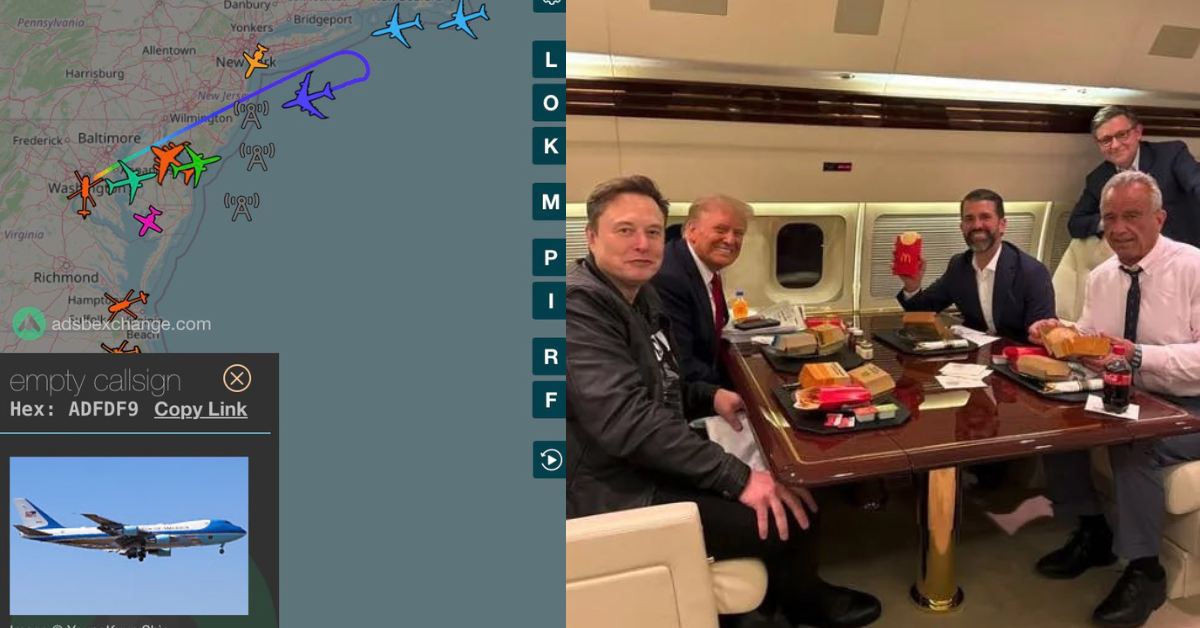
President Donald Trump was forced into an abrupt U-turn aboard Air Force One after a technical issue triggered an emergency diversion while the presidential aircraft was en route to the World Economic Forum in Davos, Switzerland, according to officials familiar with the incident.
The high-altitude drama unfolded mid-flight as the Air Force One was crossing international airspace, prompting the flight crew to follow strict safety protocols and reroute the plane to a secure location. White House officials stressed the move was precautionary, but the decision underscored the seriousness with which even minor irregularities are handled when Trump, the commander-in-chief is in the air.
🚨 SOMETHING FEELS VERY OFF ABOUT THIS
This is the first footage of Air Force One being forced to make what’s being called a “minor emergency landing” of President Trump’s plane due to an “electrical issue.”
The energy is strange. US Doesn’t like it!#Iran #NATO Davos pic.twitter.com/30QhebC5Fq— Aarnav Sharma✨️ (@sunilaarnav) January 21, 2026
Sources said the issue involved a mechanical or systems alert that required immediate attention, leaving no room for risk. The Air Force One pilots made the call to divert, bringing the aircraft safely down without incident. Trump was never in danger, officials emphasized, and the landing was carried out smoothly.
President Trump had been scheduled to attend high-level meetings in Davos, where global leaders, business executives, and policymakers were gathering amid heightened geopolitical and economic tensions. Trump’s appearance was expected to draw intense attention, particularly given his recent moves on trade, NATO funding, and global security.
President Trump boards Air Force One for Davos, where he’ll meet with world leaders and deliver remarks at the World Economic Forum
“We’re going to Davos. This will be an interesting trip. I have no idea what’s gonna happen, but you are well represented.”
The Globalist agenda… pic.twitter.com/vQONDRtXtP
— AJ Huber (@Huberton) January 21, 2026
After landing, Trump remained calm and in control, according to aides. He was quickly transferred to secure accommodations as the aircraft underwent inspection by Air Force One technicians. Another presidential aircraft was prepared to resume travel if needed, reflecting the redundancy built into presidential transport.
“This is exactly how the system is supposed to work,” a senior Trump administration official said. “When the president is flying, there is zero tolerance for uncertainty. The crew did precisely what they’re trained to do.”
Air Force One, while one of the most advanced aircraft in the world, is subject to the same aviation realities as any plane — though its safety protocols are far more rigorous. Any anomaly, no matter how small, can trigger a diversion when the president is onboard.
The incident briefly disrupted Trump’s international schedule, but aides said he remained engaged with advisors throughout, continuing to monitor developments at home and abroad. Officials said the president was kept fully informed as decisions were made.
🚨 BREAKING: Air Force One, which President Trump recently boarded to head to the World Economic Forum in Davos, Switzerland, has suddenly TURNED AROUND and seems to be headed back to DC
It’s unclear why AF1 pulled a U-turn
Pray for President Trump’s safety tonight 🙏🏻 pic.twitter.com/ILBGGYFtRe
— Nick Sortor (@nicksortor) January 21, 2026
Trump later addressed the situation casually, brushing off concerns and praising the professionalism of the flight crew and security teams. Those close to him said he viewed the diversion as a routine safety matter rather than a major incident.
The episode highlighted the immense logistical complexity behind presidential travel, especially when crossing continents. Every movement of Air Force One involves coordination between the U.S. Air Force, Secret Service, foreign governments, and intelligence agencies.
While critics attempted to spin the diversion as dramatic, Trump administration officials were quick to push back, noting that such precautions are standard and rare precisely because they work. “The reason you almost never hear about serious incidents is because safety decisions are made early,” one official said.
Trump’s planned appearance at Davos is expected to focus on American economic strength, national sovereignty, and global security — themes that have defined his presidency.
By the end of the day, Air Force One was cleared after inspection, and Trump officials said there was no lasting impact on presidential operations. The emergency landing, they stressed, was a reminder not of vulnerability, but of the layers of protection surrounding the presidency.