

President Donald Trump has ordered a dramatic overhaul of the White House’s secret underground bunker, tearing out the aging facility beneath the East Wing and replacing it with a modernized, high-tech emergency command center designed to meet today’s security threats.
The original bunker, officially known as the Presidential Emergency Operations Center, was demolished as part of Trump’s broader redevelopment plan that includes his long-discussed $300 million “Big Beautiful Ballroom” and a complete reimagining of the underground complex. While Democratic critics have attacked the ballroom project, the Trump White House has acknowledged that until construction is complete, large state dinners must continue to be held inside a temporary event tent because no indoor space within the White House can accommodate such gatherings. Trump has already added a permanent concrete patio beneath the tent area in the Rose Garden, ending decades of soggy ground that visitors, dignitaries, and reporters previously had to trudge through during major events.
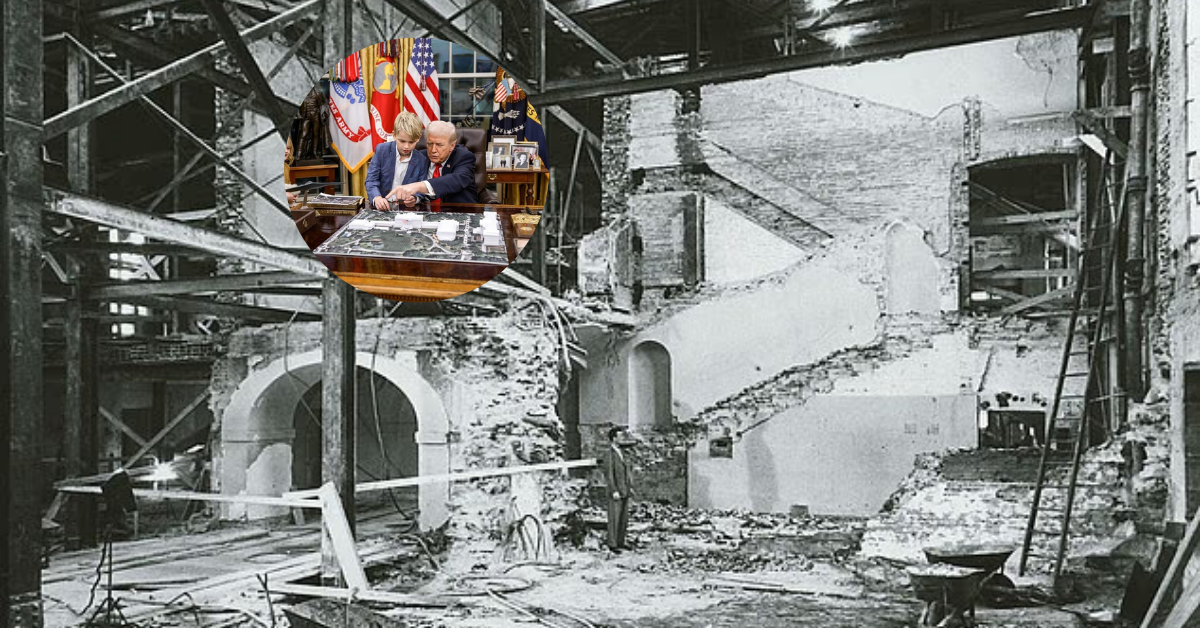
The gutted interior of the White House May 1950 …
By 1948, the White House was literally falling apart. Floors sagged. Plaster cracked. A leg of Margaret Trumans piano once punched straight through the floor of the Second Floor sitting room. Decades of ad hoc additions… pic.twitter.com/XwzU0BTmfT
— Archaeo – Histories (@archeohistories) January 12, 2026
The PEOC traces its origins to World War II, when it was built under President Franklin D. Roosevelt amid fears Washington could be targeted by enemy bombers. The facility was later significantly expanded under Roosevelt’s successor, President Harry Truman, during a massive postwar renovation that involved the complete demolition and rebuilding of much of the White House complex. Despite its critical mission, the bunker was rarely, if ever, used by subsequent administrations for decades – until Trump.
That changed on September 11, 2001. As hijacked planes struck New York and the Pentagon, senior officials in President George W. Bush’s administration were rushed into the PEOC amid fears another aircraft was headed for the White House. Former First Lady Laura Bush later described the experience in vivid detail in her 2010 memoir, Spoken from the Heart.
“I was hustled inside and downstairs through a pair of big steel doors that closed behind me with a loud hiss, forming an airtight seal,” Bush wrote. “I was now in one of the unfinished subterranean hallways underneath the White House, heading for the PEOC, the Presidential Emergency Operations Center, built for President Franklin Roosevelt during World War II.”
She recalled the bunker’s stark, utilitarian design. “We walked along old tile floors with pipes hanging from the ceiling and all kinds of mechanical equipment,” Bush wrote. She explained that “the PEOC is designed to be a command center during emergencies, with televisions, phones, and communications facilities.”
🚨🇺🇸 WHITE HOUSE QUIETLY REBUILDS SECRET UNDERGROUND BUNKER BENEATH EAST WING
So while everyone’s arguing about Trump’s giant White House ballroom, the actual action is happening underground.
They quietly tore out the old Cold War bunker under the East Wing and are rebuilding… pic.twitter.com/2DA5YjpSHM
— Mario Nawfal (@MarioNawfal) January 20, 2026
In the aftermath of the attacks, Bush administration officials concluded that the PEOC, as it was configured at the time, was not sufficient to allow the president and senior aides to function efficiently during a major national emergency. Internal assessments found the space too limited and its technology too outdated to support sustained crisis management, prompting incremental upgrades but stopping short of a full teardown.
Secret White House Bunker 🇺🇸https://t.co/KxeGJirHw2 pic.twitter.com/CNvyFipnN6
— MagnetizedPlasma (@MagnetReconnect) January 19, 2026
Much of that aging infrastructure remained in place for years, a major reason officials say Trump ordered a complete demolition and rebuild rather than another piecemeal renovation. The new underground complex is expected to feature reinforced structural elements, upgraded ventilation and electrical systems, and next-generation secure communications capable of supporting the president, military leaders, and intelligence officials during any national emergency.
White House Director of Management and Administration Joshua Fisher addressed the project at a recent meeting of the National Capital Planning Commission, explaining that the highly classified nature of the bunker rebuild required bypassing the commission’s standard approval process. “There are some things regarding this project that are, frankly, of top-secret nature that we are currently working on,” Fisher said. “That does not preclude us from changing the above-grade structure, but that work needed to be considered when doing this project, which was not part of the NCPC process.”
Fisher said the new Trump bunker will “make necessary security enhancements” and deliver “resilient, adaptive infrastructure aligned with future mission needs,” replacing systems originally built in the 1940s.
Despite the scale of the construction, White House operations have continued uninterrupted. Trump officials say the work is being carefully phased to maintain constant readiness and security.
Historians note that the PEOC has always symbolized continuity of government — a last line of defense meant to preserve leadership during the gravest moments in American history. By demolishing the old structure and replacing it entirely, Trump is signaling that Cold War-era defenses are no longer sufficient.
As global tensions persist and threats grow more complex, the president’s bunker overhaul underscores a central message of his administration: when it comes to protecting the presidency and the nation, modernization and strength come first.