


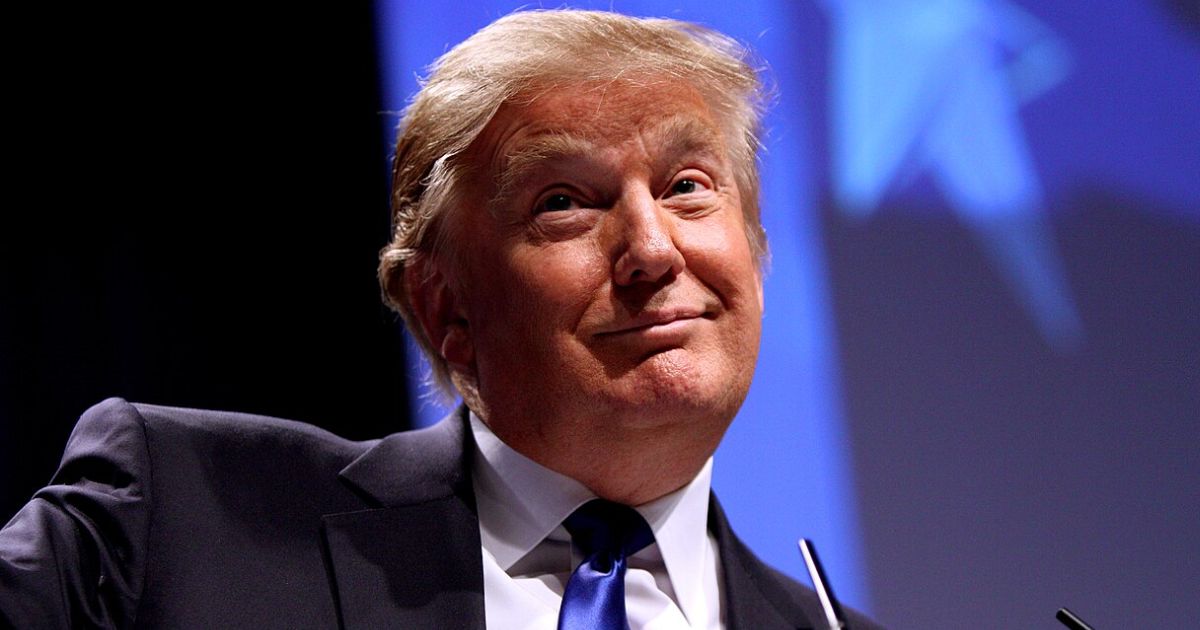
President Donald Trump said Tuesday that the United States does not need the USMCA trade agreement with Canada and Mexico, dismissing the pact as “irrelevant” during a visit to a Ford Motor factory in Michigan.
“There’s no real advantage to it, it’s irrelevant,” Trump said, per Reuters, adding that Canada wants the deal more than the United States does. “Canada would love it. Canada wants it. They need it.”
Trump made the comments while touring Ford’s Dearborn production center ahead of a scheduled speech in Detroit, where he spoke broadly about the economy and praised the US auto industry.
The USMCA — the United States-Mexico-Canada Agreement — governs most trade among North America’s three largest economies. It replaced NAFTA in 2020 after being renegotiated during Trump’s first term. Trump said the US should not rely on cars built outside its borders. “We don’t need cars made in Canada. We don’t need cars made in Mexico. We want to take them here. And that’s what’s happening,” he said.
🚨TRUMP ON USMCA
Reporter: “You don’t think you’re going to renegotiate USMCA?”
Trump: “I can, It expires very shortly and we could have it or not. It will not matter. I think they want it. I don’t really care about it. We don’t need Canadian products”pic.twitter.com/FuWRMlL9Cq
— Gunther Eagleman™ (@GuntherEagleman) January 13, 2026
Trump’s comments may be a prelude to what’s coming. The USMCA is up for a mandatory six-year joint review this year, a provision written into the agreement itself. At that review, the three countries must decide whether to extend the deal, renegotiate parts of it, or allow it to expire.
Without agreement from all three parties, the pact does not automatically continue.
The USMCA sets rules on tariffs, auto manufacturing requirements, labor standards, agriculture, and dispute resolution. For automakers in particular, it requires a higher percentage of vehicle content to be made in North America to qualify for tariff-free trade, a change designed to push production away from overseas suppliers.
President Donald Trump just said he feels like he does not need the USMCA and might let it sunset. #Trade #USMCA pic.twitter.com/OLWB1iws25
— Edward Lawrence (@EdwardLawrence) January 13, 2026
Canada and Mexico rely heavily on access to the US market. The US is by far the largest trading partner for both countries, while Canada and Mexico rank among the top destinations for American exports.
Trump’s remarks signal that he may be willing to walk away from the deal rather than extend it in its current form, reinforcing his long-standing view that the US should use trade pressure to force companies to manufacture domestically.
So far, there is no indication the agreement has been formally reopened, and US officials have not announced a negotiating position. Trump did not provide new details on how a review process would unfold or what would replace the USMCA if it expired.
The comments come amid broader legal and political debate over tariffs. A recent Supreme Court ruling limited how federal agencies can interpret statutes without explicit congressional authorization, but trade lawyers say it does not directly block presidential tariff powers under existing trade laws.
Market sentiment shifts on Trump’s USMCA comments.
Flow favors small-cap action. $TM +2.837% and $ $AMD +6.457% lead, with $CSCO +1.149%.Technical setup indicates selective momentum in the sector.
Positioning data warrants close watch. pic.twitter.com/c4dColdlOT— Carter Vance 🌟 (@open683353) January 13, 2026
In other words, the court decision does not automatically prevent a president from imposing tariffs or withdrawing from a trade agreement like the USMCA, though it could shape how future trade rules are challenged in court.
BBC reports that Trump also briefly mentioned Iran and the selection of the next Federal Reserve chair during his Michigan visit, but offered no new information on either topic.
For now, the trade pact remains in force. But with the review deadline approaching and Trump openly questioning its value, uncertainty around North America’s economic framework is back on the table, especially for industries built around cross-border supply chains.