



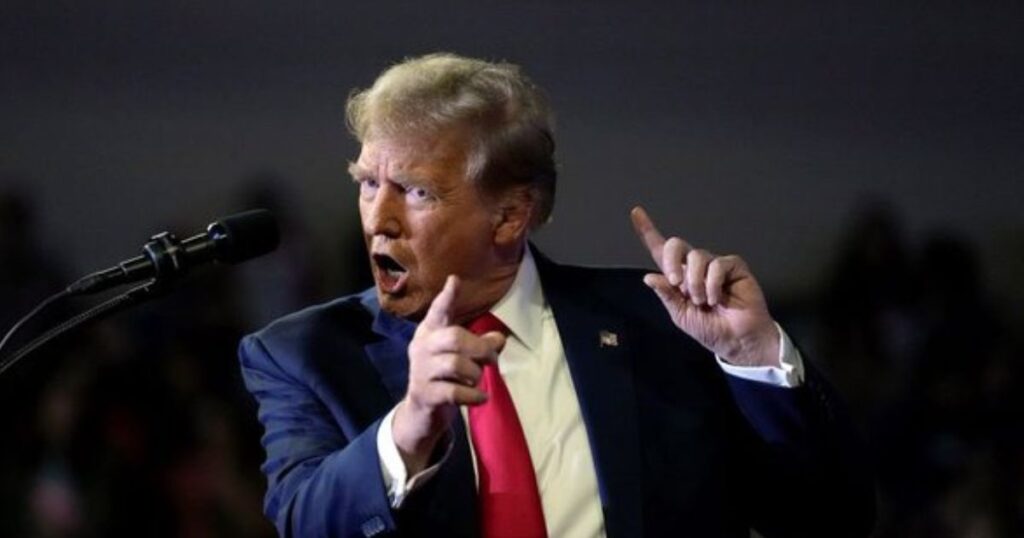
President Donald Trump said Monday he will sign an executive order this week that promises a sweeping shake-up in how artificial intelligence (AI) gets regulated across the United States. He wants to replace a confusing patchwork of state-by-state rules with a unified, nationwide approval system. Investing reports Trump believes that this approach is vital to keeping U.S. AI firms competitive.
In a post on Truth Social, Trump wrote, “There must be only One Rulebook if we are going to continue to lead in AI … you can’t expect a company to get 50 Approvals every time they want to do something.”
What exactly that “One Rulebook” will look like remains unclear. The draft order, reported last month, could include measures to preempt existing state AI laws, possibly through lawsuits from the Justice Department or withholding federal funding from states that impose what regulators consider overly restrictive rules.
Number 47 also penned, ““THERE CAN BE NO DOUBT ABOUT THIS! AI WILL BE DESTROYED IN ITS INFANCY!” As he usually does, Trump emphasized his thoughts by using uppercase letters.
Trump doubling down on one set of rules across the country for AI.
He says he will sign an executive order to ensure this.
It’s imperative we fight against this nonsense – esp here in Florida. pic.twitter.com/HKGQLapjKp
— Cookedgooseinflorida 🐊 (@CookedGooseinFL) December 8, 2025
Supporters in the tech industry have welcomed the plan. Giants like OpenAI, Google (Alphabet), Meta Platforms, and major venture-capital firms are eager for there to be a single national standard. They warning that by keeping the laws regulating AI at a state level, other countries like China will be able to develop quicker. They feel this significantly threatens U.S. leadership in AI development.
On the other hand, the move could sideline important protections that some state laws aim to provide . Many regulations are around the key issues of privacy, data rights, algorithmic fairness, and local accountability. They argue a federal override risks erasing efforts by states to protect consumers, workers, and communities from potential harms tied to AI.
Democratic North Carolina Attorney General Jeff Jackson stated, “Congress can’t fail to create real safeguards and then block the states from stepping up,” , said at the time. “
Trump just confirmed he’ll sign an executive order banning states from regulating AI.
It’s a huge victory for Big Tech, which has spent millions lobbying to stop guardrails against AI. pic.twitter.com/85aj18KvVo
— Robert Reich (@RBReich) December 8, 2025
An official White House fact sheet linked to the order reportedly establishes a central oversight body, possibly within the Department of Justice or a newly created AI office . The strategy will allow one review applications for new AI tools, assess safety and societal impact, and issue approvals or rejections under a standard timeframe.
Trump framed the order as not only a regulatory step but a strategic necessity. “We’re beating all countries at this point in the race,” he said. “But that won’t last long if we allow 50 states, many of them bad actors, to regulate AI their own way.”
Our President @realDonaldTrump understands exactly what needs to happen to keep America First in AI. #AIC #AmericaFirstAI pic.twitter.com/dfo8BFmfIe
— AI Innovation Council (@aiinnovationorg) December 8, 2025
Even so, passage won’t be easy. Earlier this year, efforts to federalize AI regulation failed after lawmakers balked at inserting it into a must-pass defense bill.
Still, by using an executive order, the administration hopes to move around Congress and quickly establish a national baseline. If enacted, the order would set the first unified federal standard for AI oversight in the U.S., with wide implications for tech firms, developers, regulators, and anyone whose life touches AI.
As companies eye new product launches and investors decide where to put their money, this single federal framework could shift the balance, making Washington, D.C., rather than 50 capitals, the center of AI governance.