

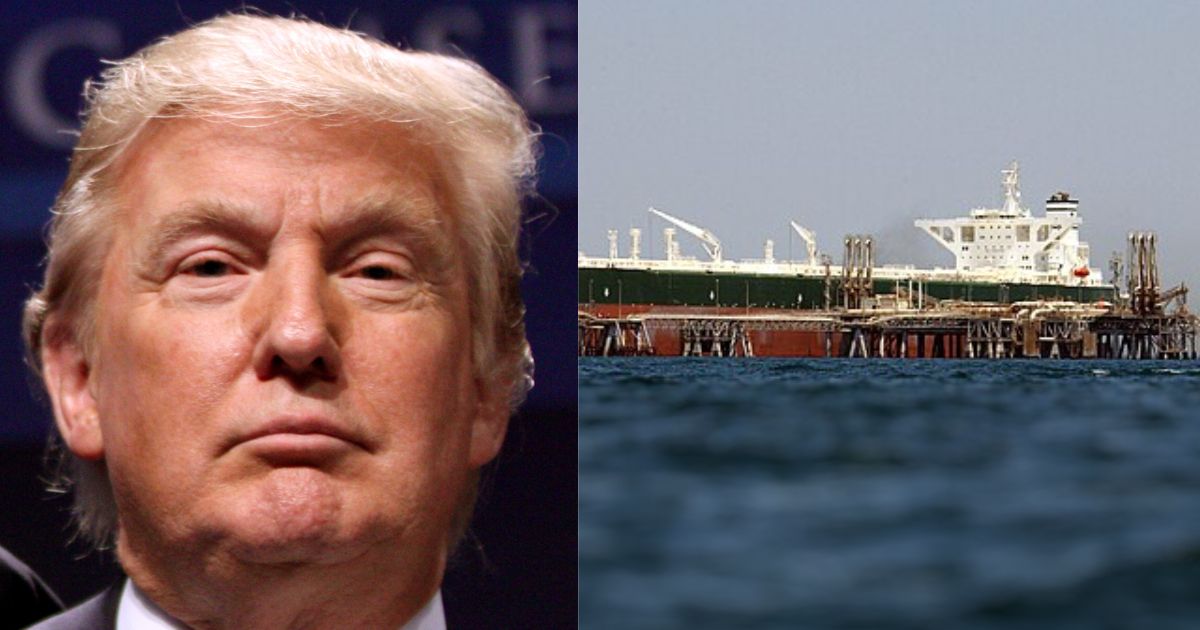
President Donald Trump escalated tensions with Venezuela as he used a late post on Truth Social to announce what he called a “total and complete blockade” of sanctioned oil tankers entering and leaving the South American country.
“I am ordering A TOTAL AND COMPLETE BLOCKADE OF ALL SANCTIONED OIL TANKERS going into and out of Venezuela,” Trump wrote. His message sounded more like a warning than a policy statement.
He accused Venezuelan President Nicolás Maduro of using oil profits to fund “Drug Terrorism, Human Trafficking, Murder, and Kidnapping.” He labeled Maduro’s government a “FOREIGN TERRORIST ORGANIZATION.” Trump also repeated a claim he has made for months, alleging that Venezuela has sent criminals into the United States and that the U.S. is now returning them.
“The Illegal Aliens and Criminals that the Maduro Regime has sent into the United States during the weak and inept Biden Administration are being returned to Venezuela at a rapid pace,” he wrote.
Then came a line that likely concerns every diplomat and shipping executive monitoring the Caribbean this week.
“America will not allow Criminals, Terrorists, or other Countries to rob, threaten, or harm our Nation. Likewise, we will not allow a Hostile Regime to take our Oil, Land, or any other Assets. All of which must be returned to the United States,” Trump wrote.
PETER DOOCY: “Now that we’ve seized this tanker, is the campaign against Venezuela still just about drugs, or is it now also about oil?”
PRESIDENT TRUMP: “Well, it’s about a lot of things. But one of the things it’s about is the fact that they’ve allowed millions of people to… pic.twitter.com/BaPVYLAKwI
— Fox News (@FoxNews) December 11, 2025
In a statement following Trump’s post, the Venezuelan government condemned the order as a “grotesque threat.” They called it a violation of international law and warned that Trump was hinting at military action under the guise of enforcement.
They labeled it “a reckless and serious threat,” saying Trump “intends to impose, in an absolutely irrational manner, a supposed naval military blockade on Venezuela with the objective of stealing the wealth that belongs to our homeland Venezuela.”
The government announced that its ambassador to the United Nations would “denounce this serious violation of International Law.” They described the move as an “extravagant threat” and claimed it revealed Trump’s “true intention” to “appropriate the country’s oil, land, and minerals through gigantic campaigns of lies and manipulation.”
“Venezuela will never again be a colony of any empire or foreign power,” the statement added. They vowed to continue on what they called “the path of building prosperity and the unrestricted defense of our independence and sovereignty.”
The immediate impact could be significant, even if the details are unclear. Venezuela’s oil sales abroad, particularly to China, often pass through the kind of sanctioned shipping networks Trump is now targeting. China is often described as the main buyer of Venezuelan crude, frequently using indirect channels to avoid sanctions.
However, Venezuela’s production is far lower than it used to be. The International Energy Agency estimated the country produced about 860,000 barrels of oil per day in November, which is roughly a third of its output from a decade ago and less than 1 percent of global consumption.
Trump’s announcement comes at a time when the United States has ramped up its military presence in the Caribbean and increased pressure on Maduro. That’s important because a “blockade” is more than just a financial measure. It suggests the presence of ships, enforcement, and the risk of conflict at sea.