


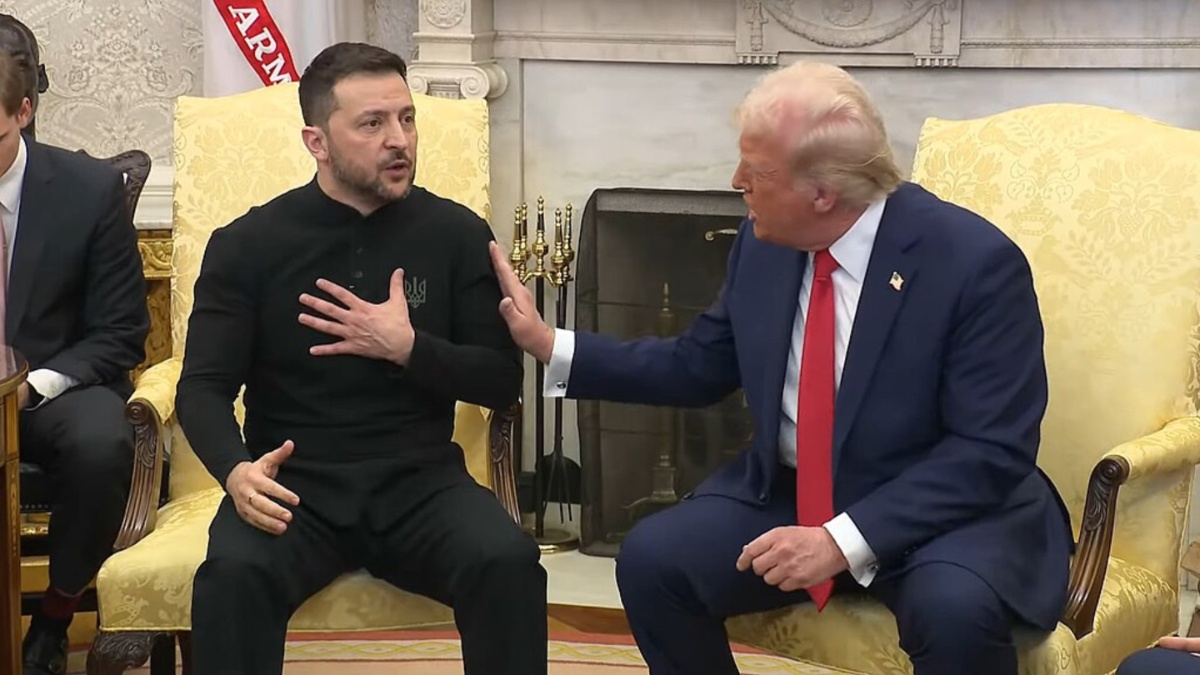
President Donald Trump’s administration ignored a Ukrainian offer last August for help with Iranian-made attack drones. After those same drones killed seven U.S. service members and prompted an expensive defensive response in the Middle East, the White House turned back to Kyiv for assistance. This shift was awkward for a White House that had previously dismissed Volodymyr Zelenskyy’s proposal.
Axios reported on Tuesday that Zelensky presented Trump with a private White House proposal on August 18, 2025. The proposal offered Ukraine’s proven technology for targeting Iranian Shahed drones. The document, obtained by Axios, warned that “Iran is improving its Shahed one-way-attack drone design” and suggested establishing “drone combat hubs” in Turkey, Jordan, and Gulf states near U.S. bases. A Ukrainian official told Axios the plan included creating “drone walls” supported by radar and similar systems.
According to Axios, Trump instructed his team at the time to work on the proposal, but a deal did not materialize. One U.S. official mentioned that the offer was dismissed partly because some in the administration viewed Zelensky as “being Zelensky.” Another described the rejection as one of the administration’s biggest tactical blunders since the Iran bombing campaign began on February 28. “If there’s a tactical error or a mistake we made leading up to this war in Iran, this was it,” the official stated.
The impact of that decision became clearer as the conflict expanded. Reuters reported that U.S. aircraft and warships struck over 1,000 Iranian targets after Trump launched major combat operations, resulting in American casualties from Iran’s retaliation. Reuters later revealed that six reservists died in a March 1 drone attack on the Port of Shuaiba in Kuwait, part of the seven U.S. deaths Axios linked to Iranian Shahed strikes during the conflict.
By last week, Washington had changed its approach. Reuters reported that Zelensky announced Ukraine sent interceptor drones and a team of drone experts to protect U.S. military bases in Jordan after the United States requested help on Thursday. The Ukrainian team departed the following day, according to Zelensky’s account to The New York Times. Meanwhile, the Pentagon and regional partners sought faster and cheaper solutions for dealing with incoming drones.
This change reflects the experience Ukraine gained during Russia’s invasion. Axios reported that Ukraine has become the most skilled country in combating Shahed drones and has developed low-cost interceptor drones and other air-defense systems to destroy them.
Reuters also noted that Gulf countries and the United States have expended hundreds of air-defense missiles, each costing millions, while Ukraine’s methods are significantly cheaper after years of adapting to Russian assaults using Iranian-designed UAVs.
The White House denied it was caught off guard. Axios quoted spokesperson Anna Kelly saying, “This characterization made by these cowardly unnamed sources is not accurate.” She added that Defense Secretary Pete Hegseth and U.S. forces had planned for “all possible responses,” asserting that “the undisputed success of Operation Epic Fury speaks for itself.” Axios also reported that U.S. officials claim most Iranian missiles and drones have been intercepted, and fatalities were lower than initial estimates.
Still, the situation left Trump seeking help from a leader he has previously mocked. For a White House that ignored Kyiv’s proposal months earlier, the request for assistance was a clear acknowledgment that Ukraine possessed something Washington required after all.