



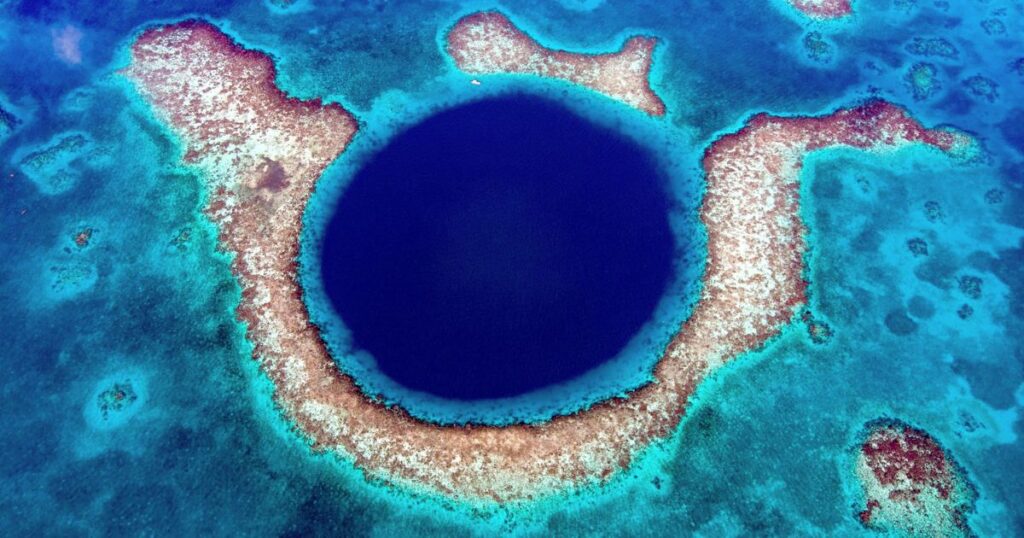
The deepest blue hole in the world has reportedly been found. However, scientists have no idea what lies at the bottom of it, as per new reports. The underwater marine sinkhole exists just off the coast of Mexico, and it is over 420 meters deep.
A great sense of mystery has now been created as explorers are yet to reach the bottom of this geological marvel.
As per LadBible, about 20 years ago, a local diver discovered the sinkhole, which is also known as “Taam Ja,” which means “deep water” in the Mayan language.
From the surface, the sinkhole has very low visibility. In 2021, a group of scientists tried to measure the sinkhole with the help of an echo sounder. It bounced sound waves off the bottom of the hole, and the result revealed that its depth is 275 meters.
Ocean’s Deepest Secrets?
The deepest known blue hole on Earth.
The Taam Ja’ Blue Hole, located in Mexico’s Chetumal Bay 🇲🇽 ️ pic.twitter.com/bKwlDzE1Il
— State_of_Mind (@StateofMind_02) May 9, 2024
However, in 2023, another expedition proved the previous result wrong, revealing that the sinkhole must be at least 420 meters deep. Scientists used a device called a conductivity, temperature and depth (CTD) profiler. The sensors of the device measure water pressure that determines the depth.
It remains unclear whether this was the actual bottom of the sinkhole. With all of its mystery, the sinkhole, which lies off the coast of Mexico’s Yucatán Peninsula, remains a significant interest for marine biology.
Blue holes, which are generally naturally occurring caverns on the sea floor, have vertical walls. They could be predominantly discovered in coastal regions. In the coastal areas, the bedrock is made of limestone and other soft types of rock. Which means, natural erosion over time could make the rock collapse.
Sinkholes are generally not affected by ocean currents, and most of them are just tens of meters deep. Although sinkholes can sometimes be linked to underwater cave systems, they have poor water circulation. In addition, the low oxygen levels also make it hard for life forms except microbes to thrive.
Divers Just Discovered the Deepest Blue Hole on Earth
﹌﹌﹌﹌﹌﹌﹌﹌﹌﹌﹌﹌ 🔵
Researchers have confirmed the Taam Ja’ Blue Hole in Chetumal Bay, Mexico is the deepest known blue hole on Earth, plunging over 420 m below sea level, deeper than previously estimated. Despite… pic.twitter.com/iMz2YEbAMn
— Science Joy (@InsideOurBodies) December 29, 2025
Taam Ja now remains the deepest blue hole known. However, another example of the same sort would be the Great Blue Hole in Belize. In 2018, Richard Branson explored this blue hole with Fabien Cousteau, the grandson of French explorer Jacques Cousteau.
The pair managed to explore a layer of hydrogen sulfide at a depth of around 91 meters while exploring in separate vessels. However, beyond that level, they found it dark and devoid of life.
“The Blue Hole is made of a complex system of caves that once formed on dry land. It is proof of how oceans can rise quickly and catastrophically,” Branson wrote following the expedition.
“Sea levels were once hundreds of feet lower. 10,000 years ago, the sea level rose by about 300 feet when a lot of ice melted around the world. At 300 feet down, you could see the change in the rock where it used to be land and turned into sea,” he added.
Reports suggest the explorer also apparently made it to the perceived bottom, and on the way, they discovered bizarre things such as garbage, a two-litre plastic bottle, a long-lost GoPro, and even two bodies.