



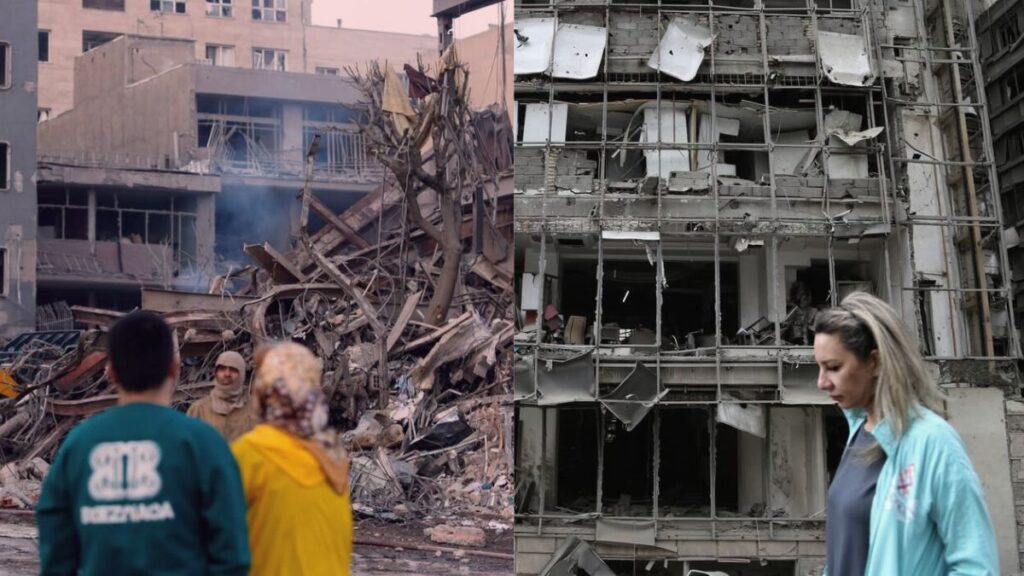
The situation in Tehran continues to deteriorate as heavy airstrikes target the second-largest metropolitan area in the Middle East. Apart from Tehran, the Israel- US strikes also targeted places like Isfahan, Karaj, Kermanshah, Qum, and Tabriz on the seventh day of the conflict.
Officials warn that the attacks may intensify, as residents in Tehran reported hearing loud explosions overnight. Smoke was observed in several areas of the capital, including near the University of Tehran. An Iranian military academy was also reportedly hit.
One of the most serious incidents was a strike on a girls’ school in Minab, where Iranian authorities report that at least 175 children were killed on the first day of the conflict.
View this post on Instagram
The tensions began to rise following joint U.S. and Israeli airstrikes on February 28. Under “Operation Epic Fury,” Iran’s Supreme Leader Ayatollah Ali Khamenei, along with his daughter, grandchild, son-in-law, and daughter-in-law, was killed.
According to the opposition channel Iran International, as cited by Israeli outlet N12 News, Mojtaba Khamenei, the son of Ayatollah Ali Khamenei, has been named as Iran’s next successor by the Assembly of Experts.
Al Jazeera correspondent Tohid Asadi in Tehran reported that the bombardment was heavier than in previous days, with strikes concentrated in the eastern and southeastern parts of the city.
“From the early hours of the morning we have seen a continuous wave of large explosions,” the reporter said.
The Israeli military said many of Iran’s air defence systems and missile launchers had already been destroyed in earlier strikes. However, Iran’s Ministry of Foreign Affairs claimed that the strikes targeted 33 locations across Tehran.
Strikes damaged hospitals, including Khatam Hospital and Gandhi Hospital, as well as rehabilitation centers, schools, residential areas, the Tehran Grand Bazaar, and the historic Golestan Palace complex. The Azadi Stadium, Iran’s largest sports complex, was also bombed.
View this post on Instagram
According to figures released by the Iranian government on X, citing data from the Iranian Red Crescent, more than 3,600 civilian locations have been damaged in these strikes. Some patients were severely injured when hospital buildings collapsed, and thick smoke blurred their sight.
The death toll in Iran has climbed to at least 1,230 people since Saturday, while Israel has also expanded its attacks to include targets in Lebanon. Residents in Tehran described their shock and uncertainty in phone interviews with the media.
Facing a lack of basic resources and ongoing fear, 36-year-old Mohammadreza said, “Today is worse than yesterday. They’re striking northern Tehran. We have nowhere to go. It feels like a warzone. Help us.”
Meanwhile, the Chairman of the Joint Chiefs of Staff noted that U.S. service members remain at risk. This warning followed a retaliatory attack after an Iranian drone strike on Sunday killed six American soldiers at an operations center in a civilian port.
View this post on Instagram
Defense Secretary Pete Hegseth also said additional American forces, including fighter jets and bombers, are being deployed to the Middle East to support ongoing operations. He said that the operation will go on as long as necessary.
The comments came after warnings from President Donald Trump and senior officials that further American casualties are possible in a conflict that could last for months.
In a recent media address, Trump said, “We are doing very well on the war front. To put it mildly I would say. Somebody said on a scale of 1 to 10 where would you rate it? I said about a 15. And we’re going to continue to do what we have. We’ve the greatest military in the world by far.”