



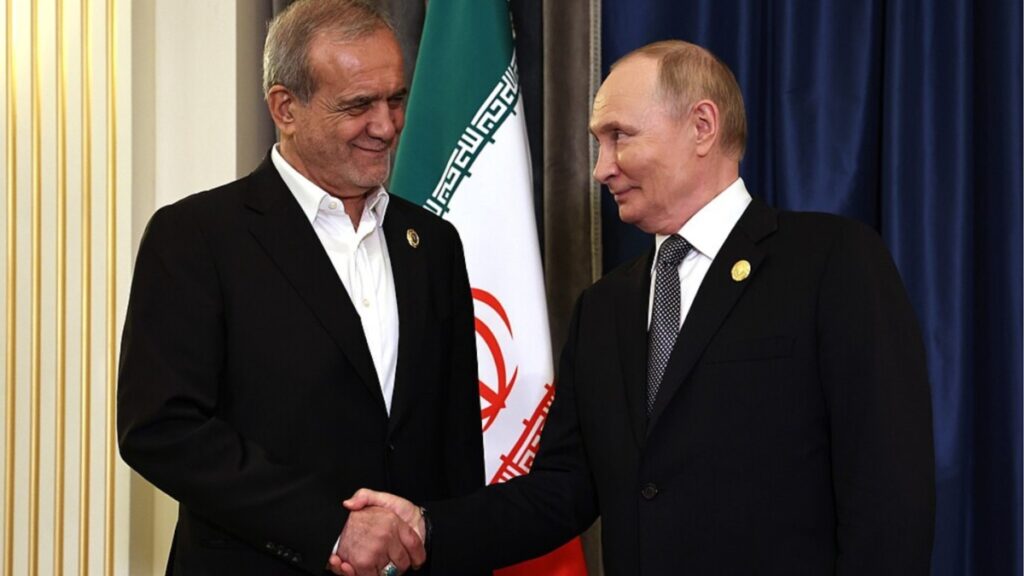
Russia condemned the joint U.S. and Israeli military strikes on Iran, calling them a preplanned and unprovoked act of aggression against a sovereign U.N. member state. The Russian government warned that these actions could lead to major regional instability, even as Moscow remains focused on its war in Ukraine, which was also described as unprovoked aggression.
In a statement on Telegram, the Russian Foreign Ministry stated that the strikes, which targeted Iranian military sites early Saturday, should stop immediately and be replaced with diplomatic efforts. “We demand that the situation be immediately returned to the path of political and diplomatic resolution,” the ministry said.
This marked one of the strongest public criticisms from Moscow regarding the military operation, which U.S. and Israeli officials said aimed to weaken Iran’s nuclear and missile capabilities. The strikes occurred as Russia continues its invasion of Ukraine, which has now lasted five years, and during which Iran has supplied drones and military equipment to Russian forces.
“The attacks risk causing a humanitarian, economic, and potentially radiological disaster in the region,” the ministry said. It claimed that Washington and Tel Aviv were using concerns over Iran’s nuclear program to push for regime change.
Russian President Vladimir Putin, whose government has recently shown willingness to engage with the United States over Ukraine, held a videoconference on Saturday with members of Russia’s Security Council to discuss the strikes in Iran, according to Kremlin spokesman Dmitry Peskov. He did not provide details of the meeting.
Russian Foreign Minister Sergey Lavrov spoke on the phone with Iranian Foreign Minister Abbas Araghchi. Araghchi updated Lavrov on Iran’s efforts to counter the attack and mentioned that Iran would seek an urgent meeting of the United Nations Security Council. Lavrov reiterated Russia’s condemnation of the strikes and expressed Moscow’s readiness to help facilitate peace.
The ministry called the bombing of facilities under International Atomic Energy Agency safeguards “unacceptable,” placing the full responsibility for escalation on the United States and Israel. It also criticized the “serial nature” of destabilizing attacks by the U.S. administration, accusing it of undermining international law.
Dmitry Medvedev, deputy chairman of Russia’s Security Council and former president, stated in comments to state media that the U.S. and Israel were engaging in a “dangerous adventure,” cautioning that the strikes could lead to widespread conflict. Medvedev contrasted the long history of Iranian civilization with that of the United States, saying “time will reveal the outcome” of the clash.
Russia has strong economic and military ties with Iran, and it also keeps connections with Israel and has engaged the United States in discussions about normalizing some diplomatic and economic relations.
The strikes provoked swift retaliation from Tehran, which launched missiles and drones at Israeli territory and U.S. military bases in the Gulf region. Tehran told the United Nations it would continue to exercise its right to self-defense and considers U.S. and Israeli bases legitimate targets if hostilities persist.
Ukraine’s government, which has been at odds with Russia since 2022, expressed support for the strikes on Iran, linking Tehran’s military support to Moscow’s war effort in Ukraine. Ukrainian President Volodymyr Zelenskyy stated that Iran’s supply of drones and weapons had benefited Russian forces.
Western governments called for restraint and urgent diplomacy; however, Australia is an exception. Albanese threw his support for US action against Iran and added that the Iranian people’s ‘struggle against oppression’ must end.


