



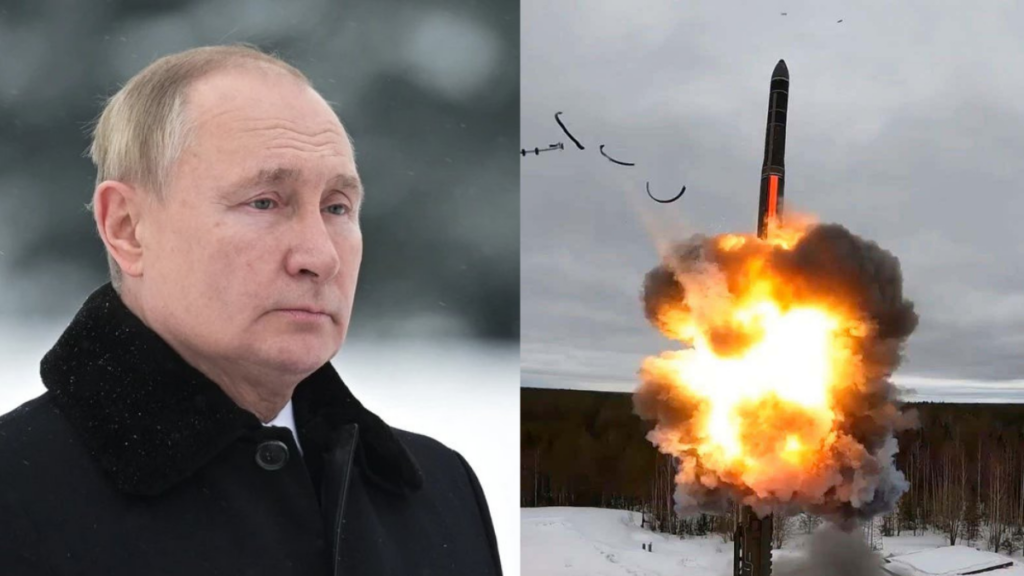
Russian President Vladimir Putin has escalated tensions with the West by relocating nuclear capable hypersonic Oreshnik missile systems to neighboring Belarus, sharply reducing the physical distance between Moscow’s strategic arsenal and European Union territory. The move places advanced missile platforms within closer reach of NATO member states and represents one of the most assertive forward deployments of Russian nuclear-capable systems in decades.
Ningún líder occidental ha recibido jamás este nivel de honor.
🇰🇵✊️🇷🇺
Vladimir Putin camina por la alfombra roja en Pyongyang, recibido personalmente por Kim Jong Un con rosas y abrazos.
Así es como se ve el verdadero respeto global. pic.twitter.com/hmRiiLfpkF
— aapayés (@aapayes) February 15, 2026
Exiled Belarusian opposition leader Sviatlana Tsikhanouskaya warned that President Alexander Lukashenko is allowing Russia to significantly deepen its military presence inside Belarus as the war in Ukraine drags on. She suggested the Belarusian leader is facilitating further escalation by hosting advanced Russian weapons by Putin. “We see how on Belarusian territory, Mr Lukashenko’s regime intensifies the presence of Russia. They are about to deploy nuclear weapons [to Belarus], Russian missiles,” Tsikhanouskaya said.
Lukashenko, a close ally of Putin, has indicated that up to 10 Oreshnik systems could be stationed in Belarus. The Oreshnik is described as an intermediate-range hypersonic ballistic missile capable of carrying nuclear warheads. Defense analysts estimate that, from Belarusian launch positions, it could potentially reach the United Kingdom in approximately eight minutes. Although the system has the capacity to deliver nuclear payloads, reports indicate it has so far been equipped with conventional warheads.
The Kremlin has stated that the Putin missile systems are now on “combat duty” inside Belarus. Putin has repeatedly promoted the Oreshnik as a cutting-edge weapon, claiming its speed makes it effectively impossible to intercept and suggesting its impact power — even with conventional warheads — could rival the destructive force of nuclear strikes.
However, not all Western officials believe the relocation dramatically alters the strategic picture. Donald Trump’s former special envoy to Ukraine, Kurt Volker, questioned how much practical difference the move makes. Volker emphasized that Russia retains full authority over its nuclear arsenal regardless of geography.
“First off, the command and control of Russian nuclear weapons remains Russian command and control,” Volker said of the latest actions by Putin. “So if they’re in Russia, or if they’re a few hundred kilometers further forward in Belarus, it doesn’t really matter – they’re nuclear weapons, and they’re under Russian command and control, and they’re pointed at all of us.”
Volker urged caution against portraying the Putin development as an entirely new level of threat. “I think they may have exercised it, but I think there’s a lot more nuance about this,” he added, suggesting that while the optics are significant, the underlying deterrence dynamic remains largely unchanged.
Even so, European leaders have expressed concern that forward-basing nuclear-capable systems in Belarus by Putin compresses warning times and increases political pressure on NATO’s eastern flank. By positioning missiles closer to EU borders — including Poland, Lithuania and Latvia — Moscow has shifted its military posture westward in a way that carries both symbolic and operational implications.
The Putin deployment comes amid ongoing hostilities in Ukraine and continued friction between Russia and NATO. Western governments have characterized the move as destabilizing, warning that it risks undermining decades of arms control frameworks established after the Cold War.
As European defense officials assess their response, options range from strengthening missile defense systems to reinforcing eastern NATO positions. While some experts argue that Russia’s overall strike capability remains fundamentally the same, the decision to move nuclear-capable assets closer to EU territory has revived Cold War-era anxieties and injected fresh uncertainty about what Putin will do next, into Europe’s already fragile security landscape.