


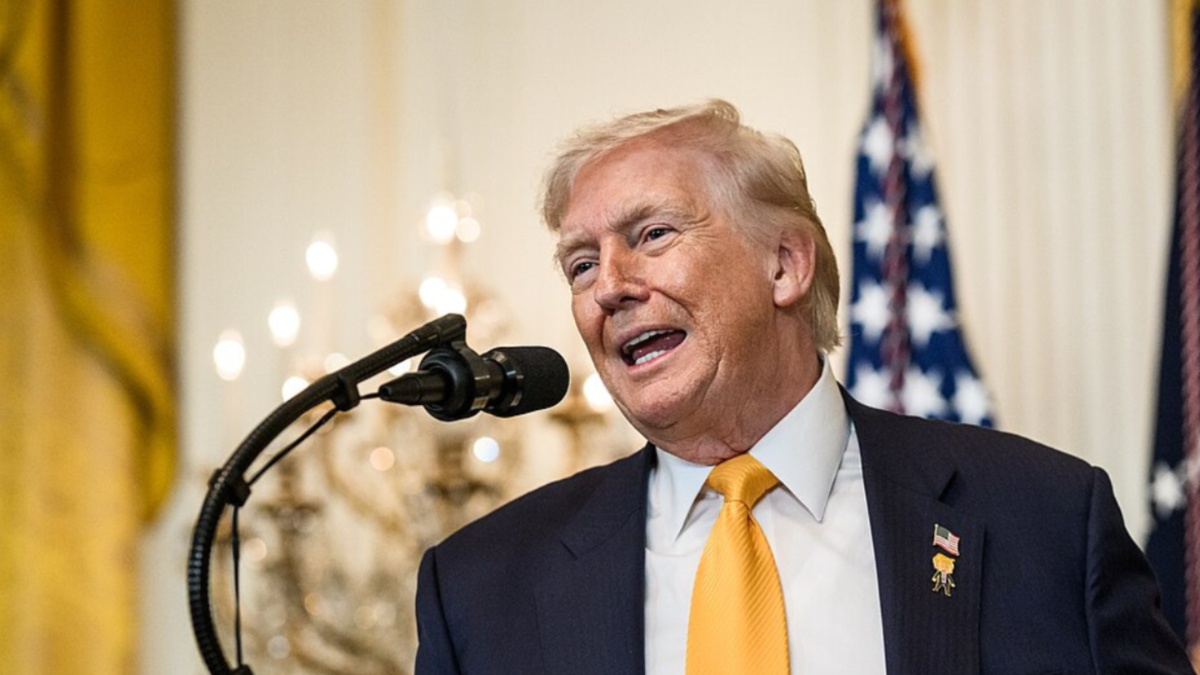
Allegations regarding Donald Trump’s narcissistic tendencies and desire for constant attention have been widely discussed in the media since his first term began in 2017.
Psychologists, authors, and numerous doctors have closely studied his public conduct over the years and reached several conclusions.
Although White House officials and Trump’s personal physician have consistently denied rumors of delusion or mental health conditions such as Alzheimer’s, further speculation has increased during his second term, which began on January 20, 2025.
Over the weekend, psychologist and psychotherapist Dr. John Gartner criticized the Trump administration’s decision to display a large banner featuring Trump’s image on the Department of Justice building.
On The Daily Beast podcast with Joanna Coles, Gartner described the display as “particularly creepy” and suggested it indicates concerning behavioral traits. He argued that the banner may reflect increasingly erratic conduct.
Gartner also claimed that the banner highlights signs consistent with cognitive decline, including “sundowning,” which refers to worsening confusion or agitation later in the day.
View this post on Instagram
“He has very little intellectual curiosity, very little capacity to concentrate, very little interest in anything, and anything having to do with the country,” Gartner said.
“He’s only interested in himself, aggrandizing himself, and putting his name on things, his picture on things.” he added.
Gartner further stated that displaying the banner at the Justice Department sends a concerning message, especially given the current political climate and past controversies. He suggested it creates the impression that justice is influenced by loyalty and not free will.
Previously, Dr. John Gartner warned that Donald Trump is showing a “massive increase” in clinical signs of dementia, which he says is worsening the president’s “malignant narcissism.”
View this post on Instagram
Gartner also claimed that Donald Trump frequently shifts topics during interviews and speeches in ways that lack logical progression. He said these linguistic slips, known as phonemic paraphasia, are not ordinary mistakes but major signs of neurological decline.
For example, on March 13, 2025, during a St. Patrick’s Day event, the president referred to Saint Patrick as the “patriot saint” twice.
One user on X said, “Mr. ‘I don’t need a teleprompter’ Donald Trump calls Ireland’s patron saint a ‘patriot saint’ as he struggles with his script.”
A clip of this incident went viral online, prompting widespread commentary and raising questions about the president’s verbal abilities and possible mental health concerns.
Meanwhile, Donald Trump’s long-time critic and psychologist, Mary Trump, discussed her uncle’s constant need for attention on December 8. She explained why she believes he is “so needy and grasping.”
Speaking on her show, ‘Mary Trump Live,’ she said that the behavior stemmed from his childhood, Fred Trump, whom she described as a “patriarchal, authoritarian sociopath.”
Narcissism is a REAL mental illness. I don’t know if there’s a treatment or cure for it. But personally, I’ve suspected that Trump has had mental health issues for DECADES!
— Michele Parrotta (@shell24915) January 20, 2026
The Trump family reportedly included three sons and two daughters. Fred Trump Jr. died of alcoholism in 1981 at age 42. His sudden death had a significant impact on Donald Trump, who decided to abstain from alcohol as family responsibilities increased. His father also developed cognitive decline later in life, and his rigid nature made the situation worse.
Trump has narcissistic disorder “mental disorder where people have an inflated sense of their own importance and lack of empathy for others
— Rocketyop (@rocketyop) August 6, 2016
As discussions about the president’s mental health continue in the news, his upcoming events and the midterm election status may provide the public with greater clarity regarding his overall credibility.