



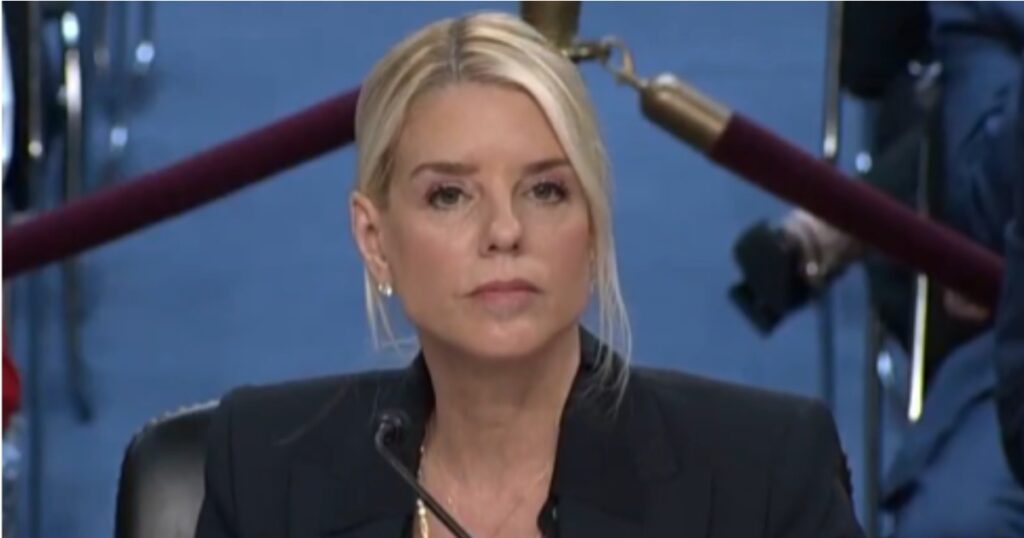
Pam Bondi walked into court this week expecting to shore up a shaky prosecutor. Instead, she may have handed Donald Trump’s enemies a stronger case to knock that prosecutor out altogether.
At the center of the fight is Lindsey Halligan, the newly installed MAGA U.S. attorney for the Eastern District of Virginia, who brought criminal charges against two of Trump’s highest profile foes, former FBI Director James Comey and New York Attorney General Letitia James. Their lawyers argue Halligan never should have been in that job to begin with and that her appointment violated basic rules governing how federal prosecutors are chosen.
Earlier this month, Bondi tried to fix that problem with a paperwork maneuver. On top of Halligan’s already contested acting U.S. attorney role, Bondi designated her a “special attorney” to the Justice Department, a move widely interpreted as an attempt to insulate Halligan from being removed and to retroactively validate everything she had already done in the cases.
But when U.S. District Judge Cameron McGowan Currie heard arguments on Thursday, the move became a glaring weakness instead of a protective layer.
Per CNN, Comey and James are asking Currie to throw out their indictments, arguing that Halligan was unlawfully installed after a previous interim U.S. attorney had already reached the end of the only 120 day term allowed under federal law and had been lawfully reappointed by local judges. They say Trump, through Bondi, tried to bypass the Senate confirmation process by cycling in a loyalist with no prosecutorial background to target his political rivals.
Attorney General Pam Bondi on U.S. Attorney Lindsey Halligan prosecuting Former FBI Director James Comey: “Lindsey is a great U.S. Attorney… The Comey indictment is going to be just fine. I have also signed onto that, backing up what Lindsay Halligan did because they’re coming… pic.twitter.com/JFpe7CHL6o
— RedWave Press (@RedWave_Press) November 14, 2025
Their lawyers came out swinging. Letitia James’s attorney, Abbe Lowell, told the court that Halligan was “pretending” when she brought the indictment, essentially acting like a private citizen who had been handed a title she was never legally allowed to hold.
The Justice Department pushed back, saying whatever problems existed were merely “a paperwork error” and arguing that the indictments should stand because any government lawyer could have brought the cases. They insisted that Bondi’s attempt to retroactively “ratify” Halligan’s actions cured any defect.
Judge Currie didn’t seem convinced.
She zeroed in on Bondi’s last minute move to name Halligan a special attorney, pressing government lawyers on why such a designation would be needed at all if Halligan’s original appointment had truly been legal. At one point, she asked, in effect, why the Justice Department would scramble for ratification if everything had been done correctly from the start.
Then came the biggest problem for Bondi. She had signed a statement saying she reviewed Halligan’s presentation to the grand jury before ratifying the indictment. But Currie noted that the transcript Bondi claimed to have reviewed cuts off before that presentation ended and does not resume until after the indictment was returned. In other words, Bondi claimed to review records that did not exist.
That revelation turned what was supposed to be a safety net into a liability. Legal analysts said Bondi’s attempt to bolster Halligan may have backfired, giving the judge more reason to doubt the legitimacy of both the appointment and the indictments.