



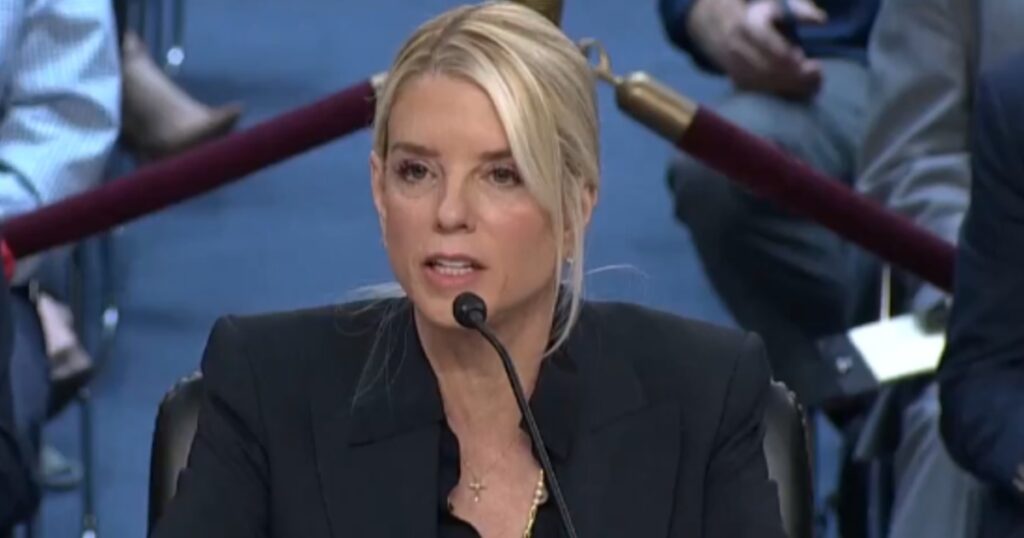
Attorney General Pam Bondi’s Justice Department is facing a growing crisis after a federal judge ruled Tuesday that yet another acting U.S. attorney she installed has been serving illegally for months. The stunning rebuke marks the third time a court has found Bondi’s appointment maneuvers unlawful, raising fresh questions about the integrity of her staffing practices and the Department of Justice’s compliance with federal law.
In a 52-page ruling, Senior U.S. District Judge J. Michael Seabright, a George W. Bush appointee sitting by designation in California, found that Bilal “Bill” Essayli, Bondi’s handpicked U.S. attorney for the Central District of California, has been unlawfully holding the position since July 29, 2025. His appointment, Seabright said, violated the Federal Vacancies Reform Act — the same statute at the center of earlier rulings that invalidated Bondi’s similar appointments of Alina Habba in New Jersey and Sigal Chattah in Nevada.
“Simply stated: Essayli unlawfully assumed the role of Acting United States Attorney for the Central District of California,” Judge Seabright wrote. “He has been unlawfully serving in that capacity since his resignation from the interim role on July 29, 2025. Essayli may not perform the functions and duties of the United States Attorney as Acting United States Attorney. He is disqualified from serving in that role.”
The ruling comes just one week after the Department of Justice attempted to defend its controversial personnel maneuvers before the federal appellate court. According to filings, Bondi and President Donald Trump created a system that critics describe as a “handbook” for circumventing Senate confirmation by keeping key deputy positions vacant and rotating loyalists through temporary roles.
Essayli, who previously served as an interim U.S. attorney for the Central District of California, was supposed to hold the position for only 120 days. But when that period expired, Bondi’s team ensured that the first assistant U.S. attorney position, the normal successor role under the law, was vacant, allowing Essayli to continue serving as acting U.S. attorney.
Criminal defendants Ismael Garcia Jr., Jaime Hector Ramirez, and Ronny Rojas challenged the arrangement, accusing Bondi of exploiting loopholes in the Federal Vacancies Reform Act. They argued that the DOJ’s strategy was “limitless,” effectively allowing Bondi to “fire the first assistant and backfill with anyone they choose” while giving the chosen person dual authority as both a “special attorney” and acting U.S. attorney.
Essayli’s own resignation letter from July 29 spelled out the maneuver clearly. “I hereby resign my position as Interim United States Attorney for the Central District of California effective at 5:00 p.m. PDT today,” he wrote, “I look forward to continuing to lead the U.S. Attorney’s Office for the Central District of California.”
Seabright rejected that sleight of hand, explaining that Essayli’s resignation didn’t trigger the law allowing for acting appointments under the Vacancies Reform Act. He ruled that the act applies only when a Senate-confirmed official dies, resigns, or is incapacitated — not when an interim official steps down.
“Essayli was not the first assistant when the U.S. attorney resigned,” Seabright wrote, adding that his later dual status as a “special attorney” couldn’t justify his continuing role as acting U.S. attorney either.
Despite the ruling, Essayli struck a defiant tone on X, posting that “nothing is changing,” even as he shared an image of the decision declaring he was “never lawfully serving” as acting U.S. attorney. His profile on the platform still identifies him as such.


