

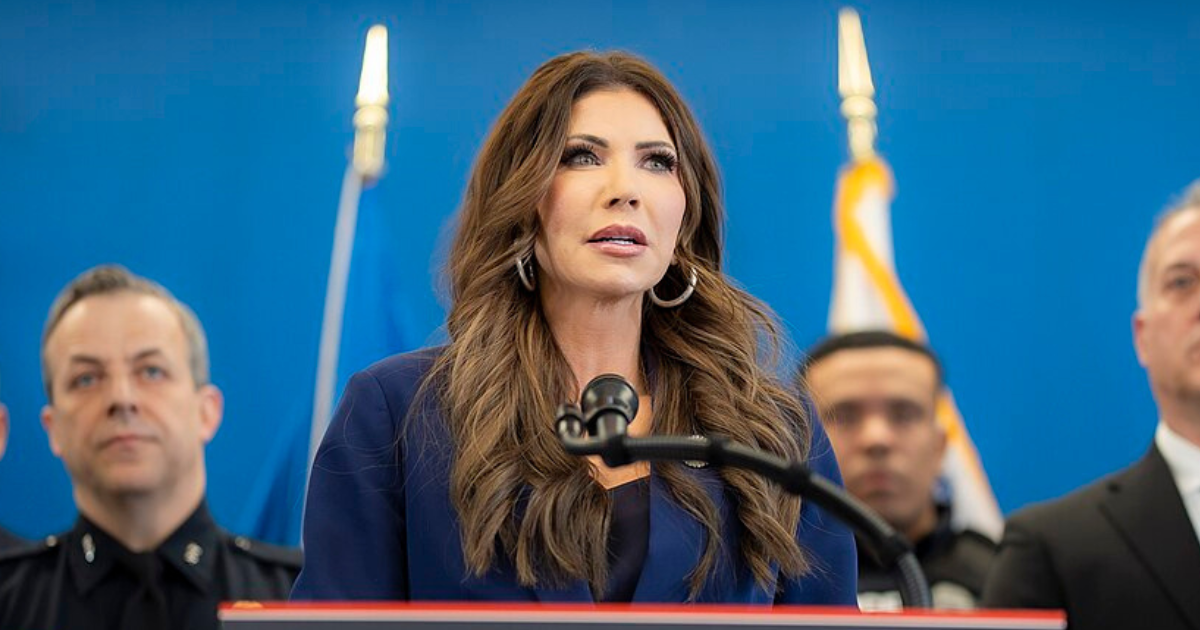
House leaders postponed work on a Department of Homeland Security funding bill this week. This setback comes as Homeland Security Secretary Kristi Noem pushes for stronger immigration enforcement. At the same time, Democrats are increasing their calls for limits on Immigration and Customs Enforcement after the fatal shooting of Renee Nicole Good in Minneapolis.
MSNBC columnist Hayes Brown pointed out that Noem is running low on cash. Like other federal agencies, DHS operates under a short-term funding plan that expires at the end of the month. Brown reported that House Speaker Mike Johnson decided to delay the DHS bill until next week. He did not want to risk a high-profile fight that could stall other spending measures.
The Senate passed a separate three-bill funding package on Thursday. However, lawmakers have not moved forward with the Homeland Security measure, which has become one of the most contentious parts of the annual spending process. The Associated Press noted that Congress faces a January 30 deadline to complete work on the full set of appropriations bills after a funding patch ended a 43-day government shutdown in November.
Democrats believe the Minneapolis shooting has made the case for new limits on ICE stronger. Good, 37, died on January 7 after an ICE officer shot her during a confrontation. Emergency incident reports later stated that she suffered multiple gunshot wounds. Life-saving efforts ended around 10:30 a.m., according to reports citing those records.
In the political aftermath, House Democrats decided to go after Noem directly. The Guardian reported that Democratic lawmakers filed articles of impeachment against her, linking their actions to ICE enforcement and Good’s death.
Brown noted that House Republicans had aimed to pass the DHS bill this week. However, the Minneapolis shooting triggered renewed backlash over the administration’s deportation efforts, complicating the Homeland Security bill’s progress. He also quoted House Minority Leader Hakeem Jeffries of New York saying, “Right now, there’s no bipartisan path forward for the Department of Homeland Security.”
Johnson can pass a bill in the House with only Republican votes. However, Senate rules require 60 votes to advance most legislation, meaning Republicans would need some Democratic support to move a DHS measure through the Senate. Brown highlighted this reality, explaining that Senate Majority Leader John Thune would need Democratic votes even if the House acts first.
The AP reported that lawmakers are divided on whether to include new restrictions on ICE funding and oversight. Democrats have proposed new limits following the Minneapolis shooting. These demands, along with the potential for ongoing political conflict over immigration enforcement, now affect the spending discussions as the January 30 deadline looms.
Noem has not publicly outlined a new funding request related to the delayed bill. However, the dispute arises as DHS aims to increase its capacity for immigration enforcement, which has become one of the administration’s main domestic priorities. Brown’s column views the stalled bill as a practical issue for DHS budget planning. Lawmakers are still debating the most politically challenging appropriations measures.
The delays create another week of negotiations, and Democrats are expected to push for conditions on funding, while Republicans will likely argue that lawmakers should approve DHS resources without new limits. Until then, the agency, like the rest of the government, is racing against the month-end deadline.