



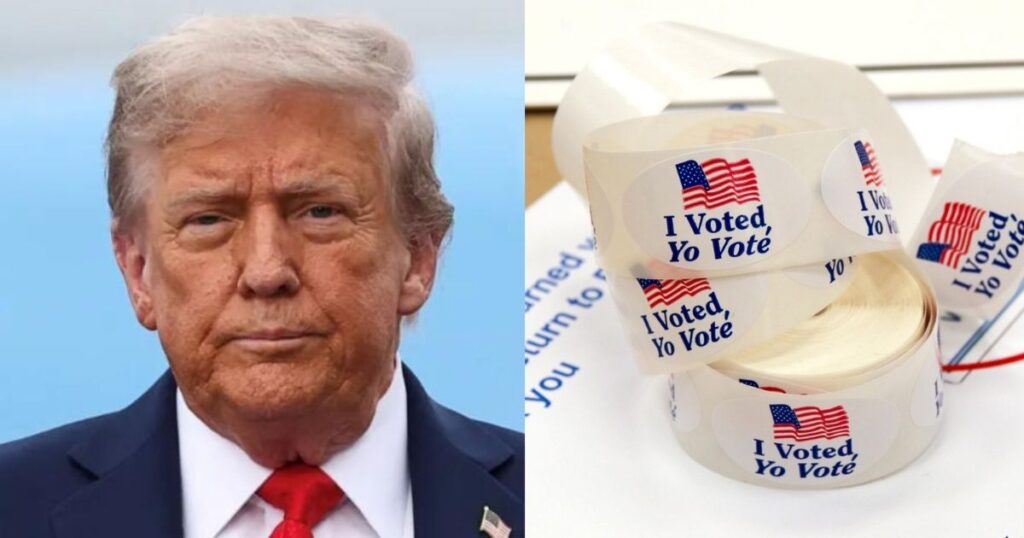
A federal judge in Washington state on Friday blocked President Donald Trump from enforcing parts of a March executive order that aimed to tighten rules around mail voting and voter registration. The judge sided with Washington and Oregon in a lawsuit challenging the directive.
U.S. District Judge John H. Chun, based in Seattle, ruled that Trump does not have the authority to require states to treat Election Day as the deadline for receiving mail ballots in federal elections. Instead, states can count ballots that arrive after Election Day but are postmarked by that date.
Washington and Oregon, both mail-in voting states, sued in April. They argued that the order violated the Constitution and interfered with how states run elections. Chun’s ruling allows these states to continue counting timely postmarked ballots that arrive after Election Day, which aligns with their current practices.
Chun also blocked a provision that directed the federal government to withhold certain election-related funds from states that do not use federal voter registration forms requiring proof of U.S. citizenship. The judge stated that the executive order exceeded presidential power, as the Constitution grants states and Congress, not the president, authority over the rules for federal elections.
The White House indicated it would challenge the ruling.
“President Trump cares deeply about the integrity of our elections, and his executive order takes lawful actions to ensure election security,” White House spokeswoman Abigail Jackson said in a statement to Newsweek, continuing: “This is not the final say on the matter, and the Administration expects ultimate victory on the issue.”
This ruling represents another legal setback for Trump’s attempt to change election administration through executive action. This approach has faced opposition from states and the judge’s order specifically affects Washington and Oregon, which argued that the measures would disrupt their mail voting systems and could lead to valid ballots being rejected due to delivery timing outside a voter’s control.
President Trump to sign an executive order – before the midterm election – eliminating mail in ballots and voting machines. Clarifying: President Trump is going to do it: the executive order to ban voting machines and absentee mail-in ballots (with rare exceptions).
This is just… pic.twitter.com/vuRFGhpQHa
— Peter Bernegger (@PeterBernegger) January 8, 2026
In the 2024 election, Washington counted nearly 120,000 ballots that arrived after Election Day but were postmarked by that date. Oregon counted about 14,000 such ballots, according to figures cited in court documents and media reports.
Trump has made election integrity a central issue since 2020, when he contested the outcome of the presidential election and criticized the growth of mail voting. He has claimed that mail ballots are vulnerable, even though studies and election officials have indicated that instances of voter fraud are uncommon and carry significant penalties.
Last year, Trump said he would work to eliminate mail ballots and voting machines before the 2026 midterm elections and in an August post on Truth Social, he expressed his intent to “lead a movement to get rid of MAIL-IN BALLOTS” and to eliminate voting machines, which he described as inaccurate and costly, while advocating for a return to paper ballots.
The lawsuit filed by Washington and Oregon focused on the March executive order’s directives to change ballot-receipt deadlines and to link federal funding to the use of federal registration forms that require citizenship documents. Chun’s decision follows earlier court actions that challenged the administration’s ability to impose nationwide election rules through executive order rather than legislation.
Some observers have accused the president of attempting to change how the midterm elections are conducted. The administration has completely changed the role of the cybersecurity agency in protecting elections by hiring officials who have denied the legitimacy of the 2020 election in agencies such as the Justice Department and Homeland Security.