



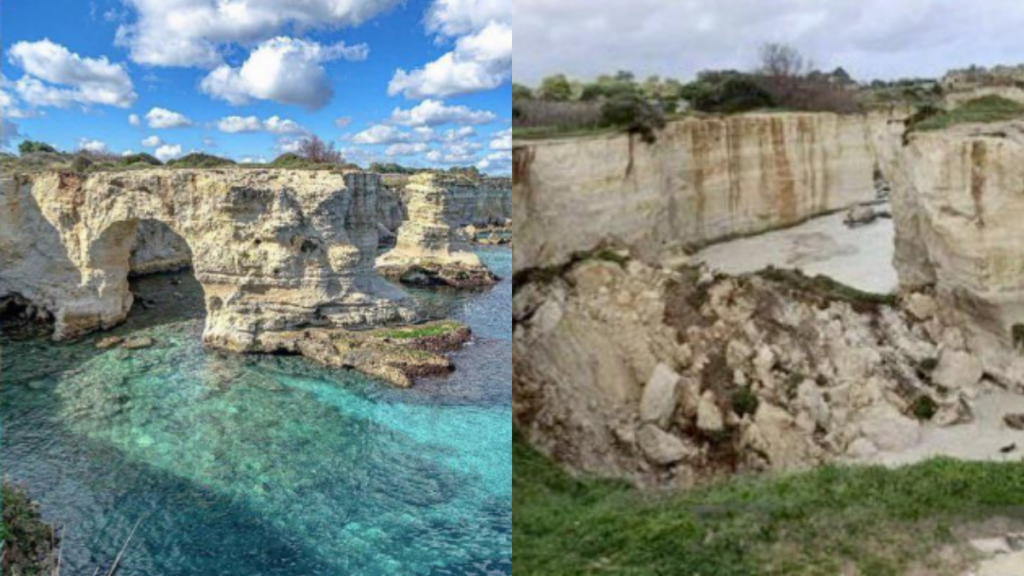
In a rather unfortunate quirk of fate, Italy’s beloved Lovers’ Arch collapsed on Valentine’s Day. The iconic spot was known for attracting millions of couples from around the world. The collapse of the structure raised concerns about coastal landmarks around the region, as they might be prone to suffering a similar fate.
According to reports from the BBC, the renowned natural rock structure cave collapsed on February 14, after weathering several days of harsh conditions, including heavy rain, rough seas and strong winds that regularly battered the Arco Degli Innamorati. The damage was irreparable and a strong blow to the tourism of Sant’Andrea in Melendugno, Puglia.
Maurizio Cisternino, the mayor of Melendugno, told the local press that this incident was an “unwanted Valentine’s Day gift.” He said that this was indeed a hard blow to them, before adding, “Nature as it created the bow, has taken it back.”
Italian Lover’s Bridge, before and after its collapse. pic.twitter.com/pcNOdLedvH
— History Defined (@historydefined) February 16, 2026
As per a separate report from NBC News, officials have warned that other parts of the rocky coastline are also prone to collapse-level danger. The rocky structures have visible cracks along the cliff, raising serious concerns of growing coastal erosion. In recent days, storms and heavy rainfall affected long stretches of the coastline on the Ionian Sea.
This threat ranges from Ugento to the beaches of Gallipoli, with beach structures, small cliff falls and ports already damaged. The unforgiving conditions have already caused damage to the tune of around 1 billion euros in Southern Italy alone. It also includes a landslide that forced people to evacuate their residences in Niscemi.
The BBC reported that people noticed the absence of some of the Faraglioni di Sant’Andrea – the beautiful natural limestone sea stacks of the region – on the morning of February 15. Officials believe that Storm Oriana accelerated the erosion of the rocks, which ultimately caused it to collapse.
Puglia Regional President Antonio Decaro told the press that the loss of the Lovers’ Arch was unfortunate because it was the region’s “defining characteristics, a symbolic asset.” He said, “Unfortunately, natural processes are often accelerated by meteorological phenomena, such as the tail end of storm Oriana.”
Talk about a falling out! Nature really took the concept of a “breakup” a bit too literally here.
— Vu2day🆗 (@vu2day) February 16, 2026
Decaro urged the authorities concerned to focus on reversing the adverse effects of the coastal erosion and make active efforts to preserve the coastline.
Experts in environmental conservation have called for immediate action to address the accelerated coastal erosion in the region that is affecting natural and cultural landscapes like the Lovers’ Arch. They are advocating for sustainable options that suppress the danger climate change poses to their heritage.
The fall of the Lovers’ Arch highlights rising concerns surrounding climate change. With rising sea levels, severe storms hitting the coastline and changing weather patterns pose a serious threat to the global tourism industry.


