



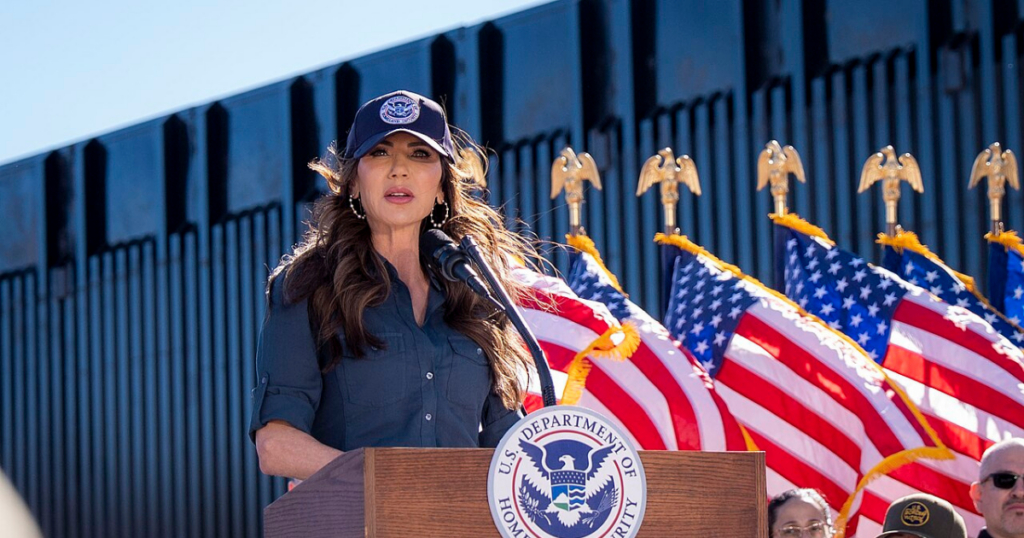
The photo was designed to be pure political theatre. Kristi Noem, hair sprayed into submission, blazer sharp enough to cut glass, sat behind a hefty stack of official papers. A staffer framed the shot just so, ready to capture the precise moment her pen hit the page. Moments later it was on X, the caption landing with all the subtlety of a campaign chant: “Build baby build.”
This was meant to be the power image — the 54‑year‑old Homeland Security secretary personally green‑lighting new steel for Donald Trump’s border wall. Instead, it turned into a reminder of a far more awkward truth: the wall that was supposed to be paid for by Mexico is being financed, in black and white, by Americans.
Kristi Noem, nicknamed “ICE Barbie” by her critics for her glossy, hyper‑managed image and love of viral stunts — including a notorious flamethrower clip — clearly thought the signing ceremony would signal momentum. DHS had frozen work on roughly 200 miles of planned barriers while it “reviewed” contracts. Her signature, the message went, would break the logjam. The wall was back on.
The problem was the fine print.
Just signed the last contract for the purchase of steel for the wall!
Build baby build. pic.twitter.com/IihkotweWV
— Secretary Kristi Noem (@Sec_Noem) February 10, 2026
The contract she was so eager to showcase taps into the $46.5 billion that Congress tucked into the sprawling “One Big Beautiful Bill” (OBBB) for border infrastructure and enforcement. There is no foreign contribution. No clever funding wheeze from Mexico City. Just US taxpayers picking up the tab for more steel.
That clashes head‑on with the story that helped launch Trump’s political career. On the 2015–16 campaign trail, he was unambiguous: “I would build a great wall… and I will have Mexico pay for that wall.” It was one of the core promises, chanted back at him at rallies, the verbal shorthand for a new, supposedly tougher kind of politics where America would no longer be the mug in every deal.
So when Kristi Noem posted her polished “build baby build” moment, social media did what it does best and shredded the illusion in seconds.
“I thought Mexico was paying for the wall?” one user wrote, the faux innocence doing more damage than any furious paragraph. Another went straight for the jugular: “Why would we purchase steel? Don said that Mexico was paying for it… what changed?”
The “ICE Barbie” nickname resurfaced, not just as a personal dig but as a critique of the whole performance. “Performative… Mexico didn’t pay for the thing that Trump promised Mexico would pay for,” one commenter noted, encapsulating the sense that Noem’s pen was doing less governing than brand management.
Strip away the snark, and there is a hard political fact underneath: by signing that contract, Kristi Noem effectively acknowledged that the central, crowd‑pleasing promise of the wall project has collapsed. The barrier is still being built. Mexico is not paying for it. Americans are.
To be fair, Donald Trump and his team have been trying to rewrite this story for a while. By 2023, faced with awkward questions about funding, the former president had shifted into full revision mode. Critics, he said, were “losers” who didn’t understand that he had only pledged Mexico would pay for “a piece” of the wall. Then came the quiet admission: “Well, there was no legal instrument to do that.”
🔥🚨BREAKING: Sec. Kristi Noem just signed the final contract to purchase the remaining steel to complete the Southern Border Wall. pic.twitter.com/5eVpkuBvyS
— The Patriot Oasis™ (@ThePatriotOasis) February 10, 2026
That is a long way from the swaggering 2015 boast that “nobody builds walls better than me” and that Mexico would foot the bill. It’s also a glimpse of how the fantasy functioned: useful on stage, impossible on paper. While Trump worked the rally circuit, lawyers and appropriations committees in Washington quietly did the grown‑up job of finding domestic money.
On Capitol Hill, the reality is straightforward. Congress — not President Andrés Manuel López Obrador — wrote border wall funding into OBBB. Hard‑right allies such as Arizona congressman Andy Biggs have bragged about helping to secure the cash and ensuring construction would be completed. For the MAGA base, the distinction between cheering the wall and paying for it may blur. For everyone else with a tax bill, it is much starker.
That is why Kristi Noem’s little photo‑op stung. She wasn’t just signing off on a steel order; she was signing a line item that proves the United States is repeatedly absorbing the cost of a project repeatedly sold as free.
The timing is not great for her personally either. Once touted as a breakout star in Trumpworld, Kristi Noem’s stock has slipped. After two fatal ICE shootings in Minneapolis, she was reportedly stripped of responsibility for interior immigration enforcement. Oversight of that turf was handed to Donald Trump’s favorite and self‑styled “border czar” Tom Homan — a man the president says he “knows and likes,’ which in this ecosystem is more important than any organisational chart.
Kristi Noem was told to focus solely on the southern border, a move that looked a lot like a demotion in all but name. Against that backdrop, the steel‑signing photo reads like an attempted comeback: look, I’m still central to the mission, still the one literally building the wall.
The irony is brutal. In trying to prove her loyalty and relevance, she ended up highlighting the administration’s most glaring IOU. The “ICEBarbie” jibe may be petty, but the underlying charge is not: voters are being asked to forget the distance between the campaign fantasy — a magnificent barrier conjured on someone else’s dime — and the dull reality of multi‑billion‑dollar appropriations and domestic procurement.
🚨I STAND WITH KRISTI NOEM! Here’s why they want her to resign- she has incapacitated their coveted voter base: “WE’VE DELIVERED THE MOST SECURE BORDER IN AMERICAN HISTORY”…@Sec_Noem pic.twitter.com/RChmEWzQQl
— NanLee Marie Carissimi (@NanLee1124) February 10, 2026
Forty‑six and a half billion dollars is not political pocket change. It is money that could be spent on roads, on schools, on hospitals. To wave it away with a glib “build baby build” while retro‑fitting the original pledge into something it never was is, frankly, an insult to anyone who has been paying attention.
From the outside, it all feels grimly familiar. Grand slogans about borders and control have a habit of smashing into the brick wall of legal and fiscal reality. When they do, politicians often reach not for honesty but for better lighting and a sharper photo.
Kristi Noem’s pen stroke was supposed to project strength and progress. Instead, it captured the precise moment a campaign myth finally collided with the invoice. The steel will be bought, the fence posts will rise, and the bills will land — not in Mexico City, but in American mailboxes.
The only real unknown now is whether the people who once chanted “Mexico will pay” care enough to notice that, in the end, it was always going to be them.