



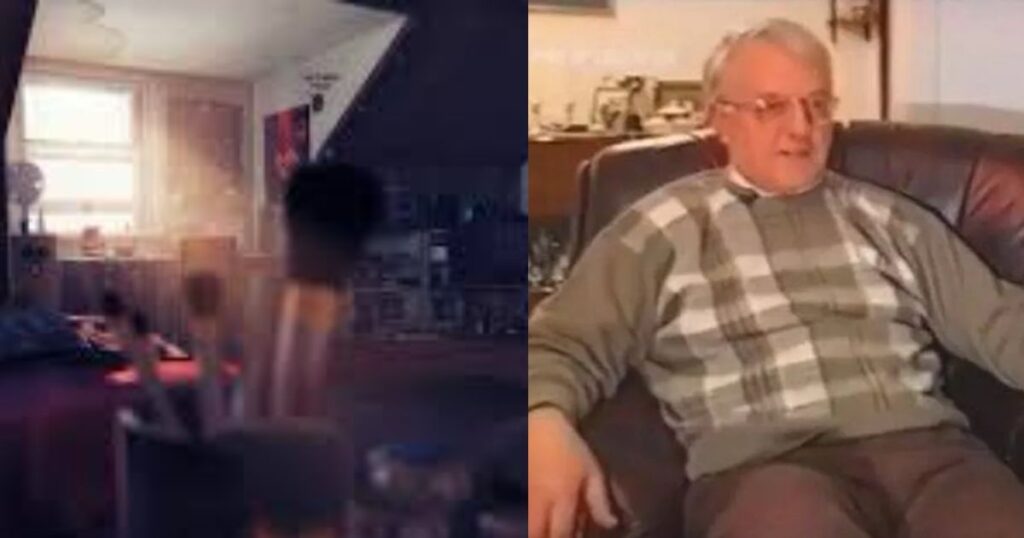
Trigger Warning: The article mentions disturbing details.
Imagine wanting to renovate a house, only to find a chilling corpse beneath dusty layers and thick cobwebs. In 1960, a seemingly ordinary home in Rhyl, Wales, revealed one of the most bizarre and memorable discoveries in British crime history. A woman’s body was discovered hidden in a home more than 20 years after her death.
It all started when a man named Leslie Harvey decided to give his mother’s house a makeover while she was in the hospital. Harvey had long been curious about a nearly seven-foot-tall storage cupboard on the landing, and finally decided to open it. He had been told that the cupboard contained old belongings left behind by former wartime tenants.
As per The Irish Star, on May 5, 1960, Harvey found a decaying blanket lying over a shrivelled human foot, and as he lifted the covering, a mummified human body emerged. He was utterly taken aback. The discovery equally stunned police and forensic experts alike, who described it as one of the strangest cases they had ever encountered.
View this post on Instagram
Leslie’s mother, Sarah Jane Harvey, was a 65-year-old woman whom neighbors regarded as kind and respectable. She was the owner of the beautiful house. As cops questioned her from her hospital bed nearby, Mrs Harvey identified the body as that of her former lodger, Frances Alice Knight.
As per Sarah Harvey, Frances Alice Knight was separated from her husband, who was a dentist, but she continued to receive a small weekly allowance from him. Suffering from partial disability and chronic pain, she often complained of muscle aches.
One night in 1940, Mrs Harvey claimed, Mrs Knight was feeling particularly unwell. She went downstairs to make her lodger a cup of tea, but upon returning, found her dead. Instead of burying her body, informing her family or carrying out the funeral process, she decided to hide her body in a cupboard.
For the next 20 years, she continued to collect Mrs Knight’s £2 weekly allowance, deceiving authorities and acquaintances by claiming her lodger had moved to a retirement home in Llandudno. Her allowance added up to £2,099, which was a considerable sum at the time, and Sarah Harvey had claimed all the money in her name.
When authorities found Frances Alice Knight’s decaying body, it was covered in dead insects and described as flypaper-thick. The body of Mrs Knight was also curled in a doubled-up position, still dressed in a faded nightgown from years ago. The forensic team had to put in immense effort to soften the tissue enough for the autopsy.
Leslie Harvey got the shock of his life when he decided to give his mother’s house a makeover while she was in the hospital. https://t.co/a2lSX1j7ry pic.twitter.com/Ez6PSrj7Ss
— Irish Star US (@IrishStarUS) October 28, 2025
That’s not all — a shocking twist emerged when the post-mortem revealed ligature marks around the neck, hinting at possible strangulation. This discovery led investigators to launch a homicide inquiry. Prosecutors later alleged that Mrs Harvey had deliberately strangled her lodger soon after gaining access to her finances.
However, Mrs. Harvey’s legal team argued in defense, claiming that Mrs. Knight had been suffering from a severe cold and that it was “common knowledge” to wrap a stocking around the neck as a home remedy. Despite several attempts, a robust conclusion that Leslie Harvey intended to kill Frances Alice Knight could not be proved.
Retired police officer Raymond Vaughn, who worked on the investigation, later reflected, saying, “It was the most unusual case any of us, including the pathologists, had ever encountered. It was the first mummified body I’d ever seen, and I’ll remember it for as long as I live.”
Mrs. Harvey was charged with financial fraud for claiming the deceased’s pension for so long and was sentenced to 15 months in prison. After her release, she entered a nursing home, where she later died of cancer. Even after 60 years, the case remains an interesting and bone-chilling case for investigators.
The story of the “Mummy in the Cupboard” (that’s what it was named) reflects that even the most beautiful houses can come with a lot of dark secrets, and maybe sometimes there’s always more to what meets the eye.


