



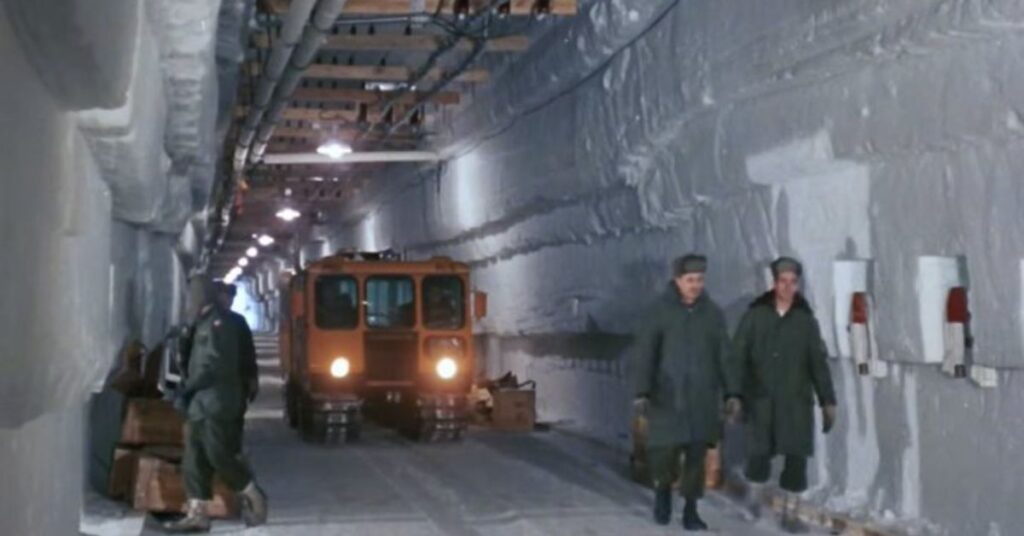
Greenland and a secret underground military base once assumed to be safely sealed beneath ice are now drawing renewed alarm, as scientists warn that a long-abandoned U.S. installation buried deep within the island’s ice sheet could pose environmental and strategic dangers much sooner than previously believed.
The Greenland base, Camp Century, was built by the U.S. Army in 1959 during the Cold War and concealed beneath more than 100 feet of ice in northwestern Greenland. The underground military bas was constructed under the the 1951 Defense of Greenland Agreement and acknowledge by the governments of both Denmark and America.
TOP SECRET US MILITARY BASE IN GREENLAND DECLASSIFIED US ARMY FILM
A top secret rediscovered US base known as Camp Century built in the 50s with talk of top secret advanced weather manipulation weaponry, nuclear missiles being hidden under the ice aka Project Iceworm all the way… pic.twitter.com/RPwPPSOFqU
— Redpill Drifter (@RedpillDrifter) January 8, 2025
Camp Century was once described as a self-contained Greenland underground town. It housed a hospital, a theater, a church and a shop, and was powered by a small nuclear reactor, allowing personnel to live and work beneath the ice year-round in near isolation. That sense of permanence has now vanished.
Recent ice-penetrating radar surveys over Greenland revealed the remnants of Camp Century in striking detail, showing intact tunnels and structures preserved beneath ice that is steadily thinning. Scientists say decades of warming have reduced the protective ice cover above the base, bringing it closer to eventual exposure.
“The question is whether it’s going to come out in hundreds of years, thousands of years, or tens of thousands of years,” one scientist involved in the research said. “Climate change just means it’s going to happen much faster than anyone expected.”
Camp Century was abandoned in 1967 after engineers concluded the constantly shifting Greenland ice made long-term operations impossible. When the military withdrew, it left behind significant quantities of waste — including chemical pollutants, biological sewage, diesel fuel and radioactive material — all once thought to be safely sealed in ice forever.
Experts now warn that assumption is no longer valid. As Greenland warms at roughly three times the global average, increased melting could eventually mobilize those buried contaminants. Meltwater moving through the ice has the potential to transport pollution into surrounding ecosystems and onward into the ocean.
Trump’s proposal to buy Greenland didn’t come out of nowhere. The US has had a military presence in Greenland since World War II and became its military defender in 1951. Harry Truman offered to buy it for $100M in gold. And our bases there are still deterrents against Russia. pic.twitter.com/zLetEHvCzv
— Glenn Beck (@glennbeck) January 23, 2025
The environmental risk in Greenland posed by Camp Century has taken on new urgency as geopolitical tensions in the Arctic intensify. Greenland’s strategic position between North America and Europe has made it a focal point for military monitoring and defense planning, while retreating ice is opening new shipping routes and heightening competition among global powers in the region.
The resurfacing of Camp Century also raises unresolved questions about responsibility. Greenland is an autonomous territory within the Kingdom of Denmark, and while the base was built by the United States with Danish consent during the Cold War, there is no clear agreement over who would be responsible for cleanup if the site becomes exposed.
Scientists stress that while the precise timeline remains uncertain, the direction is clear. Ice once believed to be immovable is becoming increasingly dynamic, and the consequences of Cold War-era decisions are re-emerging in a warming world.
The ghost of Camp Century stands as a stark reminder that climate change is not only reshaping the future but unearthing the past. What was built to remain hidden beneath Greenland’s ice forever may instead become a costly and dangerous legacy — resurfacing far sooner than anyone once imagined.


