



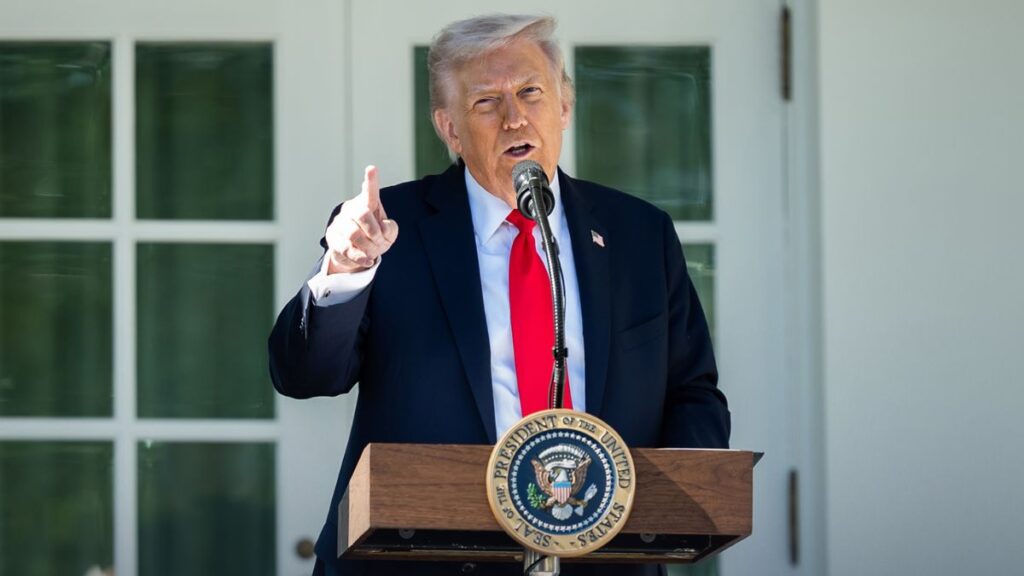
Donald Trump is approaching a key political moment with his first State of the Union address of his second term set for Feb. 24, 2026. What he says will be significant, especially as political pressure rises ahead of the midterm elections. The president has also faced public dissatisfaction, which could present challenges.
The State of the Union is a constitutionally mandated annual address in which the U.S. president reports on the condition of the nation and outlines legislative priorities. The speech carries significant symbolic weight.
House Speaker Mike Johnson has formally invited Trump to deliver the address. He praised the president’s leadership, saying it has made the country stronger, freer and more successful, underscoring Republican support in Congress.
In a post on X shared in January, Johnson wrote, “It is my distinct honor and great privilege to invite President Trump to deliver the State of the Union on February 24, 2026. Since his return to office, @POTUS has not stopped working for the American people and delivering on his promises. The best is yet to come.”
It is my distinct honor and great privilege to invite President Trump to deliver the State of the Union on February 24, 2026.
Since his return to office, @POTUS has not stopped working for the American people and delivering on his promises. The best is yet to come. 🇺🇸 pic.twitter.com/rTQF3DNw1S
— Speaker Mike Johnson (@SpeakerJohnson) January 7, 2026
The speech will give the president an opportunity to shift the narrative surrounding his time in office. The 79-year-old will need to improve his political image and address voter concerns in a country that remains divided and skeptical. In fact, reversing his declining approval ratings is an equally important reason for him to deliver a strong speech.
Trump spoke in similar terms last year before a joint session of Congress in March, though it was not considered an official State of the Union address. The speech is required by the U.S. Constitution, which instructs the president to keep Congress informed about the state of the nation and legislative priorities.
With anticipation building for Trump’s speech, there is speculation about what he may emphasize. He is expected to highlight economic recovery efforts and border security initiatives. The president, known for promoting an “America First” outlook, is also likely to extend that message to foreign policy.
🚨UPDATE: TRUMP TO TALK AT WHITE HOUSE TOMORROW 9PM ET — Will He Address Crypto & the CLARITY Act? 🇺🇸🔥
The White House has confirmed President Trump (@realDonaldTrump) will deliver his State of the Union address TOMORROW at 9PM ET. 👀
Speculation is building across D.C. that… https://t.co/lH9fLXSyBm pic.twitter.com/dxu8H8sbyW
— Diana (@InvestWithD) February 24, 2026
Donald Trump will also highlight military and diplomatic actions in the Middle East and other regions. Following the Supreme Court’s recent ruling striking down his tariffs, Trump is expected to propose a new 15% global tariff to protect U.S. interests.
Another important part of the address may be immigration enforcement. A report suggests Trump is likely to emphasize his record of low border crossings, though he will also face public opposition over suspending asylum rights.
Several energy policies and environmental rollbacks are expected to be framed as successes by Trump. These may also include foreign policy references to countries such as Venezuela and China, as well as the Middle East.
Oh, this should be interesting!
“House Democrats are bringing Jeffrey Epstein survivors as guests to Trump’s State of the Union address.”#EpsteinSurvivors #SOTU2026 #TrumpAccountability pic.twitter.com/Td7ydlN1hH
— Jürgen “jkr” Kraus (@jkr_on_the_web) February 24, 2026
With weighty matters becoming talking points in the speech, experts suggest Trump needs to maintain balance, especially when addressing voter anxieties. Pushing too hard on controversial policies may risk alienating moderates.


